
“Welcome to our home.”
These are the first words the audience hears while seated at a triangular configuration of tables in the Cotsen Auditorium of the Skirball Cultural Center in Los Angeles. Staged á la Judy Chicago’s The Dinner Party (1974-79)—the monumental work of feminist art housed permanently at the Brooklyn Museum—Dis-order offers the dining table as the locus of the familial. This new interdisciplinary work from Volta Collective, the dance-theater company directed by Mamie Green, proposes a generative site where we are invited to observe the rites, rituals, and demands this genetic institution places on mind and body.
All families carry the burden of drama. Whether small and passive, great and terrible, each one layers into a lifetime spent negotiating the boundary between who we are and who others believe us to be. In our—sometimes tragic, sometimes comic—attempts to individuate, we often end up maddeningly closer to the patterns we seek distance from; our lens of perception, pressurized from the inside, magnifying then distending these dynamics. Dis-order, directed and choreographed by Green, reimagines a Passover Seder, studying a family—Father, Mother, Daughter, Son, and Baby—as they move through this ancient spring rite. Shifting between order and chaos, the evening is composed of a five-act performance structure: a deft assemblage of dance, theater, puppetry, and music.
The first movement is an act of descent. From our vantage at the table, we watch as a marionette is slowly lowered from the mezzanine. Formally dressed in a suit and tie, the puppet is met by its mirror image in the glare of an opened doorway as the character of the Father (Sophie Becker) emerges to greet us. The patriarch’s entrance into the negative space directs our gaze inward, toward the enclosed stage, where, with a wave and a handshake, the dinner begins. The Father invites—commands?—us to “Sit at our table” before observing, “The parents in their seats, so orderly, so neat,” immediately connoting both the physical and emotional register of the gathering. Becker’s enunciated delivery—she is also a professional ventriloquist—snaps the audience to its fullest attention, drawing us into the fold with a fluid poetry that belies the rigidity of the character’s building perspective: “Life flows in and out of the house like water…”
The words, written by Rebecca Schultz, who jointly imagined Dis-order with Green, allows for the verbal transference of experience between characters. Throughout the performance, direct expression within the close fantasy of puppetry exists in tandem with the corporeal tension of the body. A collaboration with Freak Nature Puppets, a Los Angeles-based artist collective, and designer Abby Sage, the large-scale figurative creations are carried and controlled; mirrored, worn, and then shed by different family members as they engage with their silent avatars. The puppets, slow and graceful, foil the dancing bodies that energetically expand into the room, reaching their hollow limbs out to steady the complex forms of nerve, muscle, and bone. The two entities move together in dramatic play, enacting the past and projecting the future onto one another.
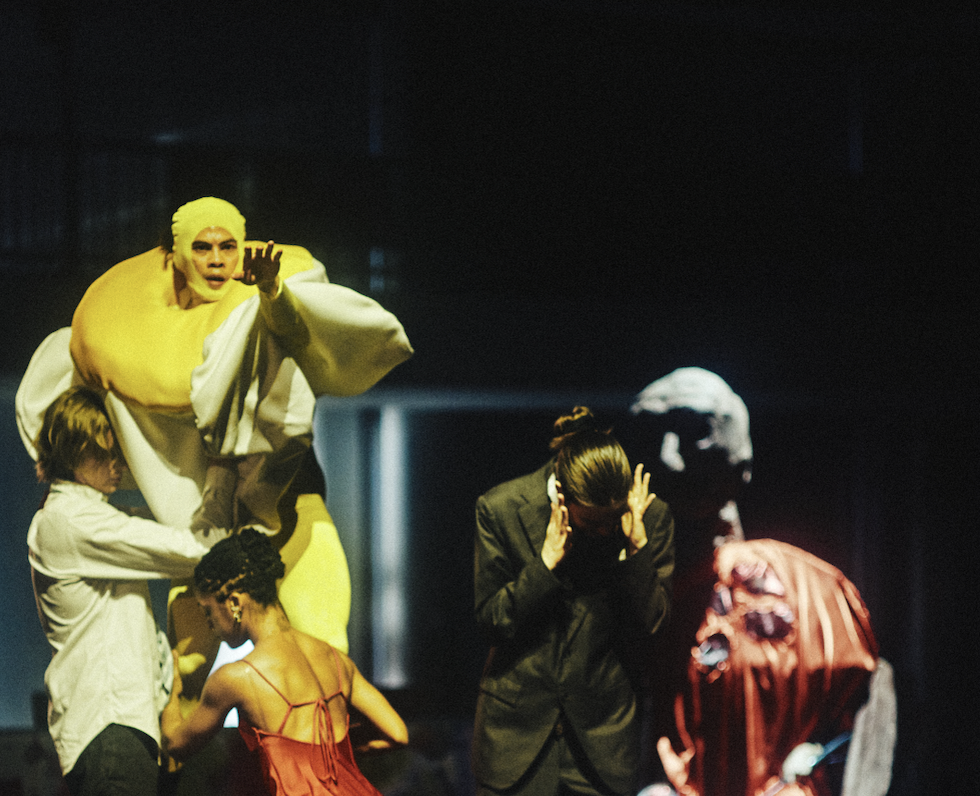
The Baby arrives with his head emerging from the bright yolk of a Claes Oldenberg-style fried egg. We are riveted by this quizzical apparition and lean forward, our elbows resting on the tablecloths laid out for the occasion, stained to reflect the bacchanalian gathering unfolding before us.
Danced by Jobel Medina and then Ryley Polak on Opening and Closing nights, respectively, we witness the power and grace of infancy—the twists, jolts, and spasms, that eventually settle into the stillness of a tender sleeping mass carried against a chest. The Baby, half swallowed by egg whites that float around his torso in a delicate construction of cloth and wire, extracts attention with cries and demands transmitted by the saxophone of Patrick Shiroishi who, with Dylan Fujioka, composed and performed the original score. Shiroishi’s instrumental expressions, variously coos and tantrums, communicate the infant’s immediate experience of the world, an instinct often suppressed as we succumb to the expectations of aging. He is seed created from seed; the emblem of generational cycles that spin from and around one another in an endless counterpoint of creation and reflection. Recent to the world, the Baby remains fundamentally innocent. He does not yet bear the full impression of familial nature—its careful language and fraught symbols—for there is “No table at the house for the baby.” His primary motivation is to return to the safety of the “black bliss” that surrounds us before life and after death.
As perspectives transfer between the five characters—each a site of exploration of Jungian archetypes—Green masterfully balances narrative potential against the inherent abstraction of dance. Each body is a compass that navigates without cardinal directions, arriving at a point that repeatedly gathers the family members into a single unit before pulling them away from one another, disbanding these precious moments of communion and, perhaps, mutual understanding. The Father’s grip, so strong at the performance’s outset, loosens as the dinner progresses and his position within the hierarchy is challenged while the Mother (Roxanne Steinberg), holding the spectrum of her family’s emotions, contends with her own sadness and rage. Her skirt, trussed into swags around her waist, is eventually undone by the Baby and unfurls into long trains then pulled taut by Father, Son, and Daughter as they circle around their matriarch in umbilical connection.
“My mother wants to swallow me. My father wants to sit down to dinner with all of you.” The Son (Tim Allan) rejects the demands of his home but struggles with the proportions of his emotions. The “Child big with anger, small with shame” eventually becomes a donkey puppet, donning an enormous equine head and disappearing into a robe of furry skin. As he manipulates the two additional legs of this creature, maneuvered by his hands like a pair of canes, he spills wine on his sister, precipitating the final act: death of the first born. Costumed in a red dress that appears to reference the Chosen One in Pina Bausch’s Rite of Spring, the Daughter (Anya Gonzalez) leads us further into the landscape of grief and history; of the memories that haunt and guide us through familial terrain—our stories, our roles, our traditions. With painstaking sculptural movements, she suspends again and again in microseconds of poise, partnered with her reflection: a towering puppet in a matching red garment the arms of which repeatedly raise toward the heavens. Their massive palms upturn in an unspoken, unanswered, question.
In the end, the perimeter of the dining table is breached. The home, threatened by the execution of a devastating act, is desperately defended by the Father:“You must keep the house standing. It’s out there, not in here. We’re okay, We’re okay…” and the Son becomes the sacrificial lamb: “A thing you decide not to know.” The family exits through the original entrypoint, illuminated by the light of an opened doorway, walking past discarded legs and a single egg, the yolk still intact.
Photo by Roman Koval.
Leave a Reply