
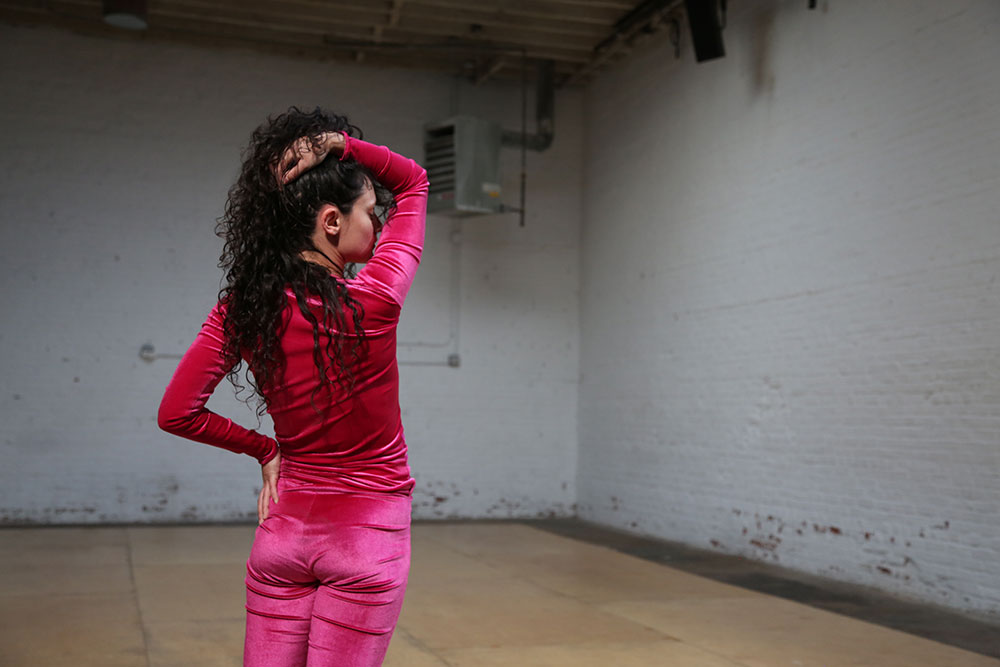

I have admittedly never been to the Chocolate Factory in my ten years in New York City. Still, I can see this might not be a typical setup. Ayano Elson has the chairs placed so they span the right side of the raised platform stage and onto the concrete floor in three rows including pillows on the ground. When we came in to find our seats, we saw that Amelia was already in the show.
Amelia Heintzelman is wearing a pink velvet unitard—striking against the cavernous industrial theater— and sits on the far end of the stage facing away from us. It’s taking everyone a while to settle in. Each time silence begins to fall, another person enters through the street door and shyly finds a seat. A band of three takes their places behind an array of instruments to our left and my attention focuses. Amelia finally begins to move slowly.
So slowly that, in moments, my mind drifts elsewhere and then refocuses. I’m thinking about the long journey from my apartment in Crown Heights to the show in Long Island City. Back now to Amelia moving in the pink unitard. She’s slowing us down with her slowness, putting a lot of space around each gesture. I hear the thump of a bass drum that sounds far away, maybe outside. Or is that part of the score? A car zooms by on the street. Maybe the drum is from a far-off party that’s made its way into the room.
Amelia is facing us now, making eye contact with the audience. She walks placidly forward, regarding us with a bold neutrality. Performers making contact with the audience is a loaded genre in and of itself. Juliana May said in her Choreographic Idioms class once that forcing presence on someone (an audience member, a co-performer) can almost feel punishing that way. But maybe because the fourth wall of Control had already been dissolved from the beginning—from our nonstandard seating set up to the porous start—or maybe because I know Amelia from dancing in classes with her, but her eye contact does not feel like a challenge. Why wouldn’t she look at us? We’re sitting on her stage, she’s in our line of sight.
The lights almost imperceptibly begin to warm the stage—or were they on from the start? That bass drum still thumps from time to time, no more or less clearly part of the show, and Amelia continues her tentative unfurling across the room. evan ray suzuki enters from behind us to our left, wearing a tailored charcoal outfit and black dance shoes. They move across the room in confident arcs and smooth twists, cutting into what Amelia has wriggled through thus far.
evan and Amelia seem to be in different and simultaneous scenes. When evan fake-trips on the concrete floor toward the audience, I jolt a little in my seat, the first quick action of the show.
Amelia now has walked off the stage, past the entrance of the theater and through the reception area up front, out of sight. Her part of the show continues invisibly elsewhere. Further smudging the boundaries of the performance, I also see this as a nod to the invisible parts of every show: the process. Control, like all performances, extends beyond what the audience sees from their seats.
Owen Prum’s entrance strikes me as the most actor-like, clearly traveling from point A to point B. He lands on the far end of the stage and pantomimes opening a door, perhaps into one of the scenes occurring already. His expression is both blank and anticipatory, as if bracing for something in the imaginary room he’s entered.
Amelia has re-entered from a different door and is getting closer to the audience, seemingly to get a better look at us, maybe show off a little. She gazes at us from beneath her fallen hair with a sort of sideways look that reminds me of a child in deep play.
These scenes sometimes interact. Amelia crawls under Owen’s bridged body, like a parasite or baby, then continues on. And Owen, with an opaque urgency, swipes his hands across a bent knee, the smacking motion just barely disturbing Amelia’s hair as she passes beside him. Another small jolt.
When Cayleen Del Rosario enters from the same back left place, it is as if she’s walking into a clearing. Wearing a shimmery lavender skirt and no shoes, she carries a lightness and fluidity to counter Amelia’s hunkered down shifting. What is this all accumulating to?
The musicians behind the table of instruments it seems have begun to ready themselves to finally fill the space with a sonic texture other than the soft sounds of the dancers feet on the ground. One player places what appears to be a reeded instrument to their mouth, another moves some of the instruments around as if searching, making some collateral noise.
But this set up goes on for another five minutes or so, creating a continuous clatter of objects being readied for the score. What’s taking them so long, I think. When I realize, of course, this is the score. The music is being played before I have a chance to recognize it. A dull cacophony of wood and metal scuttles beneath the action as the dancers continue in their still atomized trajectories.
These trajectories seem plucked from varied forms of performativity: the inward seriousness of child’s play, the stilted lines of theater blocking, the gratifying drama of opera or butoh. A slinky nod to striptease. The costumes by Kate Williams do a lot to heighten and illuminate the personality of each performer. Each character’s wardrobe could easily belong in four different shows, but somehow it is their contrast that coheres them in the space, and allows the dancers to embody a distinct persona.
Watching Cayleen and Amelia pressed against the back wall in a body-to-body duet, I’m thinking about how Ayano has exposed and hidden the seams of her work so far. The entrances and exits are clear and space-expanding, while the technical elements of light and sound sneak up on you pleasantly. A decent portion of an audience’s experience is deciding what sets any one show apart from the myriad of others they see in a given week, from the endless drone of content on their phones. While it is easy to fetishize the “new”, watching Control I’m reminded of what makes a show exciting. Ayano, surprising us by hiding nothing, demonstrates that simple, clear decisions always feel special and immediate.
The music has picked up, accumulating into a more driving texture. Owen, Amelia and evan’s paths criss-cross each other before exiting entirely, leaving Cayleen lying in a large puddle of light on the concrete.
The spotlight gives a moonish glow, a vague shimmer of musical theater, as Cayleen moves into a solo of thrashes and jumps set against thrumming chords. It feels like a deeply needed exhale, a release of energy that had thus far been carefully wound by her fellow dancers. Just as things start to coalesce into a kind of symphony, everything stops and the lights go black.
The show is over but it looks like the power went out. Before we clap, we wait for more.

Jack Meriwether is a performer and writer living in New York City and the 1998 Prince of Paulding, Ohio. @freelancebodydouble
Leave a Reply