
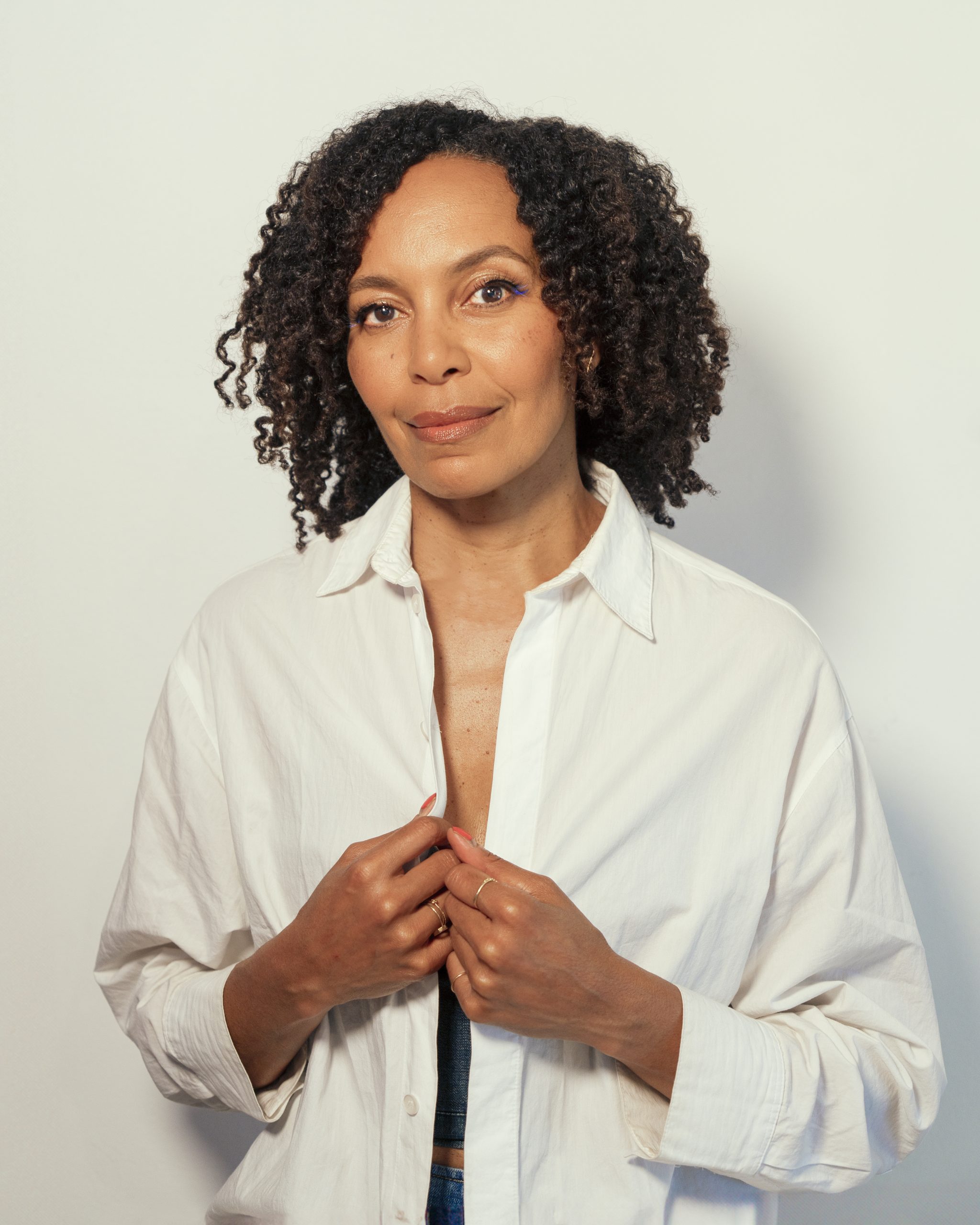
Eisa Davis is having quite the year. Last fall, she returned to the New York stage, writing and starring in The Essentialisn’t, an experimental performance piece centered around the complicated relationship between Blackness and performance. She was announced as Signature Theatre’s newest resident artist, co-curated a celebration of women in hip-hop at BAM, has continued working on Warriors with Lin Manuel Miranda, and premiered her latest play, ||: Girls :|| ||: Chance :|| ||: Music :|| which debuted at A.C.T. in San Francisco, and now is in performances at the Vineyard Theater in New York. The play follows four incredibly gifted teenagers at an all-girls music program in the Bay Area as they refine their craft, contend with natural disaster, and discover chance music. For the unfamiliar, chance music is an approach to composition in which some element of the music is left to chance. In other words, the musicians are allowed to improvise in a way that no two performances are the same. This manifests in ||: Girls :|| ||: Chance :|| ||: Music :|| in a number of ways, including via a tone row, or set of 12 notes whose order is newly determined by the audience every night. The show’s four multi-talented performer-musicians then riff on this melody throughout the show. The effect is thrilling, and it’s delightfully tricky to always tell exactly what is improvised and what is scripted. After seeing an early preview of the play, I had a chance to sit down with Davis to discuss chance music, the Bay Area, and her “superbloom” of a year.
Emily Chackerian: How did ||: Girls :|| ||: Chance :|| ||: Music :|| originally come about?
Eisa Davis: It all starts with Pam MacKinnon because one of the first actions she took when she became artistic director of A.C.T. in 2018 was to come and visit me. She said, “You’re from the Bay. I want to commission works about the Bay, and would you write a play?” I was a little hesitant. It’s tough to take on a commission, you have to make sure that it’s something you want to do, but what came to me when thinking about the Bay was this incredible music school that I went to from ages 10 to 17 called the Young Musicians Program at UC Berkeley. I studied classical piano, voice, theory and musicianship there. It was means tested, so it was free if you were below a certain income, which meant that they fed us and gave us bus passes. They were some of the happiest days of my life, and that’s what I love to write about; things that I love, things that I feel passionate about. So I thought, “Let me write about that place. Let me set it now though, and let me actually make it an all-girls or girls+ environment.”
I thought that would allow people in, in a way that a period piece wouldn’t. I wasn’t interested in what it was that I experienced beyond this great love of music. None of it happened to me, but the characters are all in me. They’re archetypes and teenage dynamics that many of us have experienced.
There are a couple of other inspirations, like the film L’Avventura by Michelangelo Antonioni. It was playing in a restaurant in San Francisco, during one of my first residencies to work on the play in 2019. That narrative about a disappearance stuck with me. One of the people that the play is dedicated to is my late piano teacher, Mr. Eugene Gash, and also to Craig Taborn, who is an incredible keyboardist/maker of spontaneous compositions. In knowing him and understanding more about his music, I started to hear music in a new way. That’s where the chance element comes in. Chance music is not new, people have made chance music for quite some time. I wanted to have young students embrace it and have it be a musical language that the audiences could start to hear in a way that they hadn’t heard before.
EC: What is most exciting or challenging about writing about the Bay Area now versus the Bay Area of your childhood?
ED: In some ways I was able to escape that question because the play is taking place mainly in this Petri dish. It’s more about the sense of disaster and the sense of being very fragile as regards to climate. That aspect of being in the Bay and being in California is something that is deeply embedded in the play, and something that is there for kids all over the world, Specifically, when it comes to wildfire season and earthquakes and floods that’s something that California has been bearing the brunt of.
EC: Yeah, I was so struck by how environmental catastrophe is so interwoven into their world. My dad also grew up in the Bay Area so I was talking to him last night about the Oakland Fires and the ’89 earthquake, which were (and still are) such huge events, but now these kinds of natural disasters in the Bay are becoming more and more commonplace.
ED: It’s there and it’s something that in particular teens are coming to accept. They also have a very strong climate consciousness and are doing probably more than anyone else to actually implement solutions that would help us. It’s actually possible. We can come back down from that cliff.
EC: As you say that, I’m remembering that for a couple years as a preteen, I went to a sleepaway music camp in the Jemez Mountains in New Mexico. The Jemez are ravaged by wildfires every year, and when my parents asked “So what do you do if there’s a fire and you can’t evacuate the kids?” the staff said “Oh, we’d go stand in the river, in our sleeping bag” in a very matter-of-fact manner.
ED: This is also a time where more ancient traditions, indigenous traditions can teach us a lot about how to live in the right relationship with the environment and how to survive the wrong relationships that we have been in.
EC: You’re pulling from so many traditions and musical styles in this play, namely chance music, and I wonder if you could explain how the improvisation works within the piece.
ED: There are a few elements there. There’s the tone row, which are the 12 notes on a whiteboard that the audience chooses when they come into the lobby. That’s a collectively created melody that then moves out of the lobby on that whiteboard, and onto the stage. The performers are then able to implement that melody as something that they are singing, performing, playing on the piano in the show, and improvising off of. That’s one of the major ways that we’re using chance in the show and keep that aleatory feeling of experiencing sounds in a certain sequence that no other audience is going to have.
Then there’s improvisation, period, which is happening throughout the show. Both around the tone row, and in the sonic language that is being spoken between some of the characters. It’s wonderful because we worked very hard to be able to find people who were incredible actors and were incredible musicians.
Naomi Latta [who plays Margo, the drummer] came in to audition for another part, but the way she was carrying herself struck me as something that was more akin to Margot. So Pam McKinnon and I were like “Do you play drums?” The answer was no. Then we said “Can you learn to play drums? Would you be interested in learning?” She said, “Yeah, I would love to channel the musicality that I have into another instrument.” The amazing drummer Shirazette Tinnin came on as a coach and taught Naomi to play. In some ways that’s another level of improvisation. Naomi learned a new instrument, and is playing in ways that are far beyond the number of months that she’s been at it.
There’s a lot of structured improv. Sometimes they surprise me, and will improvise something, which makes each show alive and present. It also infuses them with an energy that you don’t always see in shows where everything is rehearsed down to the last bit of punctuation.
EC: It necessitates the liveness of theater in such a fun and unique way. You weave in music and musical experimentation in so much of your work, and I wonder why that structural experimentation and experimentation is important to you?
ED: It’s not only music, but sound that I am deeply interested in. All playwrights are thinking in terms of rhythm. Musical experimentation and the embrace of a larger world of sound is part of a larger project that I have of continuing to expand our minds and our notions of what’s possible. I always want to shake up the way we see ourselves in the world. If we shook up our ways of thinking about climate and we shook up our ways of thinking about what a play is, what music is, what is musical, and allow for fissures and cracks into a new way of seeing, then we would have more compassion. So there’s a real aspect of wanting to create an openness in a piece with collaborators and allow an audience to think freely, consciously or subconsciously.
EC: Because you often end up with this lyricism and sense of rhythm within your plays, do you start with a central musical theme or structure and then build out from there? What’s your process?
ED: I always expect the song, sound, or characters to talk to me. I listen for that. I keep listening for the way a person talks or how a scene needs to end, because sometimes there’s a truncation or fragment that will provide an interesting rhythmic variety. I ask what is the thing that is calling to me that I need to be sensitive to and portray with accuracy and reverence. In this play, I’m listening for the ways that teenagers speak. It’s a lot of exposition or people are saying things that are right on the nose. But that’s part of being a teen. You’re learning about philosophy or about science or about literature or about music, and when you’re learning all of that, you’re trying it out and talking it out with your friends. I love very specific slang, dialect, the way that characters, people carve out their lives through the rhythms of how they speak.
EC: I really see that in Bulrusher, in Angela’s Mixtape, in this. Notably, all three are sort of plays about young people figuring out their identities. New York has seen such a slew of these plays about young women, which can be seen partially as an producorial/industry trend and also demonstrative of an openness to taking girls seriously–I’m curious what you find compelling about it.
ED: I do think it’s important to take girls seriously, and it needn’t be looked at as a trend. It’s a genre, right? People don’t ever say, “Oh, that’s an adult play,” but people go, “Oh, this is a teen play.” Teens are as much humans as adults are. And that there’s a purity to your teen experience that is beautiful to look at. It’s a place where identities are being forged. It’s a very labile time.
I wasn’t thinking about this as participating in a trend or a genre. I was interested in these people who are in fem bodies and younger bodies and not dismissing their voices as being less than. I was interested in the students’ dynamic with each other and how they treat each other. I’ve had the best teachers that exist on the planet, and I know that the way that I ingested all of the knowledge that I was being given by my teachers was in working through it, kneading it out with other students.
EC: Because it’s just centered on these students navigating the dynamics of being young people finding themselves in both the world and each other’s orbit, the piece ends up with this narrative or question of “Am I thrilled to finally find someone like me? Or am I in love with them? Or both?”
ED: Some people experience their sense of self being mirrored early on, and for some people it takes a long time. In this play there’s a scramble up a mountain to see, oh, are we mirrored? Is that mirror something that I want? Is it dangerous? Does it make me confront other aspects of how I identify that are more fragile than I’m willing to handle? I wanted it to have this kind of hypernaturalism in how the structure of the play works, how the scenes work and how the characters experience each other.
EC: As you continue with ||: Girls :|| ||: Chance :|| ||: Music :||, do you have anything you hope audiences take away?
ED: It’s about being open to considering their lives and the trajectory of their lives, and thinking about moments of deep, sometimes overwhelming passion they’ve had for a person or a thing like music. Just being able to return to those pivotal moments in life and see where they are now. There’s a bit of a look back, but it’s also a flash-forward to what it is that your life can include that you’ve left behind.
EC: I want to end by just acknowledging that you’ve had so many incredible projects this year with different styles and forms. How do you find balance? Are your projects playing off each other?
ED: You know the superbloom that happened [in Death Valley in March] with all of the flowers growing? That’s what it feels like now with my work. It’s something I don’t take for granted, because I had a show at HERE in the fall called The Essentialisn’t. That was the first time I’d had a full production in New York since 2009. It’s been a while.
It’s beautiful to be able to create and have the ensembles of The Essentialisn’t and ||: Girls :|| ||: Chance :|| ||: Music :||. It takes me back to the ensembles of Passing Strange, of Angela’s Mixtape. And I’m developing Warriors right now. I feel like that also is about women trying to make their way in the world, in a matter of life and death. All these pieces are linked in that they’re strongly about women, interiority, and handling the world as it comes at them. What I love is that it feels like it’s just the beginning. There are so many plays and pieces and musical pieces, or music theater pieces that I’m looking forward to writing. I have them perched on the horizon, and I’m also interested in some of the plays that are in the past, being able to have a second life. It’s all exciting.
Leave a Reply