
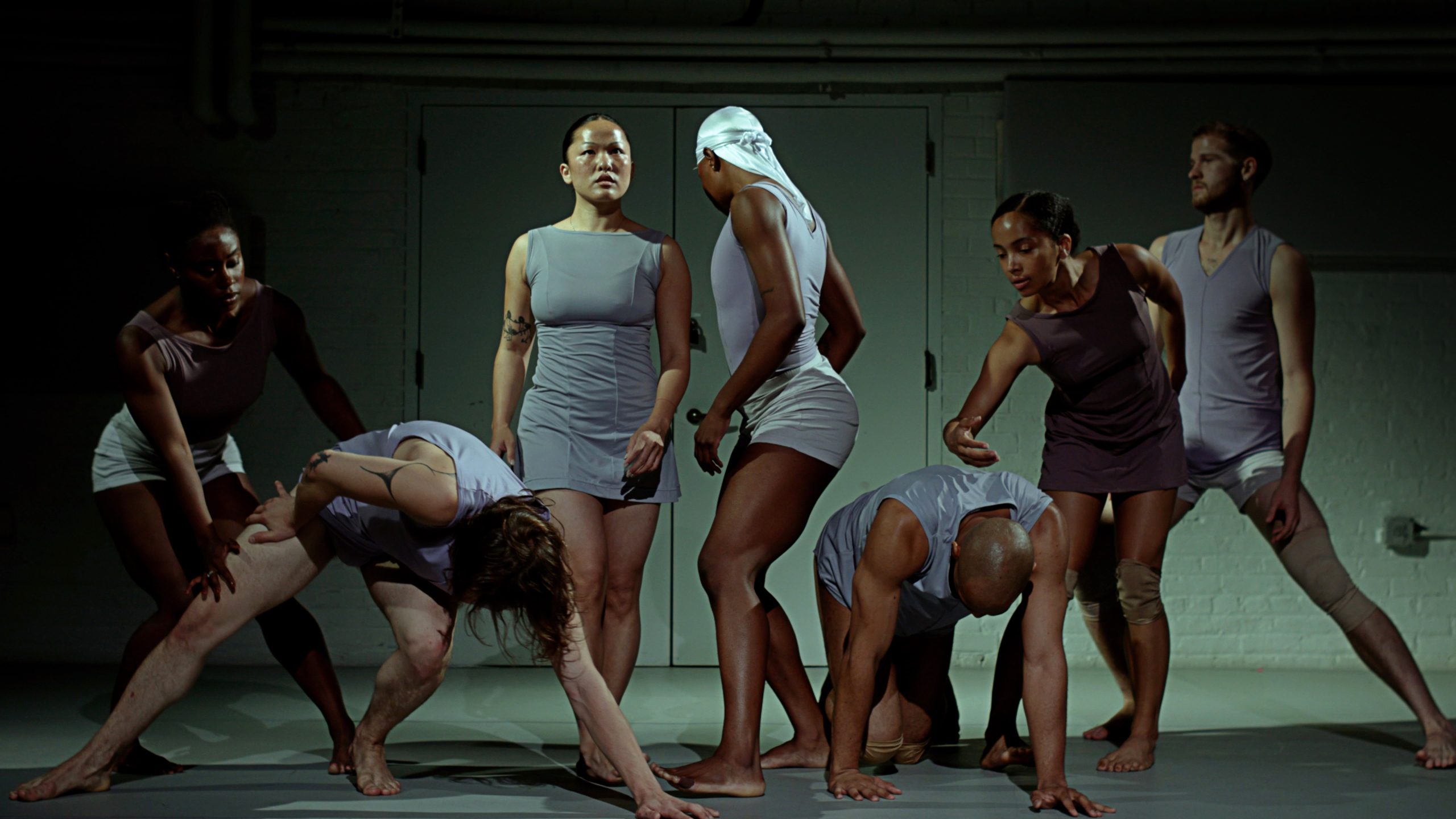
Within the historic walls of The Gym at Judson Church, BODYSONNET presents its first New York City performance as a local company with New York Now. Curated and partially choreographed by Artistic Director Moscelyne ParkeHarrison, this dynamic triple-bill program features a collection of revived works that culminate into a contemporary celebration of BODYSONNET’s seventh season. New York Now reflects the rhythms and contradictions of New York City—the struggles and triumphs, solitude and community—through an exploration of identity, connection, and spirit.

Opening the evening is newave, a dynamic duet choreographed by Associate Artistic Director Mio Ishikawa. Dancers Ian Debono and Matthew Spangler appear subtly in draping, fashion-forward black garments. As Tushrik Fredericks’ atmospheric sound score begins, the low lighting casts the dancers in shadow, revealing them only gradually as they move in a slow motion, frozen-like manner. As if underwater, they shift between suspended, sculptural poses and moments of delicate interaction, drawing into one another’s orbit.
A sense of possessiveness emerges as the dancers’ physicality begins to suggest ownership, particularly when Spangler places his hands on Debono’s head in a gesture that feels both intimate and controlling. As the score swells in booming rhythm and intensity, their bodies accelerate in response. The dancers hurl themselves into a compelling contrast of jagged, thrashing floorwork and fluid, luxuriant adagio-like contemporary movement. Throughout the duet, the charged focus and tension between the dancers maintain a powerful hold on the audience’s focus, creating an atmosphere that is both evocative and refined.
The physical and choreographic risk of newave is exciting and remains most evident in the partner work. Debono flips, folds, and hovers over Spangler, while at other moments Spangler suspends him effortlessly in soaring lifts. At times, the speed and clarity with which they execute Ishikawa’s movement seems almost superhuman. They move as if guided by invisible strings—not like marionettes bound to a puppeteer’s control, but as bodies swept up in the force of a windstorm, pulled and propelled by currents.
As the duet ripples and pulses across the stage, a question begins to emerge: are they slowly abandoning one another? newave becomes a vortex of shifting relationships, continuously redefining—and at times dissolving—the boundaries of connection. Ishikawa’s choreography probes what it means to be intimately tethered to another person while remaining connected to oneself, revealing the fragile balance between dependence and autonomy.

Providing a striking shift in energy and pace, ParkeHarrison enters the stage in an all-black ensemble, exuding confidence and class as she begins her self-choreographed solo, x dance. After briefly embracing the exposed brick wall upstage, she snaps her fingers and commands, “Blackout,” prompting an immediate blackout and light laughter from the audience. When a soft wash of light returns, she moves with a captivating blend of sophistication and groundedness. In one memorable gesture, she slips off her heels and flings them sharply over each shoulder with careless gusto.
As the solo develops, what’s most mesmerizing is ParkeHarrison’s gaze. Her eyes remain wide and emotive, unafraid to meet those of the audience wrapped around her on all three sides of the stage. She actively acknowledges her viewers, creating an intimacy that is both disarming and magnetic, and at times, slightly melancholy.
When an animated recording of a written application rejection email begins to play, ParkeHarrison morphs into an intricate contemporary mime, physically embodying the words as they are heard. The performance invites ambiguity: is she the author of the rejection, or the one receiving it? The question lingers as her expressive gestures and technique animate the text with energetic vulnerability.
Eventually, she lets down her hair, and the voicemail-like recording gives way to a hauntingly beautiful string composition. In a more expansive physical landscape, ParkeHarrison reaches, slices, battements, and piqués across the stage, as though an invisible magnetic force is constantly redirecting her. While aspects of x dance remain elusive, ParkeHarrison’s commitment to exploration—her willingness to search, transform, and explore, is captivating.

Closing the program is ParkeHarrison’s say i am you, the evening’s largest work, featuring a cast of seven dancers. Under a harsh, narrowing spotlight, dancer Miriam Gittens crumbles, smoothly descending to all fours. She begins to vibrate in a tightly constricted manner, and in an instant, say i am you sets into motion.
The simulation of say I am you builds gradually but deliberately; constructing a world which—through sound and movement, appears to be broken, repetitive, and glitching. The dancers, dressed in soft lilac and gray garments, are unified in costume yet differentiated in character.
A standout moment occurs in a solo performed by Quaba Ernest, who brings a pliable, elastic physicality to the stage, drawing the eye with his generous, fluid articulation. As each dancer begins to operate within their own world—like elegantly choreographed Sims—Ny Opong remains apart, simply walking around the perimeter of the stage.
ParkeHarrison’s deconstruction of movement and multitasking use of space is fascinating. The dancers constantly discover new ways to connect with each other, shifting between ensemble dynamics and closeknit duets. When dancer Lieana Sherry glitches and falls backwards, Ernest catches her by the grab of her hand and foot, instantly launching her into motion. She sails through space in buoyant, circling arcs. In this moment a flicker of freedom is present within the simulation, and it’s unexpectedly exhilarating.
In a closing, operatic sound score, Gittens executes a solo full of tilts, extensions, windmilling movements, and restraint. As she repeatedly throws herself off balance, the rest of the group begins to cohere into one, glitching and trembling either out of fear or ceasing to function properly. say i am you is a shapeshifting, evergrowing world that reflects the breakdowns of society and the effects of being isolated versus included.
New York Now is a gleaming introduction to who BODYSONNET is, and the mission behind the company. “The title came from our desire to communicate our commitment to being a NYC based company,” says ParkeHarrison. “This is also a nod to the theme of presence which we strive to convey in the production…”
New York Now represents both a reinterpretation of the past and an introduction to the company’s future. “Haven’t seen BODYSONNET yet? Now you can, we’re in New York Now.”
PERFORMANCE CREDITS
BODYSONNET Presents New York Now at The Gym at Judson Church
Artistic Director: Moscelyne ParkeHarrison
Associate Artistic Director: Mio Ishikawa
Dancers: Ian Debono, Matthew Spangler, Moscelyne ParkeHarrison, Quaba Ernest, Grace Foley, Colin Frederick, Miriam Gittens, Ashley Green, Ny Opong, Marcus Sarjeant, Lieana Sherry
“newave” by Mio Ishikawa
Dancers: Ian Debono and Matthew Spangler
“x dance” by Moscelyne ParkeHarrison
Dancer: Moscelyne
“say I am you” by Moscelyne ParkeHarrison
Dancers: Quaba Ernest, Colin Frederick, Miriam Gittens, Ashley Green, Ny Opong, Marcus Sarjeant, and Lieana Sherry, Swing: Grace Foley
May 23, 2026, The Gym at Judson Church, 243 Thompson Street New York, NY 10012
Photos by Hannah Mayfield
Leave a Reply