
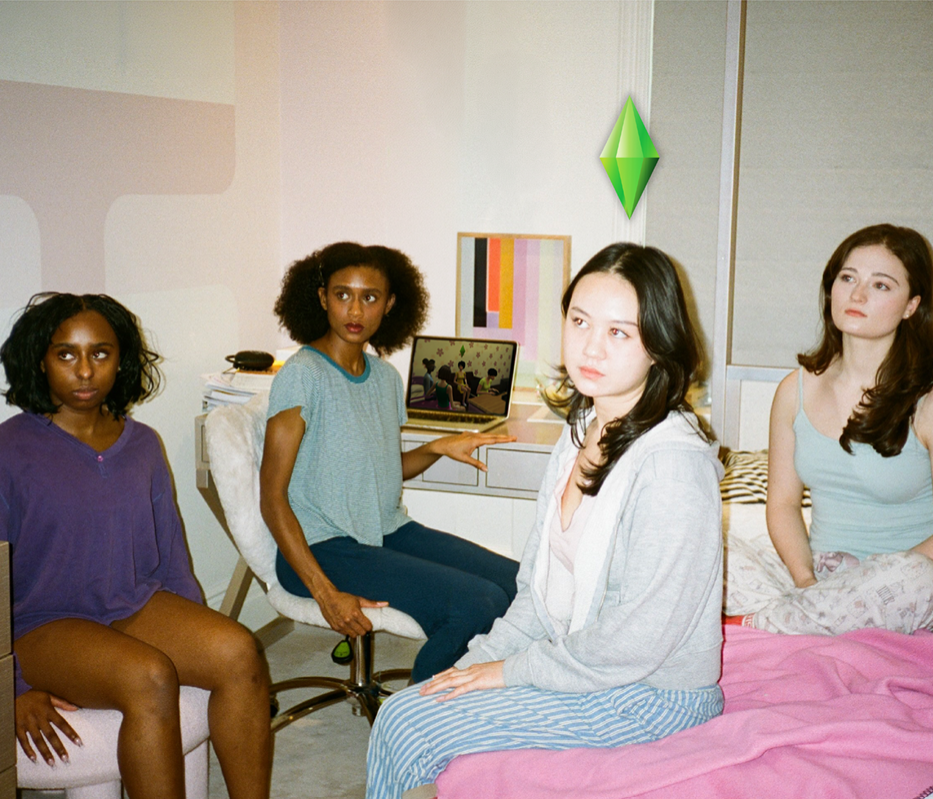

“And it’s not Ohio and I’m not me,” says Mal (Amalia Yoo) at the beginning of Dad Don’t Read This, written by Eliya Smith and performed at St. Luke’s Theater. Mal is a teenage theater spirit, loaded with a playlist of naughty showtunes and confined to a tabula rasa called Ohio. In the Midwest, you get the sense that, with so little going on, that they are part of the scenery, like deer or shrubs, something different than human, less than unique.
I spent ten years in the Midwest and left an expert on highway survival and the wonder of a new fast food chain coming to town. Sans Chicago, a life of the arts there is mostly confined to your Letterboxd log. The absence is the appeal, and Dad Don’t Read This knows this. “I’m so sick of Ohio. I bet everyone in New York-Chicago would respect me for this,” Mal says to her friend Noelle (Renée-Nicole Powell) when her Broadway playlist isn’t well received. It shows that the play also knows (unlike me) that criticism of the Midwest makes you inherently unserious.
Consistent entertainment in the Midwest is always found indoors, where you interface with technology. At Mal’s bedroom, Noelle, Sophie (Sophie Rossman), and Lida (Kayta Thomas) play The Sims with her. There, they imitate life, sex, death, and more sex. They ruminate on all the nothing going on in their Ohio suburb. They deny the exteriority of life there, despite them constantly proving there are things to do, which they do in fact do.
The contradiction manifests most clearly in Mal’s constant lies that render friendship with her untenable. In their shared stories, they tell All-American stories: parties and rumors, the circulation of drama through their lives. They talk of getting drunk, and they also get drunk. Sophie recounts brushing up against the profane id of adulthood (a family friend making sexual advances against her). None of this registers to them as relevant, as life. They perceive it as a burden. Anywhere but Ohio must be a grand place. But geographical cures never work: wherever you go, there you are. Crown Heights or Avondale won’t cure you of yourself.
Challenges to friendship are easily resolved, which depicts the endlessly hopeful/ignorant capacity for forgiveness in childhood, though on stage it appears unearned. Maybe childhood is inexpressible, and an adult perspective will never depict it in a way that’s transferrable and felt (as seen in the play’s inexplicable tap dance routine in front of a constellational light installation). Some life—eight hours of screentime, the protean lives of teenagers, the happiness that’s somehow possible in the Midwest—might be resistant to representation, but writers like Smith try regardless, because to not try at all is lazy practice (“kids these days,” etc.).
And the girls end up in bed together, again and again, lending the sense that everything is so simple and pure and yet totally insufficient. There is something deeper within that, in craving more, that assaults the present in pursuit of the future, and justifies one’s retreat to the internet, a fantastic place of electricity (pixels, cables) and air (the cloud, a whirring laptop fan) where life can be simulated, frictionless and built by an appealing fate. Mal says, “I want to cocoon myself in Sim World until college when I am hot and popular,” as if you can arrive at such high stakes woefully unprepared. Unhappiness is not a fault, but a feature to navigate.
The play is set in 2014, which is presented as a time where we transitioned toward online lives. The ease with which everyone adopted immaterial lives shows we were already there before we arrived. We’d rather live life without thinking of our organs.
Dad Don’t Read This succeeds in illustrating the reasons for escape into unreality, but its easy resolution fails to lend a sense of urgency to youth. Thomas, Powell, and Rossman illustrate that children are capable of joy (dancing and bedtime talks) and deep consideration (navigating life and their impossible friendship with Mal). Yoo depicts the insufferability of teenagers—their capacity to lie and their struggle to accept blame—and their ability to understand the world in a way that’s intuitive but often illogical. Her panicked monologue, full of fear and image, is vivid and unsettling, the moment when the play finally opens the hood on the teenage brain and shows its process in motion.
We never wanted to be here. We always wanted to be anywhere else: adulthood, New York, living as information in the air, waiting to be breathed in and known as something essential.
Leave a Reply