
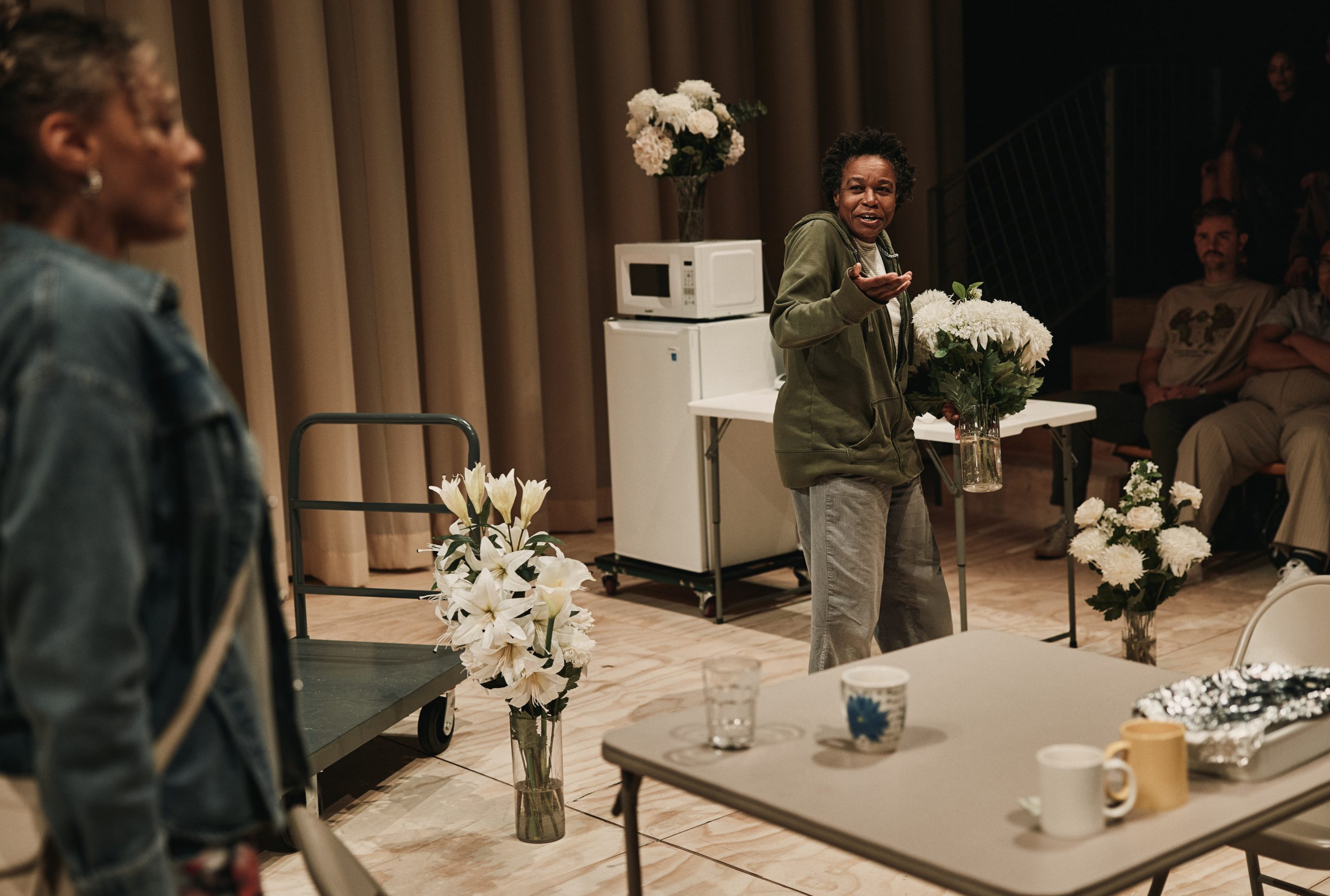

When a man in plain clothes revealed to the audience how much our protagonist owes on her home, nearly everyone seated let out an “mmmm.” Not surprised, not disgusted, merely a collective acceptance. This happens; seemingly moreso here in The United States. Here, it happens to Maggie (Quincy Tyler Bernstine), a freshly widowed former school teacher, and similar debts, literal and metaphorical, are owed by the inhabitants of the small midwestern town of Well, I’ll Let You Go. Written by Bubba Weiler, the play is quintessentially American in the most current sense; An Amazon warehouse employs most of the setting’s population, and the best place to go out on the town is a members only, BYOB “social club” that most of the police force inhabits after hours. “It’s a get by kind of town and most people do,” the plain clothed man Marv (Matthew Maher, whose comforting tone made me feel as though I was sitting under a Christmas tree) tells us. One could say that this play is about those who currently aren’t.
Wally (Will Dagger), Marv’s wayward cousin, is the first example we meet. Aged yet gangly, he is chronically broke following the passing of his twin brother and an inheritance blown on vintage nerd stuff, comic books, and figurines. “This house seems to attract people like that–people who’ve had a rough go lately,” Marv tells us. Bernstine’s Maggie is chronically scrunched in this scene and similar visits to follow, with a local funeral director (Constance Schulman, gratingly endearing), her lifelong best friend (Amelia Workman, playing the everyday bravely, down to the id), and Marv’s cop brother (Danny McCarthy, the perfect face for this), who is married to said best friend. A giant curtain, sort of beige but peachy, makes the performers seem like miniatures (Frank J. Oliva, the set designer, has gracefully fit the previously staged production into this new venue), as they process amongst a mundane menagerie; plastic tables and chairs, a kitchen that looks more like a break room, countless funereal bouquets, ugly balloons, and a lot of mulch (long story). Maggie spends much of the play shuffling about this maze, bent over, looking for something in a crowded cabinet or a dark room. Constantly searching, she only loosens when she has found something. A woman named Angela (Emily Davis, going full-sail Minnesotan to great effect) provides that discovery, one that changes the context of Maggie’s grief, her husband’s memory, and the circumstances of those she’s convened with thus far. Following this, Maher transforms into the deceased seamlessly (or perhaps he was in role all along), and we’re gifted a flash of what once was between him and Maggie; spontaneous yet careful consideration, comfort. Marv tells Maggie, following their marriage and rushed home ownership, “I don’t think it will go slow. I think it will be a blink. For me–sixty, seventy years–it’s not enough.” There’s a promise in this prediction, a faith in their partnership and the life they’ll live in their new home. At the play’s end, we see that this promise is kept.
Weiler is gifted in the art of revealing. Slow and precise, he subtly peels back the layers of history, the folds and crevices of context. We, the audience, are given just enough of that myth-making, both in Maher’s revealing narrations and in the company’s mundane observations, remembrances, and discoveries. Of course there are feelings unsaid, fragments unresolved, but such is life. To maintain the unsaid is not egregious, especially in this story. Jack Serio honors Weiler’s gift in his direction of the play, one that thrives most on the revealing brevity of Weiler’s text. In moments where little can be said, action does the talking in fragmented ways that make a bereaved whole. The play is a weight in more ways than one, and the actors carry it, mentally and physically, throughout. The most astonishing facet of Serio’s direction is his ability, and that of the company, to let it all go. A memorable instance of this is performed by Bernstine, as Marv recounts the last time Maggie felt at ease. “She’s ten years old–on water skis–hovering just beneath the air…She is in control. She is alone. She is flying.” As Marv tells this tale in earnest, Maggie time travels, controlled yet effortless, back to this moment. Tension melts, her face eases into a contented gaze. She is, indeed, flying. And all she had to do to show us was step away. She is taken from this moment just as impressively and quickly as she entered it, and isn’t given respite until Weiler’s storytelling allows it, just in time.
Following the flash of Marv and Maggie’s beginnings, as the deceased walks into a doorway of light, a cloud of smoke envelops him (this was the most Our Town thing about this Our Town adjacent play), and we suddenly see what was there all along; a glass-top table, “the most important piece of furniture in The Family Room”, a previously untouched piano (though Oliva gives it life, with photos of Marv and a small crusty black dog, as well as a nicely curated book stack), a shade of safety that contrasts the bright fluorescent we spent the past hour convening within (thoughtful work by lighting designer Stacy Derosier). A teenage girl (Cricket Brown, so endearing and so funny whilst carrying the weight of the world) touches the piano for the first time in years. This is Ashley, who Marv shielded after she was followed and almost murdered by a young man who spotted her after she received an abortion at Planned Parenthood. “Everything we do when a person dies is so weird,” she tells Maggie. And she’s right. When an unimaginable tragedy occurs, what should one do? Grieving is a solitary, private thing. You are the only one who had the relationship with the deceased that you did. It was a short time for Ashley and a lifetime for Maggie. And yet, the impact leaves them deserted together. But it seems like it’s a beautiful day for them. There is something connecting them, one grounding the other. Ashley tells Maggie things Marv said and did on his last day, his extraordinary kindness, one that can never be repaid. Marv told Ashley, “someday you’ll find somebody…it will all make sense.” Ashley pushed back; no one person can make living worth it. “Not worth it maybe but…bearable. That’ll make it all bearable”, Marv lands on. As Ashley recounts this to Maggie, shimmering in grief, “the sun hits the glass top table just right and the entire space shimmers.” At the top of the play, Marv had informed us that “there’s one moment every sunny day when the sun hits the table just right…but it’s always a weird hour of the day when no one is in the room to see it.” Somehow, Ashley and Maggie have found themselves together in the right place at the right time. In his dazed yet seminal America, Jean Baudrillard writes, “America is a giant hologram, in the sense that information concerning the whole is contained in each of its elements.” We see the whole of this country’s condition in Maggie’s mortgage, the social rites of her community, and in the tragedy that drives this piece. We see it in this very moment, as the reflection of light, a minute sight, makes something seemingly insurmountable, American life, bearable.

Leave a Reply