
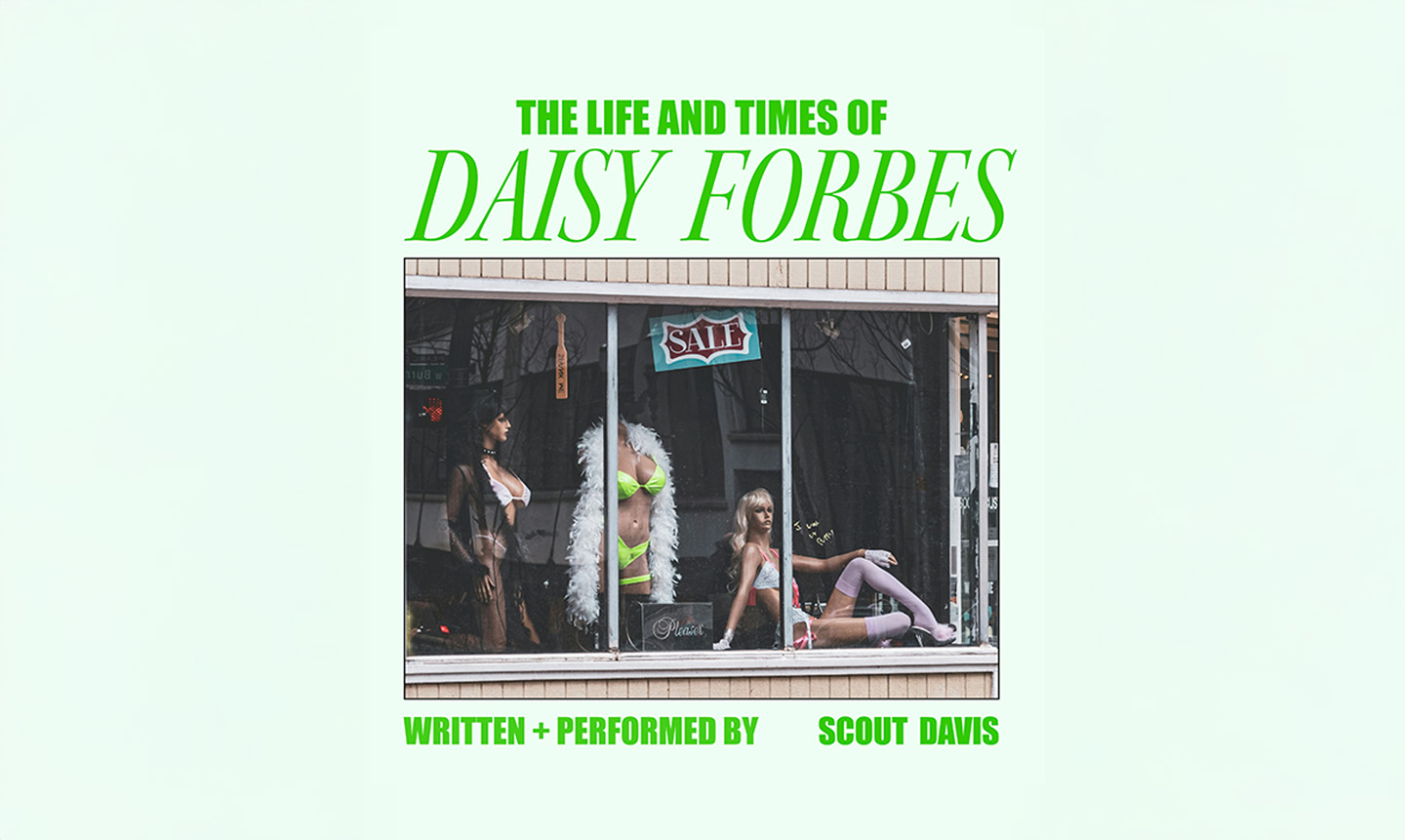
I first came to know of Scout Davis through one of my best friends from high school, Alissa. She played a fabulous Edna Krabappel in a production of Mr. Burns directed by Davis at University at Buffalo. Davis directs everything from classic musicals to contemporary straight plays, to more experimental, devised work. They’re able to place a unified, unique artistic ethos on a variety of performance genres, an incredible skill that is displayed in their solo marathon, The Life and Times of Daisy Forbes. Recently shown at La MaMa, it was a glittering festoon of despair and delight, hope and pessimism, all chained seamlessly. I was elated to chat with them about origins, references, and lineages.

This interview has been condensed and edited for clarity.
Tess Walsh: How did you initially find lip syncing as a medium? The way you use it pays reverence to the tradition of drag performance but then morphs into something unique to you.
Scout Davis: Initially, the kind of mainstream gateway of Youtube and Drag Race as a teen…I think that was the more obvious first exposure to the form. And then being able to go out while in undergrad in NYC and going to clubs and bars…to see drag artists using [lip syncing] more expansively, especially in Brooklyn…I think it’s been coined by other people or maybe I’m kind of mashing it up with other things, but kind of theatrical sampling where you’re layering one piece of media, maybe it’s a Jessica Simpson song, but then there’s like a meme moment or a reality TV show moment that is like super cut with the original song, and then there’s like a greater kind of mega mix that maybe happens. So that was like one exposure to things in a more entertainment-at-face-value kind of sense. And then getting exposed during that time to more subversive drag artists who are looking at lip syncing as a form in terms of theatrical storytelling…artists like Dickie Bo, who’s a UK based artist who has been in dialogue with me a little bit in the past and been really sweet and kind of a mentor in some ways. Just looking at their Judy Garland pieces, which are really sad and psychological and really kind of excavates her as an archetype and as a figure in terms of a queer tether and what that means today. And then looking at dance theater artists like Crystal Pite, a Canadian choreographer, who has this company that’s done pieces that have been choreographed to spoken tracks or short stories or full novels…this choreographic kind of lip sync experience that really blew my mind. And then there was Dana H. Dee Dee O’ Connell being a master class of all master classes playing Lucas’ [Hnath’s] mom, really expanding [lip syncing] as a form of channeling, and channeling a voice who is like, not necessarily in the room with us, but we’re calling back upon a certain moment in time to re-dramatize something. So I was exposed to a hodgepodge of things in terms of the form, but the output I got with the piece I shared at La MaMa has a genesis to the durational quality in that relationship to lip syncing…Morgan Jenness a long time ago was talking about a drag queen that I forget the name of that they saw back in like, I don’t know, let’s say the early 80s, who had a boombox, put it on play. And it was the cast album of Follies from top to bottom, every character, transition music, everything. It had the full nine yards of the show in a way that was subversive and raw, so that was always like the North Star in the way. And those other references that I was talking about before were guiding forces to get me to where I was in terms of the kind of form and how I was approaching it.
TW: In terms of that piece presented at La MaMa, The Life and Times of Daisy Forbes, it’s an archetypal showgirl story, but the selection of audio, specifically interview snippets and the figures they record (Courtney Love, etc) makes me wonder how much that archive drove the story, or if it was more vice versa?
SD: Yeah, it was kind of a snake eating itself in a lot of ways. I was outlining the events I wanted to happen whilst compiling the material, which was kind of an out of body experience. I’m still reflecting on the rubbing-your-head-whilst-rubbing-your-belly sensation of generating in that way. In that modality, I was able to think about what I wanted…getting to know her [the titular role] in this moment, in terms of her relationship to being performative and having an audience. I wanted to explore the relationship with feeling fully left behind or too late for someone…but I wasn’t necessarily trying to make a clear dramatic rise and fall, per se, but to get a glimpse of what these chapters could have been in her life. And maybe in a fuller production of sorts, getting to drop the needle, if you will, with certain moments…to explore the kind of brush strokes that you get with the material. I was trying to find audio that I was excited by that was going to try at various levels to explore those themes and variations and get me to a point by the end…finding some hefty weight of that cost of performing, whether that be the duration of the piece or amount of voices, to try and get to a sensation of disillusionment, the veil being lifted for myself in terms of what the archetype means for me as someone who tries to find any sense of “thick skin” or “resilience” inside, trying to just stay afloat in many ways. So that was a driving force in terms of what I wanted the materials to be, to give a roller coaster ride of uncertainty for the viewer. It can end up being a trance-like experience. So finding what those stepping stones in that trance might be to get folks into the same level of exhaustion with me, that same sense of being fully depleted that I was definitely, definitely feeling at the end.
TW: Wow that totally tracks. I didn’t even make that connection to the audience’s experience, what it is to go through the piece with you as performer and character. Speaking of said character, I’m wondering what early media representations of showgirls and that culture make their way into the piece. How did your fixation on that figure come to be?
SD: The monologues that I wrote that are not existing media are very much truth and fact, more so to my life. This one line that I was “raised by showgirls” is very much true. Why the last name is Forbes is because that was one of the first streets I lived on for a longer duration of my life in L.A. And my first pet at that time was named Daisy. The force of it all! I’m trying to honor the kind of porn star name creation, but anyways, when I was living there, our next door neighbor was a Playboy Bunny, living in and out of the mansion. And I distinctly remember her looking like a million bucks. I was in this trance of someone who was living the full fullness of that reality, 9am on a Sunday, looking incredible, in her front yard doing nothing at all. And around this same time, I was dropped off at a theatre family’s home. The wife was a principal Fosse dancer, did every national tour of A Chorus Line…she taught me to perform in a lot of ways. She was a very important person to me, along with other dance teachers that I had growing up. They had resilience and this ability to survive. We don’t even have this form [chorus-heavy performances] anymore to a great degree. All of those Vegas shows have been gone for over ten, almost twenty years. The archetype was present in sporadic moments in the media, but in the last few years [the exposure] is just enormous. For me, I was obsessed with it from a young age. The girls were keeping me going. I was always looking to the Bette Davis’s and the Joan Crawfords’ and all those girls that deal with a lot of bullshit. How one deals with it is just a marker of how they hold themselves and respect oneself. It just feels like a standard to hold oneself to. It felt like a Russian doll of sorts, finding the layers of what’s real and what’s not, how much one has to give to an audience, the expectancy of that, my own pursuit of a life in what we do, which feels absurd to even formulate. But the showgirls that raised me, they were like yeah, it’s not gonna be a thing or it’s gonna be really, really impossible. The chances of even being able to share any kind of work anywhere is slim to none. So just being presented with that reality, those kinds of jokes, always felt like an important pillar in my survival, naming what I want to be in this world.
TW: On the topic of beckoning to our own lineages, you make this amazing offering to Zaza [Diana Oh] at the end of your piece, which I found so beautiful. I knew them while I was in college, and they were, as you know, this absolute angel on this earth. And I know that we just lost Dito [Van Reigersberg]. In upholding the lineage that artists like Oh and Reigersberg take residence in, one that your work as both a solo performer and collaborative artists is borne out of, I’m wondering what your hopes are going forward, in passing this tradition down?
SD: I’m trying to process that question quite a bit. Usually I name the kind of why-we’re-all-here-tonight of it all at the beginning of the piece. But there was something about it being at the end, you haven’t heard my voice, and sitting with the fullness of my own reality, that is still rocking me, and how people have started to process it with me after the show. And now with the passing of Dito, it’s just made it even more real. And also Nilan Johnson in between, Morgan [Jenness] beforehand…folks that I’ve lost. I’m trying to hold their spirit in this kind of baton pass that you’re naming. While I’m still here and vital and able to walk, roam, and be mobile for the most part, I want to offer the sense that liberation is possible in your body and experience. And there are communities of folks, whether you’re doing a freaking solo show, 90 minutes onstage, that will tend to and care for you and honor a reciprocity in both collaboration and humanity. There are those folks out there, and they may not be in the institutions that will put your name somewhere, and that is probably for the best. Bringing it back to Zaza, to inflame that idea for everyone, to embolden and empower folks to take their artistry into their own hands and find that sense of community in like-minded folks, that active pursuit of a collective consciousness towards liberation. Then the field can be enlivened. That ideology has to be maintained with such a delicate care so that the next generation doesn’t feel like they only can and/or have to be successful through TikTok or TV, something that isn’t going to fill their well as artists or make them feel like a citizen of the world. If I’m able to offer those pathways towards that way of life and the resources to do that, and also explore that in and of itself in my own performances, whether that’s me onstage or me directing other people or a whole multitude of things in between that I would love to do in the future, I think I would be a happy camper.
Leave a Reply