
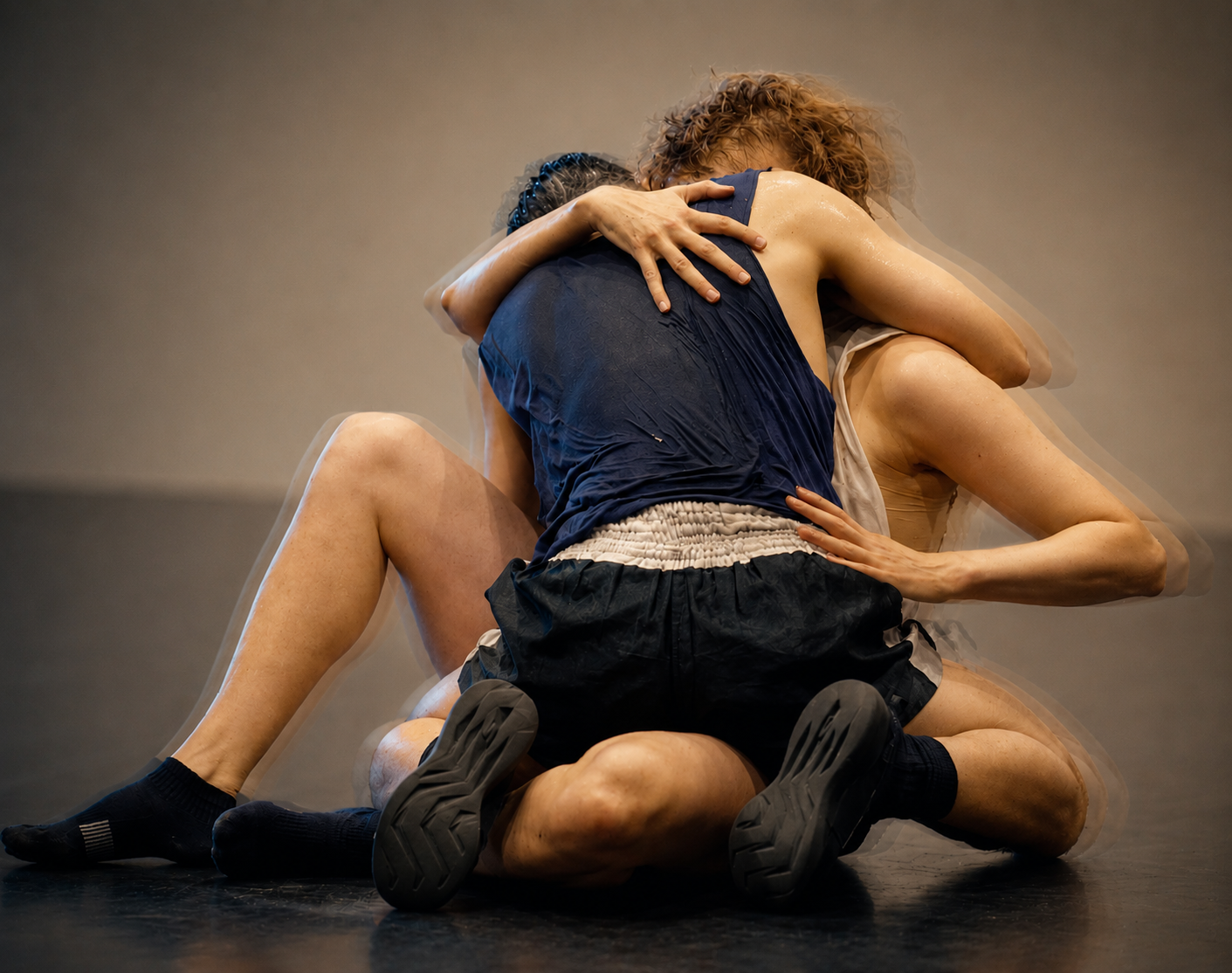
Trans theater director Dmitri Victor Barcomi and performer-writer Tamás Marquardt have been making art about being Eastern Europeans in diaspora for years. But they had never met. Then, Theresa Buchheister—theater maker and former Artistic Director of The Brick—sent them off to drink strong coffees one late-summer afternoon in between rehearsals for Barcomi’s LaMama show Dolls Day Afternoon and Marquardt’s upcoming Under the Radar show Creature. The two talked dissent in the Soviet Bloc, making art across two continents, and the state of theater in Trump’s America. The following conversation—edited for length—was the result.
TAMÁS
Okay, so thanks Theresa Buchheister for introducing us and being the artistic matchmaker for this piece. Why do you think they matched us?
DMITRI
I feel like we both fit in semi-overlapping boxes of American theater, as experimental theater artists with Central European cultural roots and connections.
TAMÁS
We’re also a bit rough around the edges. And we’re interested in particular people, whether Eastern European or whatever, that have laid their hands on Central European queerness.
DMITRI
I’m like an outsider’s outsider—maybe we both are.
TAMÁS
This is something that I think about a lot, because I’m Mennonite, Scottish, and Hungarian through my grandfather. So I’m a person in diaspora. Sometimes I feel like I’m connecting with my culture and other times I feel like I’m full of shit. Like, what do you think Eastern European queerness is? What differentiates it from queerness on Turtle Island? This is a question I do not have an answer to, by the way.
DMITRI
When I think about Polish and Central European queerness, I think about persistence, which is a trait that absolutely exists in all queer spaces. But New York City is a place where our queer ancestors fought extremely hard for us to have a degree of community comfort, visibility…New York is an enclave for culture in a way that very few other places are.
TAMÁS
Yeah, even from Upstate or like Ohio or… I don’t think it’s always other countries.
DMITRI
Yeah.
TAMÁS
I went to Hungary in 2019 under the guise of wanting to connect and found this queer bar in Budapest called the Auróra. I ended up seeing a transfemme that referred to themselves as a transznemű, which means ‘trans person’ in Hungarian. And I was speechless. That a place my ancestors came from had an idea of queerness that could have different names. It set me on a tear. But I think communism really colored my perception of Central European queerness, then and now. We have archives, stories, but the way that it manifested during Socialism was a coded way that was doubly coded, not only because you might get arrested or beat up for being gay, but there was this additional layer of being a political dissident. Which made everybody fearful, not just queer people. I feel like anyone could be a dissident in a way, and I was inspired by the records of that dissent. Like with samisztat (underground DIY magazines passed around in the Soviet Bloc), everyone had to share the same code. And I don’t think we have that or that we experienced that kind of oppression over many decades.
DMITRI
Well, I think a lot of Central European art also has such a strong voice of dissent that there’s two sometimes overlapping sites of resistance—queer culture and experimental art. And often they’re overlapping in regions, but are also separate.
TAMÁS
So then, what is an Eastern European aesthetic? Like, what does that look like in your work? Do you feel you’re pulling from that history or archive or whatever?
DMITRI
People always ask me: Why Poland? And I feel like the two things that really speak to me are darkness and resilience. Art with a kind of morbid humor and dark sensibility. I see this in Polish culture and Polish art, and I feel that sort of wry self-awareness is also a queer trait. So these sites of overlap speak to me as a queer person and a dark-minded human.
TAMÁS
Can you talk a little bit about your Foucault piece?
DMITRI
Mad about Warsaw is the English title. Szaleć za Warszawa in Polish. I wanted to pull from Foucault’s own work, this one archival text, A History of Madness, and look at the systems of surveillance and control that he’s documenting in his book, then compare it with the systems of surveillance and control that were being exerted on queer people in communist Poland. And use his gaze to kind of supplant my own, like, the foreign gays and the foreign ‘gaze.’
TAMÁS
I love Foucault so much. If we go back to why Theresa introduced us, we’re both sourcing from the queer archive. You’ve got Foucault, even though he wasn’t Eastern European, and your show now also pulls from that.
DMITRI
Maybe. Like, my most direct archival translation, artistic translation, was taking something from the LGBT Center archive, and directly adopting and staging it.
TAMÁS
This is the show you are doing at La Mama?
DMITRI
Doll Day Afternoon is wholly its own project. But it’s still pulling from the idea of a queer archive, although a different New York. The show is like another recipe in the Dimitri theatrical cookbook, which is pulling from queer archival materials and translating them in different ways. The Foucault project is a mixture; pulling from different archival sources and original writing.
TAMÁS
For a long time, I’ve cut and paste text from disparate places and jammed it together with my own writing to come up with performance texts. The piece I am making now, Creature, is pulling from the work of this 19th century transcestor Count Sándor Vay: he was born Sarolta, lived life as a man, a journalist, married twice, was a gambler, a drinker, but sweet-hearted. I have all his writing. And then this more embodied archive of learning the legényes, this Hungarian male folk dance, and placing that in relation to my ancestors and trans body.

DMITRI
That was my question for you: How do these two approaches or concepts interact in your work? You have this historical archive, and then this embodied archive of a dance. How does that translate into your work?
TAMÁS
I’m the conduit that connects the two things. When I went to Budapest in 2019, I wanted to find other queer Eastern Europeans, and was coming out a second time; as trans. And so there was this embodied space in me, something that wasn’t in an archive. I was looking for embodied experience. And the dance is something I found while falling down an internet rabbit hole, a video of a folk teacher teaching the legényes. All of a sudden, this masc-of-center space I was inhabiting had gesture and movement, a flavor, and I was like, that’s it, that’s me. So I started to copy the lesson and embody that archive.
DMITRI
That was the flavor of the piece? Or of yourself?
TAMÁS
The flavor of myself. At that point, I wasn’t making a piece. I was desperately flailing around. I knew I was going to write a book, which I eventually did, and now am publishing. So I had writing about myself coming out as trans in my late thirties…very self-referential, it’s a memoir. And after Budapest and Sándor and the legényes, my ancestors, my transness, and Eastern European queerness became interconnected. Then I was time traveling through my own family archive, Hungarian archives, and these videos and literature. That’s how the piece was created. So it’s kind of a time traveling piece, and I’m the conduit.

DMITRI
Picturing your body as both the conduit and the constant, but then it’s these different cultural contexts that are kind of shifting and moving through you that you are sharing.
TAMÁS
Yeah. But part of it, for me, has been being here in New York and being there, in Hungary. That back and forth field research is part of it too. I have recordings of the birds, the Danube, how my friends speak…
DMITRI
I think anything can be field research. It’s interesting that you have an embodied approach as creator and performer of your work. I have a very disembodied approach as a creator and director; I love to make my presence felt, but in a super incorporeal way. Disembodied. I love to make myself, but not my body known.

TAMÁS
Do you think that relates to your experience of transness?
DMITRI
1000%. And I feel it is a source of power; choosing how I want to be known and how I want to be perceived. Thinking about all of my work in the queer trans archive, how as an artist-as-archivist I’m adapting these things and I want my values and passions to transmit through my art. And that’s how I want to be known. How I want to be seen.
TAMÁS
What you’re saying reminds me of this really beautiful experience I had when I went to an archive in Budapest a couple years ago, when Fidez was still in power. I was with the archivist of a dance archive operating out of this old pre-communist building. There were programs, books, videos. He was telling me all these amazing things about dance, and I turned to him, and I was like, “Yeah, but where are the queer people?” I was asking him to show me material that was illegal for him to show publicly to minors, there were all these pornography laws, laws that still haven’t been struck down. And his whole demeanor changed. He started showing me things that had been, like you said, disembodied, floating in space, but unless you actually asked or you spoke of it, the stories were just there and you couldn’t touch it. When he showed me the materials, I didn’t take it lightly. I think about that a lot.
DMITRI
It makes me think about how knowledge is shared or hidden. And like some of the differences I see between the work I make in the U.S. and the work that interests me in Poland. There is this tension of state-funded art, and the art being heavily criticized by the government that is funding it. Theater critiqued by the government who funds it leads to them losing funding. That impacts what art is being made. Whereas in the U.S. I see there being more capitalist censorship, which is work operating in a commercial framework, and what happens if you’re not exactly what sells. So even in experimental work, people are always thinking two steps ahead: What is the future development and how can it grow within this commercial framework?
TAMÁS
Although it seems like we’re experiencing in many ways what Polish artists, Central European, Hungarian artists have experienced. I mean, with the NEA and people waking up overnight to find their funding rescinded.
DMITRI
Yeah, of course, yeah. It just feels like… whoever has the funding determines what stories are being told. I use the word ‘story’ loosely.
TAMÁS
Sure. It’s weird for me as somebody who spent a lot of time in Hungary to be watching this reversal of course. I read something three days ago that said Peter Magyar is basically going to revert laws to allow queer couples to adopt, which was illegal in Hungary with Fidez for a few years. It feels crazy, you know, watching this place where Republicans went to learn the playbook on ‘illiberal’ democracy and now Hungary has seemingly shifted and who knows what will happen.
DMITRI
Even here in New York we’re seeing these healthcare giants capitulating to Trump’s demands and rescinding healthcare, you know, for family, for trans youth.
TAMÁS
Even here, in Mamdani country. But yeah, in Hungary, even though the funding has been tough, there are spaces. There is Trafó, and Gólya—spaces where you can see queer work. Queers are everywhere, and we are loving each other and having wonderful lives. But what I notice is that even though it’s hard for queer work to get funded, there is strong community. In Budapest there is an arts festival called U500. It’s extremely queer, and co-run. Many of the people in that collective are queer, and watching the community come together, not in spite of, but because of the funding environment, and to see the level of experimentation as a means to imbue a sense of community. Like, they really are doing it because they love the work, and they believe in each other. It’s this community feeling that I don’t always feel here. I don’t know. I mean, I’m not sure if that’s true.
DMITRI
Yeah, I think the queer art scene in New York is so gargantuan that it can be very disparate. A lot of it is determined by certain proximities: to power, to money, to connections that enable work. Just living in New York, no matter whether you’re a fucking superstar or just getting out of your training, you’re living under the weight of capitalism, for better or worse.
TAMÁS
Well, we should end by talking shop, another reason Theresa wanted us to talk. What do you have coming up?
DMITRI
Mid-October at La Mama’s downstairs theater, I have a new play called Doll Day Afternoon, created by me, but adopted from the unpublished memoirs of transcestor and unsung trans icon, Elizabeth Eden, who was the subplot of the Al Pacino Blockbuster film, Dog Day Afternoon. I was introduced to Eden by a good friend and collaborator, so I see that as a testament to how queer memory passes through us, and the community as archive.

TAMÁS
That’s beautiful.
DMITRI
My friend, Sean Pollock said “Come to the archive. You need to meet Liz.” Reading her unpublished memoir, which is like this amazing snapshot of life pre-Stonewall, with her as this cheeky, audacious woman who was so determined to represent herself and create a legacy and dreamed of how her story would be told. She said in an interview that she hoped there was interest after the film came out, that some Off-Broadway producer would make work about her. It may have taken fifty years, but now she’s going to be Off-Broadway and I’m excited to honor and celebrate her.
TAMÁS
Then fast forward three months, and Creature, a folk-dance theater piece I made with my Hungarian collaborators gergo d. farkas, Bálazs Oláh, and Júlia Vavra will premiere at Under the Radar in January. And, three months after that, Creature will be published as a memoir by Arsenal Pulp Press. It starts off as I said, very self-referential about coming out at 37, and then reconnecting with the legényes and queer community in Budapest. This piece intersects with my life in diaspora, specifically in Saskatchewan, which is a province in Canada. I just became a dual citizen, so I have this additional sense of queerness that we don’t share. Hungarian farmers immigrated at the turn of the 20th century and after the two World Wars and the Hungarian Revolution in 1956, some to small settlements in the Canadian province of Saskatchewan. A bunch of Hungarian farmers lived together in these small communities like Békevár (“Peace Castle”), and this floored my Hungarian friends. So the piece has formed a cultural exchange, intersecting with family, fluidity, and Land relations, having to contend with colonialism. When my ancestors went to Saskatchewan they were given stolen Muskowekwan Land, so all those layers of history. And Sándor Vay, who I mentioned. So we both have beautiful pieces on the horizon.

DMITRI
I feel like I’m seeing shared themes of belonging and un-belonging. I think art can either bridge the gap or help us see across.
TAMÁS
Yeah, I think so. I hope so. Is that a good place to end?
Dmitri’s show Doll Day Afternoon runs October 15-25, 2026 at LaMaMa.
Tamás’ show Creature is co-produced by Mabou Mines as part of Under the Radar Festival, running January 14-23, 2027. Their book Creature: a memoir of selves will be published in April 2027 by Arsenal Pulp Press.
Leave a Reply