

The first songs I learned as a child were rebel songs. They recounted uprisings, hunger strikes, and rebellions; they rhymed and were easy to remember. Lyrics like “Some say the devil is dead and buried in Killarney / More say he rose again and joined the British Army” played in our kitchen and on our car rides. They were the earworms of my youth. I didn’t always understand but sang along anyway.
Many of these songs came out of thirty years of near incessant violence in Northern Ireland. This warring was based on territorial disputes from the 1921 Anglo-Irish Treaty, which partitioned Ireland into two separate entities – the twenty-six counties of the Irish Free State in the south and six counties in the north-eastern region of Ulster which remained under British rule. Sharp divisions in Northern Ireland formed between the Protestant population, loyal to the British Crown, and the Irish Catholic minority, who identified culturally and socio-politically with the Irish Republic and were heavily discriminated against. Local paramilitary organizations formed and mass civil rights demonstrations were held, most notably Bloody Sunday where British soldiers shot 26 Catholic civilians during a protest in Derry. The signing of the Good Friday Agreement on April 10th, 1998 signaled the end of the conflict and promised a different future for Northern Ireland.
So when, on a Friday evening, I entered the JL Greene Theatre at the Irish Arts Center, to see a documentary play on the four-day negotiations leading up to the Good Friday Agreement, I was not arriving as merely another audience member, but as a witness to my own history’s reenactment. It is one of the reasons why, after all, I was sitting in this theatre in New York and not in Dublin.
Produced by the Lyric Theatre in Belfast, Owen McCafferty’s Agreement imagines the conversations, exchanges, quips, and arguments between the key players of the signing of the Good Friday Agreement, a document widely celebrated for advancing the peace processes in Northern Ireland. The play brings the public into the private offices, halls, and urinals (yes) of the Castle Buildings at Stormont for those four critical days in April 1998; in so doing, we become the spectators who, twenty-five years later, know the ending of the story but agree to go along for the ride.
There are seven main actors involved in the peace process that McCafferty’s play focuses on, each representing a different political party. Throughout the play, we watch as they mark up drafts, advocate for the demands and interests of their constituents, confront one another, dance together, refuse to compromise on certain details, and make concessions on others. The rising tension of the play is that any of them can walk away from negotiations. In establishing a system of governance in Northern Ireland, where everyone feels represented, each party’s leader must ask themselves how much they are willing to give up in the name of peace. The stakes are high. In the opening act, U.S. Senator George Mitchell, played by Richard Croxford, tells us, “In over thirty years of conflict, more than three thousand people have lost their lives and countless other thousands have been physically injured. The emotional damage has yet to be fully understood.” But what makes McCafferty’s interpretation of this otherwise serious and grim historical moment so successful is the way he interjects humor and humanity into these proceedings.
Halfway through negotiations, at a moment when leaders are hammering out the details of the last strand of the document, urinals slowly descend from the ceiling onto the stage. David Trimble, the pugnacious leader of the Ulster Unionist Party involuntarily meets the man he despises the most, Gerry Adams, leader of the separatist Sinn Féin and political spokesperson for the Irish Republican Army (IRA), in the lavatory. They stand shoulder to shoulder, when Adams, played by Chris Corrigan, breaks the awkward silence and asks, “So is this where all the big lads hang out?” Trimble, masterfully acted by Ruairi Conaghan, responds, “Grow up.” They take jabs at each other, all while their pants are unzipped. Though it is documented that Adams and Trimble did, in real life, have a version of this talk at the urinals of the Stormont Building, we don’t know the exact details of the exchange. (Adams in his autobiographical retelling of the Good Friday Agreement jokingly referred to this moment as the “pee process.”) McCafferty imagines them for us in this much-needed comedic break.
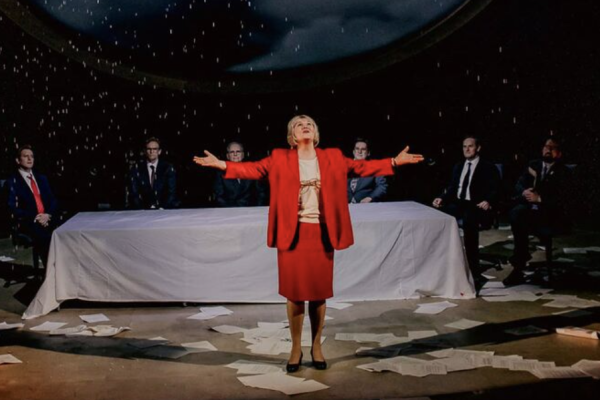
Other moments are playfully fantasized, too. On the day before the agreement is reached, Mitchell notes, “If this were a dance – which it is – the hall’s booked to midnight, so this is what you might call last dance Thursday.” A fever-dream dance break ensues, featuring all of the fatigued politicians as they throw up their hands and move together in synchronized choreography. The office chairs are pushed aside as Tony Blair, Prime Minister of the UK, imagines that he has, at long last, made it to his holiday in Spain. New props emerge – a margarita and sunglasses – and the other politicians, in rigid pantsuits, lift him up, as he ‘swims’ forward. There may not have been a dance break at Stormont, but in Charlotte Westenra’s direction of Agreement, there is always movement and motion. We have been watching these actors in a kind of durational performance; the leaders have been accosting and challenging each other, without break. With this dance, though, the pressure and traction of their debates finally give way kinesthetically. After four days of unceasing verbal confrontation, gestures come out of a need to release.

Conor Murphy’s minimalist set design transforms the drab 1970s civil servant offices into, what he calls, an “open stage with no walls.” The resulting choreography is a kind of bureaucratic ballet, as the cast skillfully roll their office desks around the stage, pirouetting around one another as they navigate the many escalations and de-escalations. The fourth wall is regularly broken, as the actors address the audience to explain procedural details, insult one another, or make a quick joke. For example, John Hume, played by Dan Gordon, the Irish nationalist leader of the Social Democratic and Labour Party (SDLP), turns to the audience and asks, “Is there any need to explain strand two again? You all get it, don’t you? And if you haven’t, pay attention.” For a play that is, at its crux, about borders, this production removes them entirely, both through its open concept set design and in breaking the fourth wall, the invisible border between audience and actors.
Reflected above the wooden circular stage is a projection of a night sky. Over the course of the show, we watch the date mark the passage of time. Time is that central, unnamed character that structures our experience of McCafferty’s Agreement. On the last day of negotiations, a newsreader proclaims, “Time moves on without favor or mercy.” Hume is always there to caution, “The clock, as always, is ticking.” There is no intermission in this show – for us or for the political leaders who are under their own internal deadline to come to an agreement.
With years of failed resolutions and thousands dead, coming to an agreement is an urgent project for these characters. Taoiseach (Irish Prime Minister) Bertie Ahern, played by Ronan Leahy, shows up to Stormont after having just attended his mother’s funeral saying, “Peace negotiations – I can’t stand in the way of that. I have to try. I can’t bury my mother and bury my head.” The sole female voice in these dealings, Mo Mowlam, Secretary of State in Northern Ireland, brilliantly acted by Andrea Irvine, is undergoing radiation treatment for cancer. She throws her wig on and off throughout altercations, making her own confrontation with mortality and personal deadline explicit to the audience.
Politicians are carefully constructed characters, too – idealized, cultivated personalities that are meticulously crafted and rehearsed. The real Adams, Hume, Blair, Mitchell and Mowlam were also ‘actors’ performing on the global stage. As they “checked in” with the outside world to update their individual political parties of the status of the peace talks, we get the sense that their performance of politics was not so different from the one we are watching acted here at the Irish Arts Center.
McCafferty’s Agreement is part of a long tradition of dramatic re-imaginings of historic events based on actual materials – transcripts, letters, newspaper articles, broadcast reports, and speeches interwoven with fictional components. Political documentary theater, while dependent on the immutable rules of historiography, asks us to (re)evaluate the events we are watching unfold from a different time and place. We reach back in time to see again. Using the privileges of hindsight, this style of theater asks how we can apply gained knowledge to our current world. In other words, have we learned and do we want to? McCafferty’s Agreement answers that question affirmatively and imagines how “two traditions on a shared rock” who live within “touching distance of each other” can finally find a way forward.
We know that peace talks aren’t the same thing as peace. Though the Good Friday Agreement was supported by over 71% of the Northern Ireland electorate in a subsequent referendum, a power sharing assembly between political parties is not, in itself, peace. Peace is a process, not an event. It is slow. And it is rendered visible here – not in the document itself, but in those moments when these leaders expose their humanity when they listen to each other’s grievances, and make room for each other’s perspectives – a pressing lesson for today.

Leave a Reply