
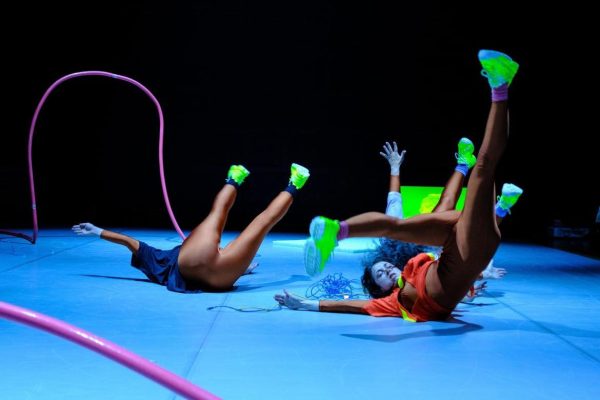

Audrée Juteau’s methods are fungal. She is breaking down detritus in our societal soil and making it into art.
Dance is the mushroom in Mystic-Informatic, which Audrée and her human co-creators Zoey Gauld, Catherine Lavoie-Marcus, and Ellen Furey presented in its US premiere on June 8th at Abrons Arts Center as part of the 2024 Performance Mix Festival.
The experimental piece celebrates wild physicality as resistance in a landscape of consumerism and digital waste. On stage with large metal and 3D-printed structures and a vintage computer, the performers engage in a riot of destruction and renewal, releasing their ecological despair with punkish, danced-out defiance.
Following the festival, Audrée spoke with me from her home in Abitibi-Témiscamingue to discuss the genesis of the piece, sensemaking in an increasingly disembodied world, and a new project that’s taking her even deeper underground.
This interview has been edited for both length and clarity.
Givens Parr: In devising this work, you and your collaborators were inspired by anthropologist Anna Lowenhaupt Tsing’s discussion of matsutake mushrooms in her book The Mushroom at the End of the World: On the Possibility of Life in Capitalist Ruins. In her prologue, Tsing likens the book to a mushroom in the way that it emerged from many threads of research and conversations, just as mushrooms grow from large underground mycelial networks.
To extend that analogy to Mystic-Informatic, if the show is a mushroom, can you describe the underground mycelial network and the greater ecosystem that gave rise to it for you and your collaborators?
Audrée Juteau: Absolutely. Yes, the piece is a mushroom! When we began the project, the first thing we did was write down all our inspirations, the network of ideas and people under what we were doing.
Nothing we do comes from just ourselves. Ultimately every artwork is a collaboration; there are a lot of people participating in it, whether or not we are conscious of them. And we were very inspired by the mycelial networks of mushrooms, the way they help trees to communicate, and the whole underground network and how that relates to the Internet.
The network of inspirations that gave rise to Mystic-Informatic also included various other works of art and scholarship, questions about ecology, questions about the future of dance, and our ties to one another.
The matsutake for us was also a metaphor for dance. Dance always happens in relation to others. The mushrooms worked through us, through the creation of the piece, which emerged from the relationships between us and others.
GP: So you felt like the fungi were co-creators of this piece? Can you describe the process of integrating what you learned from them?
AJ: In the greater discourse, and institutionally, there is this idea that we have to innovate with art, to use technology for innovation. There’s some pressure to include technological elements in dance works. The current discourse suggests that art has to be useful, to make progress in line with this idea of technological development. So our desire was to reverse this discourse and say: Dance has always existed, like mushrooms. It existed before us and it will keep existing. And mushrooms also grow in and decompose garbage. They bring life out of what’s left in the ruins of capitalism. We were inspired by mushrooms and mushrooms as a metaphor for dance to reverse the discourse, and to say, no, dance will bring new life to the technological waste that capitalism has introduced.
I started the project with Zoey Gauld. We take psilocybin mushrooms together once a year as a friendship ritual, and this new piece also came out of that experience.
I moved to Abitibi-Témiscamingue, a region in Quebec that’s about 600 km north of Montreal. I had been living in Montreal for 20 years, and after I moved, Zoey sent me a postcard with a mushroom on it, and that was the starting point of this project. We found the book by Anna Tsing, which helped us link mushrooms and the digital turn. Tsing describes how the matsutake was the first mushroom to emerge from the bomb site after Hiroshima, how it grows in disturbed landscapes, and we began to see a link between mushrooms and the technological landscape. We saw dance as the mushroom that will grow on technological waste.
GP: Your description of that process reminds me of one of the interesting things about matsutake in the context of human-driven markets in this stage of capitalism: Matsutake hasn’t been domesticated. It only grows in symbiotic relationships with the roots of certain trees in wild ecosystems. It commands a high price as a gourmet mushroom, but people haven’t been able to get it to grow as a monoculture or however would maximize the monetary value they could extract from it, in the way that people have capitalized on so many other agricultural products.
In Mystic-Informatic, is part of what you’re investigating how to shake off the domestication and utilitarianism of performance?
AJ: Yes, the piece feels like a liberation. It’s expressing a lot of desire for life and for doing what we want to do. We are not doing this to be useful. It’s like the mushroom, like taking mushrooms.
GP: Sounds like it’s also about joy and embodiment outside of the digital world.
AJ: Yeah, it’s about joy, definitely. I don’t know how to describe it exactly. It’s kind of healing something. For some people, it’s healing this dependence in our daily life on technology, especially after the pandemic, with all those meetings on Zoom, always on our cell phones or computers. In the piece, there is technological hardware that we interact with physically, really roughly or organically, like jumping on a keyboard. It’s wild. It’s joyful, and it’s not about making sense. It’s about the sensation of approaching these objects with a lot of physicality and generative life force.
The more the work emerged, the more we thought we were mushrooms ourselves: Mushrooms that have consumed humans and were playing at being humans that have meetings, talk on the phone, and walk on two legs. Starting from the mushroom’s point of view to create and interact with the work and the objects was quite exciting.
So it’s healing in regard to the relation to technology, but also people from the dance world sometimes say to us things like, oh, I haven’t danced for a couple of years but this makes me want to dance with you. Non-dancers also told us they wanted to dance with us. The piece calls out kinesthetically. We did what we wanted without caring. I mean we care about others, but maybe not about expectations of what a dance or a dance piece should be. There is something a bit rebellious about it.
GP: Almost like a primal scream?
AJ: Yes.
GP: I associate the world of professional dance with tremendous discipline of the body and rigorous, often rigid, training regimes. This sounds like a defiant response to that.
AJ: Yeah. It’s not exactly that we made fun of it, but we really just danced like we wanted.
GP: Does the piece change each time you perform it?
AJ: It’s improvised, but structured. So, it changes, but not the arc. There’s a lot of freedom in it.
GP: Do you think of the audience of each performance as interlocutors? Is inviting audiences to participate important to you as an artist?
AJ: What’s important to me is that audiences feel included, but that they don’t feel pressure to be a certain way. It was a question we had in the devising process, because the dancers had this system of dancing together, and we were not sure if it would be accessible to the audience. But I’ve realized that if I’m into what I’m doing, the audience is going to have access to it.
And there is this final part of the piece where we present a website we designed with a tool for divination. We take questions from the audience and answer them with some digital mushroom tarot cards that we made. So it is a very direct way of interacting with the audience. It’s very casual; we just ask if someone has a question, or they’re experiencing any transitions in life or need some guidance. At first, people are a bit shy about asking questions, but then it really opens up. It’s a very intimate moment, very rich.
GP: Can you describe one of these exchanges that particularly moved you?
AJ: There were so many. One really intense question we had: A trans person asked if she was going to die because of transphobia. It was very charged, and we felt a lot of responsibility about giving the answer. The card showed a very strong mushroom that was about bringing up new consciousness. It was a beautiful card indicating that people’s consciousness will evolve. It was also funny: The imaginary mushroom was a destroyer of condo developments…. The card was full of hope. It was really perfect for the question.
GP: Could you describe your experience sharing the work in various places with different audiences?
AJ: We premiered the piece at a festival called OFFTA in Montreal in 2022, and then we showed it at festival FURIES at Marsoui in Quebec. Then, we did it in Quebec City at a performance art festival of multidisciplinary work. Then we did it in Rouyn-Noranda at a museum and an art gallery in Ville-Marie. We premiered the piece in the United States at the Performance Mix festival. That was the last performance that we did.
GP: Was there anything about this most recent performance, the US premiere, that made a particular impression on you?

AJ: Well, the space where we performed at Abrons Arts Center is interesting. It’s an underground theater, circular, with stairs going up either side. We felt a playfulness in the space in that we could come out from either side. And the audience’s questions were very strong. Someone asked if there was going to be a civil war in the next four years. And someone else asked when “all that” was going to end. We didn’t exactly know what she meant by “all that,” but it was charged with the political context of the election.
GP: If the piece is a mushroom, what do you imagine as the metaphorical spores being sent out from it? What is your hope for where they will alight and what kind of life they will bring forth?
AJ: They will bring some kind of joy of reconnecting with bodies and dance. The joy of dance, and the generative power of movement. And the powerful forces of friendship and connectedness.
GP: How do you see this piece within the greater landscape of contemporary dance performance?
AJ: I think there was something radical about going back to dance — not dance that was all crafted, movement by movement — but the pleasure of dance. Not trying to make sense, but making sense with the senses.
GP: Do you expect to continue making work that could be considered radical?
AJ: We will continue doing similar work. We have already started a new piece about metals with heavy metal singing. Where I’m from, there’s a lot of mining. So we are learning some death metal singing as a way to connect with the mining territory, the metals that are underground, even deeper than the mycelium of the mushrooms. Like Mystic-Informatic, this new piece is also about ecological despair and about trying to connect physically. We communicate by trying to connect with the matter, through being the metal, being the land.
GP: Your process of looking for ways to connect, create, and find joy amidst ecological degradation and despair reminds me of a line from Tsing’s prologue: “…there are still pleasures amidst the terrors of indeterminacy.”
AJ: Yes, it’s really that.
GP: One of the other major themes in Tsing’s book is precarity, especially economic and ecological precarity, which Tsing analyzes in the context of capitalism.
Could you speak to your relationship with precarity as an artist? What do you see as effective means of resistance to the trend of increasing precarity, especially that brought on by ecological destruction and these economic systems and social disconnects that we’ve been talking about?
AJ: Oh good question. When I read this book, I noted how Tsing talked about the new economy of mushroom pickers. They were independent, foraging by themselves, not working for a company. It’s very precarious to be a mushroom picker, but it also sounds wonderful to be in those forests looking for mushrooms. I also pick mushrooms, and that moment of being in the forest, searching, makes me feel really full. For sure it’s precarious, but it also brings so much sense.
And while I’m saying that, I feel a bit like I’m reproducing the discourse justifying the precariousness of dance — the discourse that says it’s acceptable to be precarious if you’re doing what you love and it brings you meaning.
As an artist I feel less precarious than others right now because of where I moved. And also because I have a job outside dance now; that’s been my strategy. When I lived in Montreal, I was much more precarious. Now I live far from there. And we’ve been very lucky with this project.
In the dance world, I have noticed, however, a solidarity and pooling of resources, even if these are limited. It’s quite inspiring, and goes against the grain of competition. Solidarity is resistance.
GP: It seems like you’ve found the right ecosystem to make what you want to make.
Is there a question you hope people will consider as they participate in or resist the digital turn, or as they consider themselves within a greater ecosystem?
AJ: Yeah, I have to say that of course I’m also dependent on technology.
GP: I’m glad we can use it for this interview.
AJ: Yeah. My life involves a lot of contradictions.
GP: How do you hold the tension in using digital technology while also finding liberation from it, embracing embodiment, and making this kind of work?
AJ: Humans can play a positive role in our environment, like the mushroom. And this work is not against technology, but against the proposition that this kind of technology is the solution, is progress, is the future. The piece encourages slowing down…like, stop being “useful.”
GP: Is there anything else you want to share about the work?
AJ: We were also inspired by the power mushrooms have to renew land, the way they can break down or help remove toxins and heavy metals. Mushrooms bring hope.

Leave a Reply