
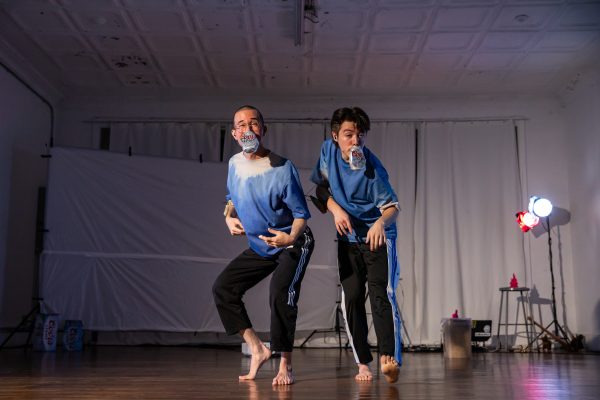

A golden age is brewing once again for AAPI experimental performance[i] with Glenn Potter-Takata and evan ray suzuki serving as crafty kodama (木霊, 木魂 or 木魅) leading us through the forest to refreshing springs of compositional bliss. The two have been collaborating since meeting at Sarah Lawrence College while evan was an undergrad and Glenn was pursuing an MFA degree, bringing the specificity of a Japanese-American yonsei perspective to the fore in recent years. “Bodhisattva Beer Run,” an evening-length live and mediated dance theater work performed at Pageant in June, mobilized their established collaborative practice to play upon the commodification of Buddhism and gender performance in a deliciously satisfying investigation. There is a legacy here that harkens back to the days when “Peeling the Banana” and the Asian American Writers Workshop lived on St. Mark’s Place and Slant was a a La MaMa staple. However, the work feels entirely contemporary and, thankfully, part of an evolving discourse around aesthetic, inhertance, physical practices, nationality and “the” diaspora.

Like the finest cold-water stream feeding a Coors-filled pathway to nirvana, the piece conflates the iterative nature of binge drinking with a kind of drunken euphoria achieved through Buddhist practices. Glenn is a practicing lay monk in the Shingon tradition, notable for its intricate ritual practices and pantheon of buddhas and bodhisattvas. Like their previous works together and individually, “Bodhisattva Beer Run,” works as a reinterpretation of the ancient within a contemporary American context, while also serving up an invigorating tonic of temporal fantasia. Everything can be here, now – nostalgia and futurity, disappearance and emergence, grief and liberation – as long as you hit the packy[ii] first.
The work opens quickly with Tei Blow appearing suddenly on video, a benevolent sensei directing our path towards enlightment:
And we form the mudra of Hayagriva Avalokiteshvara, Bato Kannon, the horse-headed bodhisattva of compassion, patron deity of beasts. For that is you, my dudes, beasts in a cage of obligations.
And while we hold bako-in, the horse-mouth mudra, we recite his mantra three times. Repeat
with me:
On Amiritodohaba Unpatta
On Amiritodohaba Unpatta
On Amiritodohaba Unpatta
And envision your mind stream flowing like a stream of macro lager to achieve a cold-certified dharmadhatu.
For if the path of enlightenment is the one-millionth recitation of mantra, then that path is also lined with one-million beers.
Immediately following this, evan arrives and stomps a beer can into the floor reminding me of many late-night basement can-smashing rituals of the high school years. While loosely based on Glenn and evan’s experiences growing up in Asian-American enclaves on the West Coast, the work reaches across land and time. From a generation ahead and identity formation on the opposite coast, I meet it with smirking side-eyes at the mindfulness industry’s secularizing of ancient belief systems and ritual while also sighing in relief, full of gratitude at the un-precious ‘repesentation matters’ labor, as a once isolated Vietnamese Irish weirdo stuck in white suburbia in the 1900s, checking the “Other” box over and over. Glenn and evan are offering contemporary Asian American dance, what Jonathan Wang and the Daniel Kwan (of The Daniels) offered cinema. Minus the still requisite intergenerational conflict at the heart of most AAPI narratives (including the aforementioned’s record breaking “above the line” awarded “Everything, Everywhere, All at Once”), “Bodhisattva Beer Run” arrives as a hearty entry in the growing discourse that we can be conscious of inherited legacies, thoughtfully devoted to crafting complex artworks, and absurd. Not a model minority, nor marginalized peoples, but happily pushing at the margins, happily out there.
 Amidst nimble sequences of ritualized spoken text and highly precise reenactments of beer can batting practice home videos, butoh serves as a binding agent for intangible states of becoming. There is a fluidity, focus, and pace that butoh provides each dancer, while it also serves as a reference point to annihilation, artistic lineages, and the legacies of war without overt didactics. Both have studied with Kota Yamazaki and Mina Nishimura – vital presences in the NYC dance scene for the past twenty years, and the expansive approach to butoh as a lens and not a dogma is apparent. At times, they dance in simultaneous solos in front of projected 3d renderings of Batō Kannon. At others, they physically connect such as when Glenn mounts evan’s back like a horse head or they dance with stuffed animal horses attached to their heads.
Building on evan and Glenn’s interest in Shingon Buddhism, the piece folds many layers of rite together while also providing a nuanced glimpse into the many threads of a lived experience. It’s a lo-fi aesthetic with sophisticated subversions of mediated performance tropes. Their accrued butoh-etics allow for cultural slippage wherein sacred and profane aspects of a Japanese American experience can be filtered through po-mo performance into sly critiques of appropriation. What they describe as a “sometimes irresponsible use of source material” allows for a piquant aesthetic tastemaking. “Bodhisattva Beer Run” makes the Asian diasporic experience of being an alienated American part of a larger project of survival[iii] within the excesses of consumption and masculinity. With zen-like placid demeanors, Glenn and evan kneel across from one another and deliver text quietly into microphones, pulling cultural identifiers apart, reconfiguring and operating in a space of meaningful irreverence.
Glenn: We must protect our natural resources and we must recycle as a metaphor and embodiment of the finite nature and interconnectedness of all things.
Evan: The ego is the only thing that separates us.
Glenn: The future of the non-ego is hidden in the barley suds.
Evan: That’s why we have committed to leading water stewardship by partnering with farmers to reduce water usage by as much as 25% while growing our 100% American-grown high country Moravian barley.
Glenn: And why we use a unique blend of different hop varieties in our natural extracts from whole hops to get consistent flavor and a balanced aroma.
Evan: Macro lagers and practiced mantras are the entrypoint to a true cold-certified dharmadatu.

Post-modernism can be a vital refuge for the wry and the sincere, realms of deadpan can meet aesthetic egalitarianisms of a traditional Japanese practice.[iv] The dream state of the dances, the 3d renderings, the sound score, and a rapid replay of live video captures (of live reenactments of previously recorded home videos) activate a portal to Asia-futurisms where we can compress millennia. Glenn delivers Shingon chants while evan bats empty Coors cans into the white screen. The labor of transcendence is near, even in the wake of evan’s final virtuosic act of shotgunning the last beer. We meet all moments at once in an expansive realm tapping into, as evan earlier stated:
a pool of limitless diasporic consumer-based positive energy [that] provides a throughline between our childhood dream states and our empowered future selves.

- [i] See “An Arrival” in Benjamin Akio Kimitch’s Tiger Hands: A Dance Document, limited editition, 2023.
- [ii] Regional slang for liquor or package store of my youth, not part of Glenn and evan’s particular lexicon
- [iii] See “reclamation of the disposable” in Dancing in the Aftermath of Anti-Asian Hate, edited by Dr. Yutian Wong and Dr. SanSan Kwan, Dance Studies Association, 2023.
- [iv] See “Ambivalent selves: the Asian female body in contemporary American dance” in Contemporary Directions in Asian American Dance, edited by Dr. Yutian Wong, U. Wisconsin Press, 2016
Leave a Reply