

This past May, US downwinders (people who lived near nuclear testing sites) testified before Congress. Certain groups of afflicted people, particularly those in southern New Mexico, where J. Robert Oppenheimer’s team conducted the first atomic blast in 1945 still have not been compensated for rare cancers, autoimmune disorders, and other illnesses as a result of their exposure when the US exploded over 100 nuclear devices in aboveground tests from 1945 to 1962. Meanwhile, next month will be the 75th anniversary of the first atomic explosion at the Semipalatinsk Test Site in Kazakhstan. More than 630 nuclear and thermonuclear bombs were detonated in the past 40 years, many of them in the Semipalatinsk and Azgir regions. The effects of the Cold War continue to this day with millions of people living with the genetic and environmental aftermath of radiation here in the US and on the other side of the globe. As the arms race shifts from a “Fallout”-style faded fantasia into an emerging news thread, remembering the continuing impact on human lives rises in urgency.
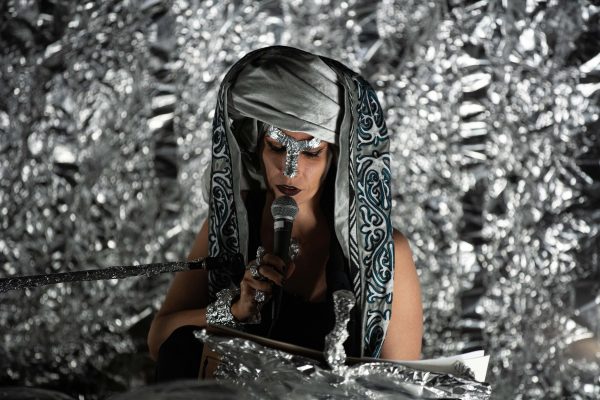
In June, La MaMa ETC and CultureHub presented Kazakhstan’s ORTA Collective for Spectacular Experiments on the Great Atomic Bombreflector, with support from Goethe-Institut Kasachstan. ORTA Collective’s ongoing project, “The Great Atomic Bombreflector,” is a direct response to inhumane nuclear weapons testing in Kazakhstan. As part of La MaMa and CultureHub’s Experiments in Digital Storytelling program, “Spectacular Experiments” completely transformed La MaMa’s Community Arts Space with 3000 feet of aluminum foil for an immersive performance that was both spectacle and ritual. It educated attendees about the realities of Kazakhstan’s status as the most nuked country in the world while also building a community of joyful resistance through a collection of lecture, concert, participatory singing, communal grieving, spiritual visioning, and delightful whimsy.

ORTA Collective is a group of transdisciplinary artists from Kazakhstan engaged in the proposition that gathering in artistic community can harness the destructive power of the atomic bomb and aim it toward a greater good. Founded in 2015 by actress and guide-performer Alexandra Morozova and director Rustem Begenov, the group includes artist and set designer Alexandr Bakanov, photo and video artist Daria Jumelya and contemporary artist and Chief Genion Researcher Sabina Kuangaliyeva. Since 2017, their projects have been mainly focused on the New Genius Theory – a unique approach to creativity that ORTA has been devising from the life and art of Kazakhstani artist, writer, inventor, thinker, and “the Genius of the Absolute Interplanetary Category” Sergey Kalmykov (1891-1967). The genesis of the BOMBREFLECTOR dates to the 1930s when Kalmykov prophetically invented this device that transforms the destructive energy of the atomic bomb into creative energy during his lifetime of poverty, obscurity, and loneliness. The New Genius regards genius as a practice anyone can perform, as opposed to the traditional notion that genius is a rare phenomenon in exceptional individuals. The New Genius was presented at the National Pavilion of Kazakhstan at the 59th Venice Biennale in 2022.
Decades of testing, driven by the U.S./Russian nuclear arms race, delivered horrific, generational damage to the Kazakhstani people and land. Still, few Americans know of the scale of loss experienced there, nor the ongoing issues on this soil. The Bombreflector offers the world a new machine, powered by the human voice, vibration, and visioning. Together, at LaMaMa, artists and audience created confluences of creative energy, making the resistance to destructive energy more powerful through relational efforts across the confines of national borders.

My experience began with protective shielding, as each audience member was wrapped in large pieces of brown paper to provide a barrier for the skin. I was also fitted with a plastic face shield, asked to write my name on a long sheet of brown paper, and brought upstairs from the lobby of La MaMa’s 74 East 4th St building. Finding my way through an aluminum foil hallway, with posters welcoming everyone to the Temporary Temple of Everyone’s Genius and declaring that our “genions,” particles of genius present in every individual, would be activated as we collectively became forces of uplifting genius, I stepped through a curtain of foil, into a shining cavern and nestled into piles of crumpled foil, carefully adjusting my paper robe to avoid scraps of aluminum edges. I was landing into an environment designed by Alexandr Bakanov that had been in development for over 7 days and amidst 25,000 foil balls

Alexandra Morozova was seated before us, a shining iconic figure in a silver temple, while a soothing drone played out of speakers. Director Rustem Begenov welcomed us and delivered a 20-minute instructional account of Kazakhstan’s history of nuclear bombings, the story of prolific, but ridiculed artist Sergey Kalmykov, the New Genius Theory, and the order of upcoming events. We were told we were here to participate and help develop the ritual practices that will launch the great atomic bombreflector in 2026. The seven phases of the event were titled:
- Attuning Of Sense And Mind To See Through The Visible World
- The Loud And Bright Stupid Representation Of Atomic Inhumanity
- The Grief
- A Communion Of Kazakh Instruments
- The Activation Of Genions
- The Emanation
- The Returning And Time With Your Own Genions

Morozova sings a “famous Kazakh song” called “Dudarai” (translated from Kazakh as “curly”). Rustem tells me the song (as well as the song “Balkadisha”) became widely popular after its performance by the famous Kazakh singer, Amre, in 1925 at the Paris International Exhibition of Modern Decorative and Industrial Arts, at which he won the silver medal.
Dudurari,
I was born only for you!
There is only one road between Ashchykol and Tuschykol
The beaver hat suits you very well
Dudar-ay, if you decided to come, come as soon as possible!
Both Russians and Kazakhs are vying for your place
Morozova sings again during the Grief phase of the Experiment. The song “Balkadisha” (a woman’s name) was written by Akan Seri, one of the most famous Kazakh “akyn” (an improvisational poet and singer within the Kazakh and Kyrgyz cultures).
I am telling you, Balkadisha
You will miss our conversations, Kadisha
Carefree, rebellious you
For whom will you become a wife, Kadisha?
And I fell on Zhylandy
I grabbed the mane of my horse
When I heard that Balkadisha left
How I cried hugging the rock!

During The Communion of Kazakh Instruments a variety of homemade hair clip mouth harps, rubber band spike lutes and other music makers are passed around for us to play along. We activate our genions through a song where we celebrate every person in the room by singing their name, which had been written in the lobby, out loud. The effort is durational and delightful, people have fun with their own names and the room is like a joyous sit-in, love-in, teach-in. The Emanation is a capricious DIY invention – Billy Clark, CultureHub’s Artistic Director and stagehand, lifts a makeshift “drone” (a large LED screen with house fans) through a block and tackle rope rig and I can feel every homespun sci-fi basement dream-spirit glowing across decades in reverence.
The entire endeavor never leans away from an absolute sincerity amidst apparent preposterous situations. It feels like the necessary spirit of actual resiliency. Often resiliency has been expressed as a way of withstanding the buffeting forces of oppression. This can establish the impression that one is then harder against the wind, instead of evolved enough to know to softly bend like bamboo or even better, as the Great Bombreflector experience proposed, the real victory over a history of bombardment is to rise, and rise again together… laughing.

After the Spectacular Experiments, its creators – ORTA Collective, CultureHub and La MaMa ETC – stated that the Experiments were very successful and they managed to collect a lot of data regarding the ritual part of the future Bombreflector. These results allow the Planetary Team to continue development of the project with confidence and talk about planning the next iterations in New York, London, Almaty, and also possibly in Germany, France, South Korea and other parts of the planet.
Leave a Reply