
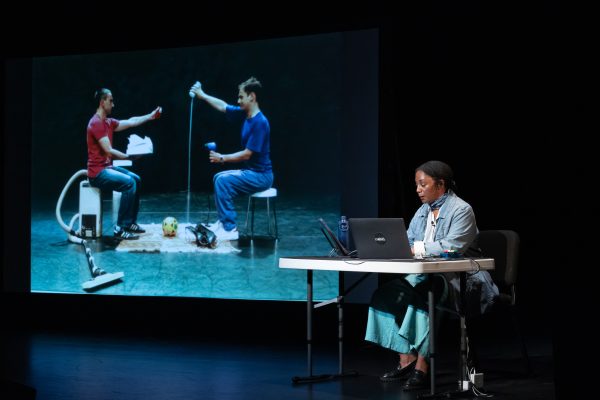

The French choreographer Jérôme Bel is a white man in his late fifties. He has a round hairline, a salt and pepper beard, and brown, downturned eyes. “My name is Jérôme Bel,” a performer says in the first few minutes of his self-titled show at L’Alliance New York’s Florence Gould Theater, which opened the institute’s Crossing The Line festival last Friday. “I am single, I have a fifteen-year-old daughter, and I identify as a choreographer.” Were it not abundantly clear that the person on stage speaking these lines was not Jérôme Bel, these assertions would have been entirely, even dully, straightforward.
But April Matthis, a versatile New York actor tasked with performing this piece—a work she described in an interview with the online journal Extended Play as a “retrospective PowerPoint presentation” of the avant-garde French choreographer’s career—is a Black American woman who bears no physical resemblance to Bel. Perched on a plastic chair in a pair of teal trousers, a denim shirt, and a scarf wrapped tightly around her neck, she delivers Bel’s text in the first-person. Bel, we soon find out, stopped traveling for ecological reasons in 2019; she is filling in for him.
So, this choice is practical; but more important, it is conceptual: Bel could have cast a middle-aged white male. By choosing not to, he calls into question the rigidity of categories like race, age, and gender, and expresses a desire to collapse them. His work necessitates a fragmentation of the self. Each time his dancers perform in front of a new audience, or every time someone presses play on a YouTube video of an old show, new meanings are ascribed to his pieces and, by extension, to him. So why would it matter who plays him?
During the two-hour performance, directed by Steve Cosson, Matthis, playing Bel, cues several videos of his seminal works from a laptop. As they are projected on a large center-stage screen, she unpacks them for the audience. Part theater, part oral history and part memoir, Bel calls this approach “auto-bio-choreography.” In one video, the ballet dancer Véronique Doisneau, who describes herself as someone who never became a “star,” holds an uncomfortable pose from the corps de ballet’s “Swan Lake” choreography for an excruciating amount of time to illustrate how the form’s hierarchical systems alienate low-rank dancers. In another, a woman examines herself by prodding and tugging at the skin on her arms and torso.
Harking back to the Judson Dance Theater, a 1960s experimental collective in New York that questioned the very definition of dance by elevating everyday movements to the status of art, Bel’s work is notoriously hard to digest. His performers—many of whom aren’t professionally trained dancers—talk on stage and move erratically, if at all. His shows have elicited mixed critical responses over the years. Bel offers an example, showing a clip from his self-titled 1995 piece in which a naked person, standing center-stage, relaxes their muscles so effectively that they urinate onto the floor. He recalls how some audience members walked out. Most choreographers would have been disappointed; Bel was overjoyed.
Central to his performances is the notion that art shouldn’t exist to please or pacify its audience. He seeks to resist spectacle, which, he argues, is intertwined with the demands of capitalism. And yet the show at Crossing the Line is entertaining. When Bel, deadpan, pokes fun at himself—by remembering failed relationships, failed ideas, and failed performances—members of the audience chuckle. When he recalls the deaths of close friends during the AIDS epidemic, we are moved. And when we see Catherine Gallant perform the only live dance in the show – an excerpt of Isadora Duncan, a re-creation of pro-Soviet work by the pioneer of modern dance – it’s captivating. By turns, the show is funny, self-aware, and full of pathos.
Even so there is something deeply unsettling, and unsatisfying, about watching an artist interpret his work for you. In his 1967 essay, “The Death of the Author,” the French literary critic Roland Barthes – one of several postmodern French theorists whose work Bel quotes in the piece – argues against the tyrannical centering of the artist’s biography in interpretations of their oeuvre. “The birth of the reader,” he wrote, “must come at the cost of the death of the author.” But in Jérôme Bel, it is impossible to “kill” the author. Bel—even in his absence—is there, chronicling his every move, breathing down the audience’s neck.
Of course Bel knows none of what he says is gospel. Throughout the performance, he often speaks of moments when he reconsidered his motivation for creating a piece, or admits he saw something the wrong way. His shifting doubts are a reminder that all works of art are living entities.
And so, a sense of wonder at his own art’s capacity for transformation sits at the crux of Bel’s retrospective. “For this piece, I have not produced anything new,” he says as the show draws to an end. He didn’t need to. In the final stages of the making of Jérôme Bel, the choreographer’s previous works’ potential for reinvention seemed so palpable he considered never producing another piece. Then, one day, “several ideas” came to him all at once, and Bel changed his mind again.

Leave a Reply