
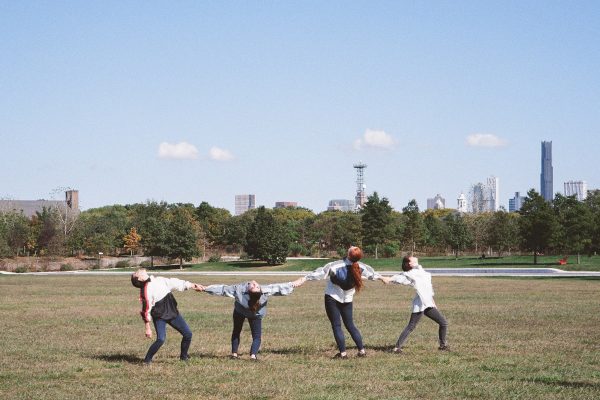

As if from nowhere, four figures appeared between a line of scrubby fruit trees on a low ridge of Governors Island. Dressed in dark-washed skinny jeans, black sneakers and oversized anoraks, they could have been any weekend visitors to the arts and recreation site in New York Harbor, except for their stillness. That eerie stasis made it clear to the audience loosely arrayed at the center of the island’s Play Lawn that “Analphabètes” was beginning. For the next 30 minutes, the work, by the Athens-born, Paris-based choreographer, Lenio Kaklea, took the parched lawn and its surroundings as its expansive stage. Through repetitive, methodical movement, it wrapped the audience in a ritualistic space that produced a hyperawareness of the natural landscape. It was presented by L’Alliance New York with Governors Island Arts as part of the Crossing the Line festival.
By turns the performers rotated to face the audience then away from it. They made asynchronistic gestures with their arms, lifting one into a languid right angle, then crossing their wrists above their heads, the shapes mimicking the lines of the trees. The lightweight tech material of their pearly silver jackets caught the stiff breeze blowing across the lawn from the harbor, adding volume to their drifting arm movements. The gestures suddenly resembled semaphore, a system of signaling across distances with flags, each position a letter of the alphabet. “Analphabètes” translates as “illiterates,” but the dancers’ insistent, repeated movements suggested, instead, an inscrutable language of ciphers.
Kaklea has said that she designed the piece as an inquiry into perception, how the performance and its movements are synthesized by the audience as the dancers shift from far to near to very far, in that order. From the ridge, the quartet flexed and contracted, proceeding gradually across an asphalt path and onto the lawn. As the dancers (Kaklea along with Lizzie Feidelson, Leah Fournier, and Evelyn Dugan) closed in on the audience, their formation tightened, and their movements became more refined. They dropped to the ground, out of view for anyone sitting at the center of the audience circle, and they rippled back up again. Then, almost unexpectedly, they were in the audience. They felt close, too close.
They planted themselves in front of spectators in angular stances that recalled petroglyphs. Intensifying the sense of a primordial confrontation, they flicked their tongues and bulged their cheeks. In low squats, they cycled slowly through a series of hand gestures: thumb, index finger and pinky extended in a rock-and-roll sign that morphed into flipping the bird. (The hand sign has been traced back 2,500 years to the ancient Greeks.) That rude gesture was startling, but taken without its standard meaning, it was a shape made in space, just as the semaphore-like motions that opened the performance spelled no discernible words.
Kaklea first created the piece in 2017 as a solo, “Analphabète,” which she performed on a small island in the Cyclades, its moves informed by the island’s arid and vertical landscape. Since then, she has restaged it at Versailles and in the Tuileries gardens in Paris, both times as a trio —renamed “Analphabètes” — and adjusted the choreography to respond specifically to those multi-level environments. For her performance on Governors Island, Kaklea chose the seemingly flat expanse of the Play Lawn over sites with more vertical features that had been suggested to her, according to Crossing the Line curator Violaine Huisman. But as the dancers pulsed across the terrain, they revealed the subtle, varying heights of the island’s topography.
As the dancers leapt in unison away from the audience, they seemed to expand into the space. Holding arms then breaking apart, they tilted and whirled north toward the baseball diamond at the back of the field before veering off to the east. Still in formation, they faced the harbor. They returned to the long arm movements from the beginning of the piece, the “far.” Now, at “very far” and with their backs to an audience that had pivoted 180 degrees, they signaled to the Statue of Liberty, her own arm raised in a permanent sign. Then they ran out of sight behind a soft roll of landscape, their disappearance revealing yet another elevation I hadn’t registered before.

Leave a Reply