
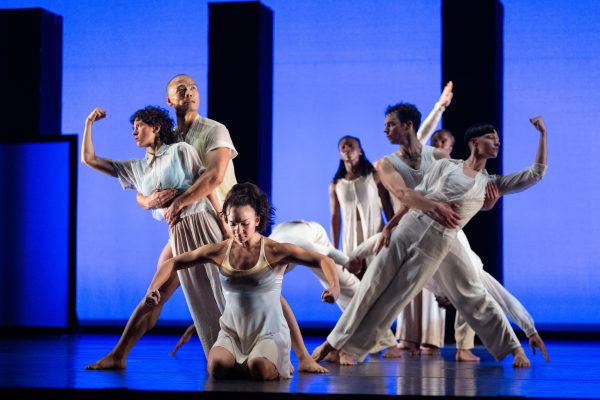

Dances are rarely historicized. They exist instead as ephemeral events, never repeated exactly as they were once performed. When a piece of dance is staged again in a new context, it appears as a product of its present, rather than the moment it was first choreographed. Bill T. Jones’s 1994 multi-media dance piece Still/Here, is an exception.
When the work premiered thirty years ago, it was at the center of a critical battle waged by Arlene Croce in the New Yorker. Croce refused to see the dance because it was an example of “victim art,” rendering it “beyond criticism.” Still/Here bears the imprint of this past. The New York Times’s coverage of the BAM revival frames the work through Croce’s hit job and explains that Jones is still recovering from her blow, even as he aims to disentangle himself–and the piece–from its influence.
Missing from contemporary coverage of Croce’s infamous review is a discussion of her own political beliefs as an arch-conservative. Though all writers, critics especially, are shaped by their politics, Croce has been sanitized over time, understood as the poetic voice of dance writing for liberal The New Yorker. Yet she started her career at the National Review, William F. Buckley’s publication meant to provide a respectable platform for conservative ideas. Croce’s early pieces for the right-wing outlet dripped with disdain for the liberal tenor of the performing arts world. She despised West Side Story, for example, because it was “New Deal Proletkultur.” The taste of its director and choreographer, Jerome Robbins, “perennially reflects the ideological avidity of the ‘responsible’ Liberal audiences he serves on and off Broadway,” she wrote. Such work was a “waste [of] one’s time.” Still/Here, which was choreographed by a black, gay, H.I.V. positive choreographer at the height of the 1990s culture wars, was an obvious target for her ire and dismissal.
Material for the work came from workshops Jones hosted around the country with people diagnosed with terminal illnesses, not just AIDS but cancer, too. Contemporaries of Croce’s pointed out that beyond the discourse and drama, Still/Here was a typical modern dance not particularly interested in taking a political stand—about AIDS or any other “leftist” cause. Dancers mime writing and rocking a baby, they skip, leap, and cartwheel. Athletic stunts punctuate pedestrian impulses like running, walking, and bending over. Interviews from the sessions serve as the soundtrack to the performance, and dancers mime words voiced by participants in those recordings. Video footage of the events, documented, edited, and manipulated by the video artist Gretchen Bender, appear throughout the piece on screens that the dancers carry around the stage. If anything, contrary to Croce’s predictions, the combination of movement, text, and visuals conveys a message of hope and resilience: expressions of defeat are tempered by joy. In the final moments, the dancers spin together in a round, an explosive moment of solidarity and embodiment of uplift.
Even beyond Croce’s essay, the vocabulary of Still/Here feels heavy-handed thirty years after its premiere. A section that borrows the experience of a breast-cancer patient features a gesture in which the femme and nonbinary dancers in the cast clutch their breasts with one hand and cover their crotch with the other. They maintain this pose while they roll on the ground, perching on their knees and opening their legs, crass expressions of femininity. The choreography could have responded to our contemporary expansion of gender categories, and explored the idea that one does not need female genitalia to be a woman (especially since nonbinary dancers were cast). Instead, the moment reads like a dance break in an early MTV music video. Throughout Still/Here, literal interpretations of the dance’s thematic concerns do not elevate or intensify their meaning but render them corny and distract from the movement sequences.

I do not know what was updated for this revival, or if Jones and his cast reimagined any of the choreography. Perhaps because the audio-visual elements are so clearly archival, the gestalt of Still/Here remains dated. The multi-media elements hindered my ability to make any meaning out of the choreography in our contemporary moment. At one point, the audience laughed when two dancers broke out into the running man. The inclusion of a popular dance from the 1980s only further places Still/Here in the past.

The one aspect of Still/Here that transcends time is the quality of the dancers, who are miraculous. Jada Jenai transitions seamlessly between intense dynamism and stillness, her sky-high extensions providing emotional levity. Huiwang Zhang possesses the hops of a great basketball rebounder, traversing the stage with a delightful display of muscled effort and accomplishment. Shane Larson endows the trite choreography with much-needed subtlety; the gentleness with which he moves pays respect to the stories he inhabits. The cohesion of these dancers as a group felt natural, aiding the many moments of unison movement and ensemble formation. (The company has recently unionized, and while I’m now displaying my own political convictions, I hope they receive a fair contract swiftly).
Reviving Still/Here was an opportunity to think about how the forces of history shape our present, and how dance, an artistic medium that constantly reinvents itself, is an excellent vehicle for understanding change over time. Yet rather than demonstrating the dynamism of history, Still/Here appears frozen in the decade of its creation. Renewed attention on Croce’s review also contributes to Still/Here’s brittleness. Instead of reinterpreting the dance within current political frameworks, we are stuck repurposing Croce’s unsatisfactory, out-of-date conservatism. Of course, she was wrong, motivated by resentment for liberal identity politics. We ought not to rehash the “victim art” debate but ask how dance can be used to provoke conversations about what matters to us now.

Leave a Reply