
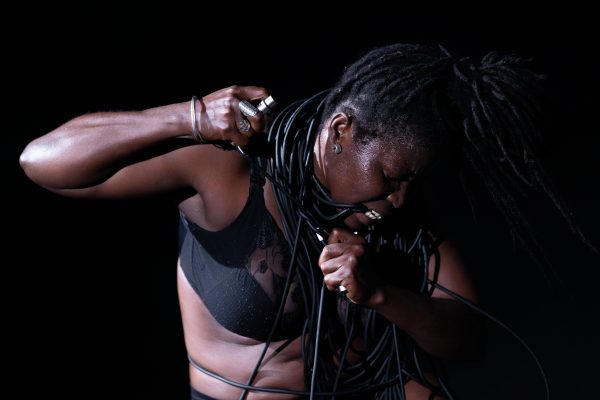

Breaking free — from a cord, a confined space, cultural norms — can be a lonely, painful endeavor. But it doesn’t have to be. In “Quartiers libres,” translated as “free rein,” choreographer and artist Nadia Beugré of Ivory Coast brings the audience along with her on a trek to potential freedom that is by turns agonizing and joyful.
Beugré’s piece, staged previously in New York in 2012, was reimagined for L’Alliance New York’s Crossing the Line Festival as “Quartiers libres revisited,” the title’s modification referring mainly to the addition of two Ivorian dancers, Kevin Sery and Beyoncé (who, like the pop star, uses a mononym). To begin the performance at New York Live Arts, the new duo loosened up the audience by toying with the unstated rules of theater etiquette.
The two dancers bounded into the lobby, where audience members, unsure why the theater doors hadn’t yet opened, formed a circle to watch them bop, sashay, twist and flip around, periodically persuading individual spectators to join them.
Partially unleashed, the audience filed into the theater, where most of the tiered seats except for the first rows were roped off. Ushers invited people to sit on or stand next to a rectangular raised stage on the floor below. Not being relegated to “Row C, Seat 22” felt refreshingly liberating, if slightly chaotic.
The freewheeling atmosphere continued when Beugré sauntered in to a recording of Nina Simone singing “It’s a new day / It’s a new life for me / And I’m feeling good.” It indeed felt good to watch Beugré strut up the stage steps wearing a glamorous short gold dress and pointy black heels — until I noticed the long black microphone cord coiled around her neck.
At first, Beugré had a little fun with this ponderous neckwear, twirling the microphone and bantering with audience members.
Then, the music and Beugré’s movements grew heavier, and she started to make choking sounds. She kicked off her cumbersome heels. Freed! But when she tried to remove her dress, the snaking cord made the process tortuous. Confined! In a black bra and underwear, Beugré moaned as she crawled on the floor, holding the cord out, seeking help. Three women from the audience, who appeared to be volunteers, untangled the cord in a painstaking way that was both intimate and uncomfortable to watch. Finally, free? Not yet.
Beugré wielded her arms and legs with more grace and athleticism than she had when the cord constrained them but encountered another barrier: the wall behind the stage. Her back against it, she danced deliriously, twisting her head from side to side, her body still stuck.
Any journey to freedom is frustrating, messy and never complete, and while the act of creation can be liberating, the creator might be battered in the process. Beugré, both on and off the stage, seems to thrive on such contradictions. “I try to create places based on confusion,” she told New York Live Arts artistic director Bill T. Jones in a video conversation (with translation from French). “[C]onfusion stimulates me.”
Born in Ivory Coast and now living in France, Beugré has been searching for liberation from classical dance norms throughout her career. “Ever since I was young, I’ve felt that I didn’t just want to be confined,” Beugré told Jones. “I began to question the body, to really question space and my surroundings inside my little shell.” If Beugré engaged that exploration in her solo choreography with the cord and at the wall, she expanded the query when she turned the spotlight to Sery, who, like Beugré, was stripped down to his underwear. Although dancers are not necessarily shy about showing their bodies, watching them in their ordinary cotton underwear felt voyeuristic. To expose one’s body confidently is yet another form of freedom. But being exposed in clothing that makes one vulnerable as well as sensual lays bare the human body’s fragile power.
Sery began to dance and interact with the production’s most prominent prop: a curtain of clear plastic bottles strung together vertically, and hanging in the upstage-left corner.
Plastic bottles transformed into an artistic textile express a not-so-subtle condemnation of environmental degradation. Waterways around the world are clogged with plastic containers as well as the microplastics that leach from our clothes and other objects into our water supply. Ivory Coast residents rely on bottled water because natural sources are unsafe or depleted.
Bottles are a form of containment as well. Consider the phrase “bottled up,” or trapped genies, or miniature ships crafted inside glass containers, doomed never to sail. Dancer Sery clashed with the bottled curtain. At times the strands of plastic seemed to control him, trapping and tangling him, or sending him crashing to the ground. Alternately, he grabbed the strings and flung them away. It’s not clear who won this battle of the bottles.
Sery and Beugré, now joined by Beyoncé, each began to wield yet another trash-y prop: a black plastic garbage bag. The sound of an ordinary trash bag hurled overhead like a flag, flung forward like a rag, or wrapped around the body like a skirt is surprisingly loud and unsettling. Thwack. Even more disconcerting, the dancers slowly stuffed the trash bags into their mouths.
One more impediment to personal, artistic and environmental freedom remained: three spiky round sculptures fashioned from yet more plastic bottles. They looked like giant Koosh balls, but turned out to be absurd, choking costumes that each dancer pulled over their head. The dancers kneeled, crawled and kicked until they began to yank off the plastic bottles. Beugré’s upper body emerged, and she walked like a wobbly ballerina in a tutu of plastic.
Partially freed, they all crashed forward or backward to the sound of thundering cracks as plastic bottles hit the concrete. Then the dancers ripped off what was left of their bulky costumes.
They were finally free to take a bow, but the coiled mike lay conspicuously on the floor, and plastic bottles and their lids littered the platform stage. A spotlight remained on the curtain. Even the most fierce fighters can’t permanently fling off stubbornly indestructible restraints.
Along with a few other spectators, I walked onstage post-performance for a closer look at the curtain of bottles, now slightly dented after Sery’s struggle with them. One bottle still had a tiny price-tag sticker: “cash $3.99, credit $4.15.” I’d forgotten one more meaning of “free”: without cost. Parodoxically, though, freedom, as “Quartiers libres” viscerally illustrates, is expensive.

Leave a Reply