
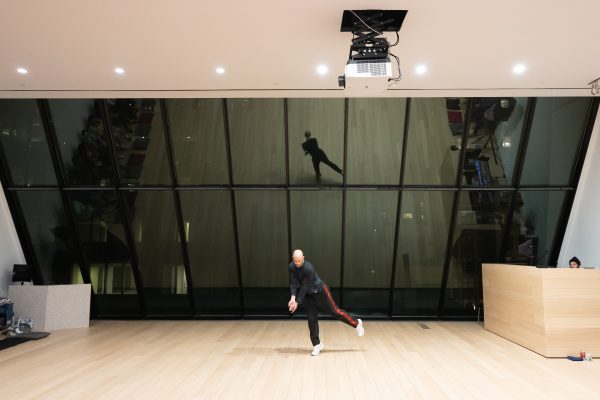

Dressed in a dark gray long-sleeve T-shirt, black sweatpants, and silver sneakers, choreographer Adam Linder strode alongside a slanted glass wall lining the Skyroom of L’ Alliance New York last weekend. This was the stage for the Crossing the Line festival’s presentation of “Mothering the Tongue,” a solo-lecture performance in which Linder explored his spontaneous creative impulses through free dance, seeking out movements driven by pure imagination.
Coming to a halt, he dropped down and positioned the top of his shaved head firmly on the wooden floor, planting his hands on either side. To the audience — seated on chairs and cushions around the space’s periphery — this inward-looking pose evoked a ritual for Linder to get “in character” before the performance.
Without warning, he began writhing on the plane beneath him, exploring its tactility. He then sprang upright and contorted his body into off-kilter shapes, until he was on the precipice of falling over. His limbs quivered as they were strained beyond their load-bearing limits. Once he was satisfied with his warm-up, Linder pulled his smartphone from his pocket and read out an introductory monologue.
In the monologue, he contemplated whether assuming a mental state of total immersion in the present would allow him to instinctively meld the diverse vocabularies of dance burned into his muscle memory. To him, entering such a state would force his body and mind to act seamlessly in sync at the speed of thought, liberated from what he viewed as “the self-criticality that can turn an impulse into an actual choreographic idea.”
Linder then connected his phone to the venue’s sound system and triggered a musical cue: a piano concerto. He seemed transfixed by something as he effortlessly launched into a series of graceful, swiveling movements. When he sought a new challenge, he pulled out his phone again, and switched things up with an eerie ambient track. His breathing grew heavy as the scale of his choreography expanded and he moved across the Skyroom’s entire floor.
Structurally, “Mothering the Tongue” comprised several segments of freestyle dance, either set to music or executed in silence. Linder has described it as a snapshot of his choreographic process, where he is essentially “writing in real time.” Throughout the 45-minute performance, Linder read out various texts that functioned as prompts for his choreography, as well as interludes to convey the themes of each segment, spanning topics ranging from mental states to stylistic constraints, digital malaise, neurophysiology, and the role of hands in dance. He shifts the order of the texts and musical cues with his phone in every presentation of the piece, refining it through iteration.
Linder’s past work has often employed elaborate scenography, costumes, and visual art to examine how the body and mind are transformed while performing. The scene at the Skyroom, however, was stripped down and intimate. The mood resembled that of a practice session: Linder casually paced around as he changed tracks on a seeming whim, he delivered monologues while stretched out on the floor, and at one point, he pretended to smoke an invisible cigarette between segments. Were these gestures part of his process? Or reactions to his quasi-informal environment? Freed from the need to find or infuse meaning into his movements, he had given himself carte blanche.
In contrast, his choreography was anything but vacuous. His improvisations to Sinéad Connor’s “Drink Before the War,” and an a cappella rendition of Roland Clark’s “I Get Deep,” combined gliding footwork with soaring leaps and elegant pirouettes, demonstrating his fluency in multiple dance traditions. Following one of his monologues, he fixated on the concluding phrase, “after you leave,” uttering it repeatedly in various permutations as he danced to the staccato rhythm of his own voice with glitchy, popping movements.
Linder also created his own makeshift props: he embraced the metal framing of the room’s glass wall, and later used his smartphone to riff on the gesture of taking a selfie. He even incorporated the act of dropping his phone into his choreography. Was this by design or accidental? No one but Linder knew. Occasionally, he toyed with the audience through seemingly absurd actions: taking off his shoe and sniffing it mid-dance, or getting on all fours to imitate a caged beast guarding his territory. In all this, I sensed that he wanted to capture the irreverence of acting on pure instinct, having surrendered his body to his most impulsive thoughts.
As he stood panting after his final improvisation — his body glistening with sweat — it appeared that he had found what he was seeking. But his search was not truly over. Every iteration of this performance is an incremental step towards Linder’s vision of free dance: a blended language of movement that honors, subverts, and transcends his influences. Through recursion, the same body and mind, guided by the same lived experiences, encounters, and shares, new truths.

Leave a Reply