
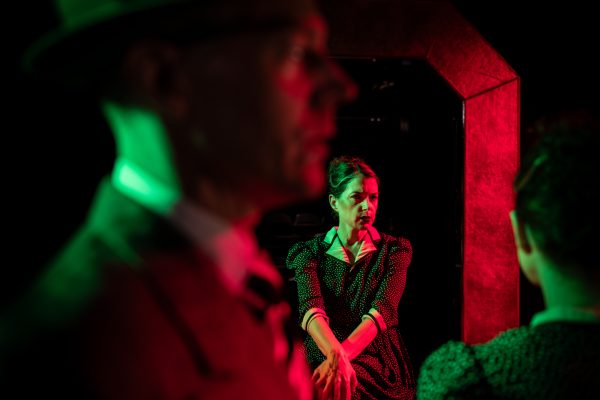

In the Fall of 2023, between rehearsals for their upcoming production of Richard Foreman’s new play “Suppose Beautiful Madeline Harvey”, Object Collection co-directors Kara Feely and Travis Just sat down with Foreman in his home to talk about the artistic process, influences, life and legacy. Foreman retired from the theater in 2013, but this year has seen a renewed interest in his work—first with the Wooster Group’s revival of “Symphony of Rats”, followed by a series of panels hosted by the Bobst Library at NYU, and finally Object Collection’s production of his first new play in ten years “Suppose Beautiful Madeline Harvey” which premieres at La MaMa this December.
Object Collection got their start as a burgeoning theater company in Foreman’s own Ontological-Hysteric Theater in the St. Mark’s Church in-the-Bowery back in 2004, and has since produced over 15 original works, created by Feely (writer/director) and Just (composer). Now in their 20th year, they revisit Foreman’s work and essential aesthetic voice, in a sense getting back to their roots while simultaneously pushing relentlessly forward. This interview marks the halfway point of development for this new production.

Travis: This year, along with “Suppose Beautiful Madeline Harvey”, our production, there’s also the revival of “Symphony of Rats” [by The Wooster Group].
Richard: Yes, I think it is really exciting for two Foreman productions in New York at the same time.
Travis: There is obviously a big gap between them. “Madeline” is a new text and “Symphony of Rats” is from 1988. And we were interested about the space between those and if you feel any difference between the two, if there were different approaches in terms of writing or the style. There is quite a sizeable gap, the entire St. Mark’s Ontological period is in between.
Richard: Well “Madeline” was not written as a play, which is no reason not to do it as a play. I think texts that are not plays are better staged now than texts that are plays. I remember that there was a whole period there where I was just pouring out language and this was part of it. I’m trying to think if “Madeline Harvey”…where did that name come from…I don’t know.
Travis: Roger Vincent comes from [French author] Patrick Modiano.
Richard: Madeline Harvey may be from the same place.
Kara: I’m very interested in your process of writing because it feels like Madeline is constantly cycling back on itself. I wondered if that was something that just sort of came out as you were writing it or was it consciously done?
Richard: No, it just came out as I was writing it. I wasn’t consciously trying to do anything.
Kara: One of the interesting challenges with the text you gave us is that though it is continual narrative, sometimes it is a first-person narrative and sometimes it is a second person narrative talking about Madeline Harvey and Roger Vincent. What we have done is tried to change up who is doing the narrative. Sometimes it is in first person, sometimes second person. And the story is getting passed around to different people.
Richard: Right.
Travis: When we reached out you gave us a stack of things. What was it about this one? Kara was really drawn to this text in particular.
Kara: I thought it was so perfectly constructed. It seemed to be very self-contained.
Richard: That’s because of the character of Madeline Harvey who just organized things automatically.
Kara: In a lot of ways, the experience of just reading it…because you continually return to the moment when they see each other. She’s stepping off the bus and Roger Vincent is in a cafe. And they have this moment, for whatever reason, that seeing each other makes them verify some moment from their past. And that makes them question whether they exist or not. It all becomes a little bit of a dance of trying to determine whether somebody’s life and past has really happened if nobody witnessed it.
Richard: That word dance…any good dialogue should be a dance.
Kara: I felt like that moment keeps coming back and it keeps being talked about and resurfacing, kind of like a coil. But it’s never the same, the repetition is never the same. It’s always a different repetition. It was a lot like the experience that I would have sitting in your performances. Of being always in that perpetual present, always being snapped back into a present moment. And this did that in the writing, it did it to me through language, which I thought was really exciting. And it seemed like a good piece for us to work on because it felt so different. I mean, it feels like your work, but it doesn’t read like your plays.
Richard: No, because I’m so turned off of almost any plays I can think of.
Travis: Well certainly, that’s what we’re trying to rectify here.
Kara: That’s our experience.
Travis: That’s the project of our adult, quasi-professional lives certainly. I share an intense dissatisfaction with my discipline: music and most composition. There are a few exceptions, but that’s a driving force for me. I mean, the easiest thing would be to just give up and just stop doing it and do something else. But for whatever reason I don’t, Kara doesn’t, and you didn’t and haven’t.
Richard: I didn’t because I knew I was going to stage my own plays.
Travis: So that’s the thing: having that space within a field that you’re not terribly interested in.
Richard: Yeah, I was sure that if I didn’t stage my plays nobody else would.
Travis: But why would you even want to engage in a discipline that you weren’t interested in in the first place? There’s something about it obviously.
Richard: Because as a kid I started doing plays. It was a carryover, it was what I knew from being 15 years old.
Travis: It was just like a bad habit you couldn’t give up?
Richard: Well it was something I did. I didn’t analyze it in that sense. I just did it. And I knew that nobody else was doing it the way I did it and that made it interesting. You know, I live in the expectation that maybe 15 years from now… I mean, you’re doing plays of mine which I think is great. Will that inspire somebody else to try? I don’t know. I’ve always lived thinking it’s sort of like Gertrude Stein. Maybe after I’m dead, thirty years later people will do my plays.
Travis: That’s interesting the idea of legacy. Do you think about that with this body of texts that you’ve left behind? When I asked you if you had anything that we can do, you gave me something like a dozen substantial texts. Most of them very recent. Obviously something is driving you to continue to make those things.
Richard: I never thought about it much. I think texts are what survive anyway.
Travis: That’s true. That’s a difficult thing and it’s also a lovely thing about the theatrical medium: like that old Eric Dolphy quote: once you do it it’s in the air and it’s gone. It’s a strange thing to build up a body of work. We’re at a position now where we have one, and that’s an odd feeling: to have a history.
Richard: Oh? Why odd?
Travis: Because you go through a period when you’re starting where there’s just a road in front of you, you haven’t done anything, or you’ve done very little and you’re trying to figure out just how to function.
Richard: Right.
Travis: At least that’s what I remember about our thing with Object Collection. This will be the twentieth year since our first show which was at the Ontological at St. Mark’s Church. At first, you’re just making up your own environment. But then at a certain point you have made these environments and I think it becomes a question of what do you do with that now? Do you try to ignore that, or do you push against the things that you’ve done? Do you work within them? It becomes a question. You have to acknowledge it or disavow the things that you’ve done.
Richard: In my situation I don’t know if it was the same or different. I grew up as a teenager being an actor in plays. You know, in junior high school and in high school. I acted all kinds of roles from Shakespeare to whatever. So when I started doing my own plays…I don’t remember. I don’t remember anything. It’s better that way.
Travis: Yeah perhaps. It certainly makes it easier to continue to do work. In a sense a legacy is just an accumulation. I find that I don’t want to think too much about it because I find it constricting.
Richard: I certainly am not capable of thinking much about it. I just started doing things.
Travis: And just keep on doing things.
Richard: Yeah. I started going to the theater regularly on Saturday afternoons with my friend John, oh when I was maybe 15, 13. And even then, I used to dislike what I saw. All the big successful things I thought, my god is that what they want? That’s so terrible, that’s so boring. And then there’s no chance for me because I certainly don’t want to do things like that.
Travis: And then finding a space with Jonas [Mekas].
Richard: Yes, yes, Jonas gave me a space to do my things, right. And, of course, the inspiration to a large extent was the so-called underground filmmakers who were making films with their little home movie cameras that in terms of movies in those days were very far out.
Travis: But then at a point it becomes a machine because you start to make these things year after year after year.
Richard: Yeah, what’s interesting is that a big inspiration – a big, great artist was Jack Smith. Now, Jack was a very…strange human being who had a very difficult time. I was different, I was from a middle-class family, I had been very successful in school. You know, I was a good student. And so, I did not start making my strange art out of a strange orientation of my personality or the life I was living, because I was very successful as a kid. So why I started doing other things…I don’t know. I was always interested in the Surrealists or whatever I could find that didn’t fit the major canon, but still I was a very conventional kid. Maybe that was my strength, I mean, I was very conventional. And I still am. [laughs]
Travis: Well these characters, well for lack of a better term…I don’t know if you think of them as characters or if they are just people talking. Maybe those are two different things, I don’t know. But the text and the people onstage, they’re obsessively rehashing themselves and the people around them and their environment. In a sense they’re, I hesitate to say they’re analyzing, but they’re definitely obsessing about the words they’re saying and where they are. And this is pretty thematic, I think, throughout your work.
Richard: But that’s what came easy.
Travis: It’s funny because you don’t want to obsess about it, you don’t want to analyze it. You let the characters do it, but you don’t want to talk about it. [laughs]
Richard: Yeah because they weren’t afraid of being stupid and I’m afraid of being stupid.
Kara: Me too.
Travis: We kept saying when we were getting ready to come here the last couple of days, that we have to really try to be smart.
Richard: When you started making music, did you start being a so-called avant-garde musician?
Travis: No, I was a conventional jazz saxophonist.
Richard: Yeah well there you are.
Travis: But I drifted away from that pretty rapidly, and the speed of the drift increased.
Richard: But even a jazz saxophonist was a little bit far out.
Travis: Yeah it was, from where I came from it was weird. And then I went from more conventional stuff to Ornette Coleman and John Coltrane and Sun Ra right when I was a teenager, that felt like the natural thing.
Richard: I remember when I first heard Ornette Coleman…what on earth is this wow [laughs].
Travis: You know, when we were kids, you sought out the underground. You wanted to be a part of it. That was the desire, you wanted to find underground things. That’s what you were sort of culturally taught from watching older artists. Like, rock bands were telling you to find the underground. And once you got into the arts, the most exciting stuff was always on the fringe and pushing forward.
Richard: And the person who led me to that was Jonas.
Travis: So, you were doing conventional stuff until starting to hang out at the Cinemateque.
Richard: Well, not that conventional. Long before I knew Jonas I thought the Surrealists were interesting. And in terms of growing up in Scarsdale in the 1950s, the Surrealists were – phew! I remember my art teacher when I made a surrealist picture at one point, he said: oh, that’s interesting Richard. But you know, just be careful because the people that you’re copying, they were not very healthy, they had a lot of problems. [laughs]
Kara: I was in plays and musicals.
Richard: Yeah? Normal musicals?
Kara: Yeah, normal.
Richard: But when did you discover there was something else?
Kara: I think I sort of knew what was happening maybe in high school, but mostly in college.
Travis: When I started working for you in 2007, I had only been involved with music. I had no idea who you were.
Richard: Right.
Travis: I had worked for La Monte Young.
Richard: Oh well, that’s it!
Travis: I know, I had already met people like Christian Wolff and I was already invested in the music side of the avant-garde. When we started doing shows [at the Ontological], Kara of course, and all the other actors were very intimidated, but I was just like, yeah, he’s just another guy in New York.
Richard: Right.
Travis: Which is not a bad thing in a way. La Monte and I, we sort of bonded just because I was a saxophonist. We would just talk about saxophone when I was working for him.
Richard: I knew him through Jonas because he performed his Dream Theater with [John] Cale and Marion Zazeela at the Cinematheque. It was funny, my father was a sort of conventional Democrat, a fairly liberal Democratic lawyer in New York and I thought it would be difficult. But he loved Jonas. He thought Jonas was very adventurous and interesting. The filmmaker that I first saw that really was my introduction to all that stuff, believe it or not was Ron Rice.
Travis: Are you working on any films now?
Richard: No, that’s long past. I have no interest in that.
Travis: No interest?
Richard: No interest no.
Travis: You were so interested, for a long while.
Richard: No more.
Travis: Did something happen?
Richard: Maybe it was too hard. [laughs]
Travis: There’s a challenge doing your work too because the design and the directorial style and the lighting, it’s all so bound up in all those productions. There is the text, of course. But it’s not only the text.
Richard: Oh?
Travis: Everything else becomes text I think. And that’s such an identifiable part of it. Which, obviously, we’re not engaging. All those things, we’re going to do the way that we do things.
Richard: Yeah, hopefully, yeah.
Kara: Which, of course, is greatly influenced by your work.
Travis: But it’s a massive recontextualization of this language. The visual language is a whole other thing that won’t be present.
Kara: Your productions were always so incredibly dense, and I wondered in terms of the text, was there that feeling of density when you were writing the text itself? Or was it sort of like, this is one layer and then I know I’m going to add all these other layers to it.
Richard: No, because the text jumped around and had gaps. I thought of the text as being dense. Not in the same way I suppose as the physical production ended up being dense. But the physical productions were an attempt to not lose, actually, the density of the text.
Kara: Mmhm, to bring it out.
Richard: Well I didn’t think I had to bring it out, I felt it was there. But I felt that you could do a production that would domesticate it. Where there weren’t connectives, that you could provide connectives in terms of the staging. In other words, if the text said: “I hate you. Have an ice cream.” Well, I could stage it in such a way that the transition was: [said sharply] “I hate you! [regretfully] Ehhh have an ice cream.” As opposed to: [said flatly] “I hate you. Have an ice cream.”
Travis: So, in a sense creating little mini-narratives as you go to sort of smooth the breaks?
Richard: I didn’t want to smooth the breaks.
Travis: No, you wanted to emphasize them.
Richard: Yeah yeah yeah. Because good god, we have enough of smoothed breaks. Mundane, terrible smoothed breaks. I guess that was why I liked Kathy [Acker], because she had gaps.
Travis: When you say gaps what are you referring to?
Richard: I don’t know, her writing just didn’t flow. In other words, people always used to say that William Burroughs was the great teacher of narrative of that period. I always found Kathy more interesting because I found Burroughs had sort of smoothed things out even though he was doing strange things in a way. And Kathy didn’t. Kathy wrote in a clunky style. Kathy didn’t try to be a ‘good writer’ in the sense that I think Burroughs was a ‘good writer’.
Travis: Would you have considered yourself a ‘good director’? Or were you willing to be a clunky director? Is one of those things more desirable than the other? I think that’s a big problem in music too, that people ultimately want to sound like they know what they’re doing.
Richard: [laughs]
Travis: But I was asking in terms of directing or making a thing. The willingness to have it be presented as being awkward.
Richard: I don’t think I was, in a sense what I was interested in doing was presenting it as being awkward but doing that with such strength that they had to admit that, “well, I don’t get it but yeah, I can’t deny it.” I didn’t want to just be seen as a bad director [laughs] there are enough of those around.
Kara: So: awkward but purposeful.
Richard: I really wanted to seem like a strong director. Stronger than any directors that were out there. But, my idea of a strong director I’m sure was different from what most people wanted to see.
Kara: But as you continued to work, you felt like text, the play texts, were too boring. And you weren’t able to do what you wanted to do with them.
Richard: Oh yeah but I didn’t direct many plays in general. I think the instructive thing for me wasn’t at the beginning. You know the big director in my youth was Elia Kazan. And I liked a lot of his stuff, and I remember I especially liked “Camino Real”, which I dragged my parents to see and they said “oh, what is this?” And Kazan in later years, I read an interview where he said, “I think I failed in Camino Real because it was such a poetic text and yet I didn’t bring a poetic sensibility to it. I brought a very down to earth, gritty, realistic sensibility.” And I thought that’s what made it so great. That colliding with the poetic text. I thought there was a lesson in that.
Travis: Your texts are very philosophical, they’re, for lack of a better word, there is an intellectuality to them.
Richard: Yeah, yeah.
Travis: You were very involved with Sylvère Lotringer [founder of the journal Semiotexte] and all those writers and filmmakers. And sometimes in our conversations over the years I would talk about things like structure, ideas out of philosophy: Badiou, Deleuze, all that nonsense. And you might give it a moment but then you would bat it away and say you weren’t interested.
Richard: Well I was interested in all that stuff, but like one might be interested in fiction. It was interesting and enjoyable to entertain their notions, but I certainly didn’t think about it when I was writing my plays.
Travis: It’s almost like going to the gym for your brain.
Richard: Well I never liked going to the gym. [laughs] For me it was romantic. It was a way of entering those things like one would enter a fairy tale.
Travis: A fairy tale of Badiou.
Richard: Yeah. Yeah.
Travis: You don’t think about those French guys anymore?
Richard: Anymore? No.
Kara: In the Madeline text, as they’re cycling around this single moment of trying to verify their existence, Roger Vincent kind of goes on his own tangent. And he starts to talk about: if he had a different way of expressing himself – not through language but another way, he might actually be able to say something that’s true. And I wondered about truth, how important that is. It’s something we’ve never really felt like we’ve dealt with in Object Collection.
Richard: I do think that language always lies. It’s hard with things spoken to state the truth. Now is there another way to get at the truth and what is the truth…well, the truth is sensation I suppose. Closer to music I suppose.
Travis: The question is, if truth is even a desirable end goal at all.
Richard: Sensation is, that’s why I say that truth is closer to sensation.
Travis: Sensation as a substitute for that.
Richard: Yeah.
Travis: But music in general I think tends to lie in the same way – and watch out, here comes some structural discussion [laughs] – because it usually is more concerned with its own construction. I mean, that’s what it expresses.
Richard: Yeah.
Travis: Whether it’s a melodic thing that you’re supposed to follow or whatever. And this is, to me, shockingly true in things being done now. I mean, this was problematized over 100 years ago, if not before. But it’s still the going concern. And you talk about shaving off the edges and smoothing things out, but the vast majority of music is doing precisely those two things: trying to create a narrative arc, trying to make a smooth thing and bring you along.
Richard: That’s why I always like loops.
Travis: Yeah, because it is just a thing in itself.
Richard: Loops to me are…actually [laughs], this can be the headline.
Travis: [laughs] Is this the pull quote?
Richard: Loops are mankind’s greatest invention. [laughs]
Travis: Well, there is something poetic about it. It is like a single line of text, taken outside. In a way it’s like a one-liner, a musical one-liner.
Richard: Yeah but it could be a text too. I mean, I’ve never done it because I realized I’d be the only one reading it, like a text: “I won’t do that. I won’t do that. I won’t do that. I won’t do that.” Well, people wouldn’t stay with it for very long. They should. If they would stay with it for page after page it might be interesting.
Travis: There are some of your plays, and even in a sense I think this one, where it is kind of an obsessive restating of a textual one-liner in a way. And then you might move on to a different one and later return to the first thing, but it is always kind of reconfiguring itself. Sort of like in those later Morton Feldman pieces where it’s just obsessively doing this little note-constellation that might shift a little bit, but it’s ultimately the same thing over and over.
Richard: [gradually quieter] Morton Feldman, Morton Feldman, Morton Feldman, Morton Feldman…
Travis: Yeah. Maybe that’ll be the next one, just repeating the name. [laughs]
Richard: [quiet] Morton Feldman, Morton Feldman, Morton Feldman, Morton Feldman, [loud] MORTY, [quiet] Morton Feldman, Morton Feldman, Morton Feldman [laughs].
Kara: Another thematic idea that keeps coming up in the Madeline text is the idea of “Elsewhere”. That actually ‘real life’ is happening in another place even though we think that it is happening here. And that somehow or other we are missing out on it or we’re not able to see it.
Richard: Well, real life is a term that stands in for something else. Like, “something else” is Elsewhere. I don’t know what. Not real life, I guess. Real life is nowhere to be found. But blahblahblah is Elsewhere. Blubber is Elsewhere. My uncle is Elsewhere. Something must be Elsewhere because I’m 84 now, I guess.
Travis: Coming back to the idea of language and the thinness of it or the weakness of it. It seems like Madeline is trying to either define or create reality using language. I wonder if there are maybe two different things there. Using language to mediate something or using language to generate something.
Richard: Well I think it does both, I think language is everything. Language is everything. It creates a false reality and we can’t escape it.
Travis: It really is all that we’ve got. But then through staging these things you bring in visual elements.
Richard: That’s right.
Travis: And the visual elements, obviously they’re not language, they’re not book-language, spoken language. But they have a function.
Richard: I guess they do suggest that language isn’t to be trusted, yeah. Even though it’s all we have. But it’s been so long since I’ve thought about any of that because I don’t make plays anymore. What year was my last play? I don’t know.
Travis: 2013.
Richard: 2013?
Travis: Ten years ago
Richard: Oh [laughs]. That’s all? I was making plays up until ten years ago?
Travis: Yeah.
Richard: Wow.
Travis: I guess the practicalities of it became unpleasant enough that you don’t miss it necessarily? Or do you miss it?
Richard: I certainly don’t miss it, but I don’t think impracticality was a question. It just got self-evident. I felt I was doing the same thing all the time.
Travis: Oh really? Caught in your legacy.
Richard: Yeah. Absolutely.
Travis: Well that’s interesting because I worked on the very last two shows at St. Mark’s. And there was the Zorn one [Astronome, 2009], but especially the one right before that, which was the last piece that was entirely yours: Deep Trance [Deep Trance Behavior in Potatoland, 2008]. That’s one of my favorite pieces, in fact it might be my favorite piece of all the things that I’ve seen of yours, and I have seen most of them. So, it’s funny that you would say that you felt that you were played out in a sense. Because that was not my experience as a viewer, and I was there for every day of rehearsal. I was involved.
Richard: What was it about?
Travis: Oh…Victor Mature, a lot about Victor Mature.
Richard: Oh wow.
Travis: Yeah.
Richard: Victor Mature?
Travis: Yeah, you were really into him…and vampires…
Kara: Spirit photography
Richard: [exhales] I don’t remember any of that. I have no recollection. But Victor Mature, I must have been interested in because he was in one of the great movies of all time: Shanghai Gesture.
Travis: I think you dedicated it – no, you dedicated the Zorn one to Edgar Ulmer.
Richard: That was just being flippant. [laughs] Demonstrating to people that I was far out or something. I have no interest in Edgar Ulmer [laughs].
Travis: [laughs] Is that right?
Richard: Very little. But a great deal of interest in von Sternberg [director of Shanghai Gesture].
Travis: I don’t know that it’s necessarily a problem to get lost within your own references. To say that you wanted to stop because you were making the same piece…there are always different iterations. There are always different combinations to be made.
Richard: Yeah. But I no longer felt challenged or woken up. But you know, you can always go back to the past. Like, recently, Kate [Manheim] and I watched Ivan the Terrible and Alexander Nevsky [both dir. By Sergei Eisenstein]. He was great! He was really good.
Travis: It’s an interesting thing because as the twentieth century went by, so much of it was zipping through these aesthetic moments. With Eisenstein, that period is only ten years between Nevsky and Ivan the Terrible. All of Fluxus happens within two or three years.
Richard: Yeah.
Travis: Zip. On to something else. Zip through large-scale free jazz in the early 70’s. Zip on to this, zip on to that. Zipping through early punk rock. And the things fly by so fast. There is an idea that goes around that the culture has slowed down considerably in the last twenty or thirty years.
Richard: Oh yeah.
Travis: I don’t know if I have an opinion on it. Because we’ve been trapped in that sensibility for our entire adult lives. So maybe we’re guilty of it, I don’t know. Or maybe we’re victims of it. But it’s definitely a different experience than when things are catapulting past, movements and so on. Thinking about legacy again, in a way maybe things don’t really matter once you’ve made them. You just make them, somebody sees it, and it’s like food. There is a Cage thing, John Cage talking about – I guess it would have been in the late 60’s in some interview, and he was saying that culture was much like food. That it had been proven at that point, by the late 60’s or whatever, that a different kind of food was needed. Not the idea that we need to have these monuments that we’re going to remember for all time but that you need to have a different food that goes in your system and out of your system and, somehow, nourishes or changes you.
Richard: Right.
Travis: But you know when we make these things, you know, we put a lot of work into them. But then I guess you just have to put them down and walk away. Get on to the next one.
Richard: How long will Cage be remembered? I don’t know.
Kara: Well, we’re very happy to be working on your piece.
Richard: The worst that can happen is that I come and see it and I say, “I’m sorry but I’m banning this production from going on. [laughs] I’m closing this production.”
Travis: That’s fine, we’ll just cut all the text and do a silent pantomime [laughs]. Same production.

Leave a Reply