

Windows down. Music blasting. The wind in your hair. Exit signs, strange billboards, a succession of identical-looking sleepy little Midwestern towns. A clutch of empty 40s and tequila bottles clinking against one another in the passenger seat. The stench of old vomit. A pounding headache. The sinking feeling that your life is not working out the way you planned. Does any of this sound familiar? Almost like you’ve already been down this road and back a few times?
A palindrome is a word, phrase, or sentence that reads the same backward as it does forward. A generational cycle of addiction is a sentence that’s already been written, and read—a sad cliché, the inexorable progress of words across a page, destroying a person (or a whole family) in the process. In Kallan Dana’s RACECAR RACECAR RACECAR, a surreal and high-octane one-act that premiered at the Hearth with A.R.T/New York Theatres, an innocent father-daughter road trip devolves into a recursive journey through substance abuse and the host of unpleasant side effects that come with it.
RACECAR begins with a heartwarming premise: an adult daughter choosing to accompany her father from New York all the way to California and back at Christmastime, so the two of them can reminisce as they go through his old storage unit. From the outset, I’d assumed these two are particularly close, as I don’t know that I could spend forty-some hours in a car with one of my parents without resorting to Mad Max-style warfare. (Love you, Mom and Dad!). And indeed, for the first hundred miles or so, Father and Daughter are like two peas in a pickup truck, swapping palindromes and memories of the good ol’ days while bickering gently over the steering wheel.

Daughter is portrayed beautifully by Julia Greer, who is not only the lead actor, but the producing artistic director of the Hearth. It’s clear that Greer is firing on all cylinders with this production: it’s her rhythm and chemistry with Bruce McKenzie, who plays the role of Father, that keeps the play speeding down the highway even as it seems prepared at any given moment to veer off into a ditch.
The first big hint that things may not be as hunky-dory as they seem comes in the form of a scoliosis-ridden elderly woman in Ohio, with whom Greer’s character attempts to make peace following a minor car accident. “I already have your information,” cackles the woman, played by an incredibly creepy and compelling Camilia Canó-Flaviá, before rattling off the Daughter’s stats and scuttling off into the night. At another gas station, Father and Daughter almost get into a fight with a man who recognizes the Daughter from another life—one in which she acts like a completely different person.

Mid-journey, Father and Daughter pick up two hitchhikers, a strident man and an eerily silent little girl whose unsettling dynamic mirrors that of our two main characters. As they crisscross Nebraska, Wyoming, and enter the Silver State, our Daughter grows increasingly concerned about the wellbeing of her young passenger (other Daughter)—a concern that gets her and the girl nowhere, as her attempts to communicate are rebuffed and criticized by both men.
Things sour further in Utah when a pit-stop at Wendy’s turns sinister and vaguely Freudian. The drive-through attendant, appropriately named Wendy, has trouble understanding Daughter, who miraculously starts vomiting and slurring her words. Wendy wrongly assumes both that Daughter is pregnant and that Father is her husband, or at least the father of the child. It’s not the first time on this trip that someone has made the mistake of assuming that Father and Daughter are a couple– perhaps because, as Father proudly tells Wendy, they don’t act like Father and Daughter– nor will it be the last! They are, in fact, more like friends who get drunk together. Unperturbed, Wendy commiserates with Father’s desire to treat his child like a vessel for his id: “I’m looking for someone to get me pregnant so that I can regurgitate my soul into my child and live forever,” she chirps cheerily, before wishing Father and Daughter a merry Christmas and, presumably, handing them their ironic Wendy’s meals.
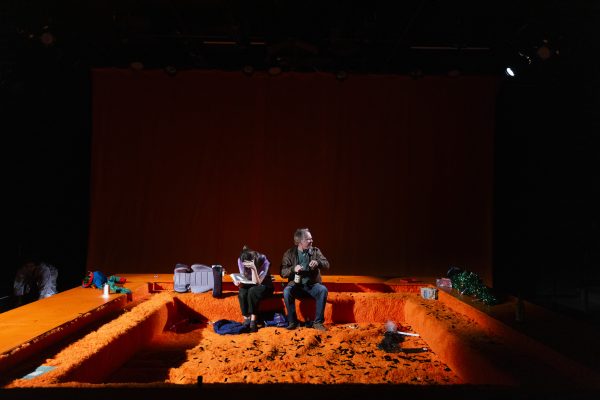
In an exciting departure from realism, Brittany Vasta’s set for the play is a lurid orange 70’s-style-conversation-pit-meets-cat-bed, ringed by a narrow ledge that represents the interior of the car. I’m sure I wasn’t the only person to pick up on a David Lynch-esque ambiance. Sarah Blush’s directing, Cha See and Bev Fremin’s lighting, and John Gasper’s unsettling sound design all work to bring the uncanny elements of Dana’s script to the fore. Most of the action of the first part of the play takes place on a walkway, with the characters dancing determinedly around the edges of the fuzzy orange abyss. When Daughter grabs the steering wheel whenever she begins to poke at forbidden topics, she brings the road trip to a crashing halt as she attempts to untangle how Father and she got to this point.
After a hallucinatory post-car-accident Christmas party sequence, past and present blend. The sinister shapeshifters who have dogged the Daughter along her journey, in her life outside of her time spent in this car, return as her ex-boyfriend and estranged sisters. They taunt her about her inability to pump the brakes on the dependency– of Father– that is destroying her life. After this illuminating interlude, the recursive logic of the road trip fully reveals itself. We spend the remainder of the play traveling through the booze-soaked backroads of road trips past of Daughter at various ages, as an eager study, proudly picking up the finer points of drunk driving from beloved Dad. This time around, Daughter seems to have had enough of the cycle. In the end, we return to New York and to present day. Daughter makes a serious attempt to confront Father, but he refuses to acknowledge even what she’s saying.
In RACECAR, language is as slippery as a December interstate. Words meant to explain, describe, and soothe often veer away from an intended mark, ricocheting off one another and exploding in a symphony of misunderstanding occasionally offering a sliver of insight. “You cartographize,” the Father character accuses his Daughter at one point during the road trip, referencing something a family therapist supposedly told them once upon a time. “I catastrophize!” Daughter corrects him, irritated, but in doing she, she, and he, have hit on something far closer to the truth of this trip—a chance for both Father and Daughter to reflect, as they criss-cross the country, on the well-worn grooves of dysfunction carved into the map they share. It’s just that, in the end, it is only the Daughter who proves herself capable of doing so.
Leave a Reply