

Heading towards Danspace Project at St. Mark’s Church in-the-Bowery, I take a slight circular detour to avoid a group of pigeons gathered on the sidewalk. Tossing a plastic water bottle into a trash can near the theater, I think of the bottle’s residual microplastics, the tiny debris that remains within environmental bodies and animal organs. Both of these everyday occurrences situated the human body (mine) between animal and object, between organic and synthetic forms. The grouped pigeons choreograph my walk, exerting influence on human actions. The water bottle leaves its traces in my biological systems, tempering boundaries of flesh and plastic.
Similar fluidities between human, animal, and object were on display in Jade Manns + Glenn Potter-Takata: A Shared Evening, the performance which brought me to Danspace Project. The double-bill, which ran from December 12-14, 2024, featured Manns’ Kingdom and Potter-Takata’s Immaterial Supreme. Both choreographers had showcased earlier iterations of these two dances, respectively, as participants in DraftWork, an ongoing work-in-progress performance series hosted at Danspace Project and curated by choreographer Ishmael Houston Jones. Although representing very different aesthetic styles, Kingdom and Immaterial Supreme cohered around a comparable thematic prodding of human singularity — that is, the human being as autonomous and as uniquely possessing a deep interior world, assumedly in contrast to that of the animal and object. Through movement, sound, and physical objects, both dances complicated efforts to represent interiority altogether, instead embracing flatness and nothingness as crucial performance possibilities for humans and non-humans alike.
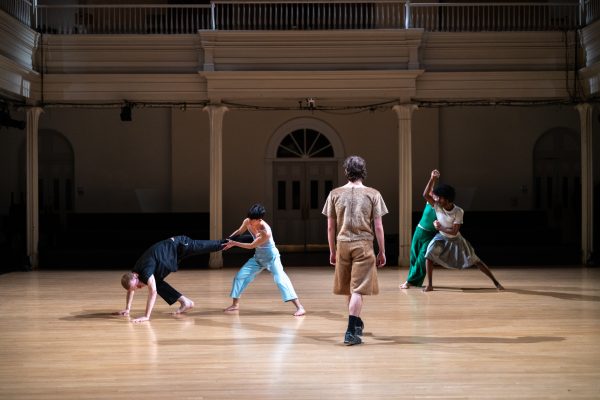
We began the evening with Manns’ Kingdom, a dance for five performers dressed in monochromatic costumes, which were designed by Kate Williams: Kalliope Piersol (in green), Owen Prum (in black), Isa Spector (in brown), Noa Rui-Piin Weiss (blue), and Zo Williams (silver). Often organized into a single-file line running along the stage’s vertical axis, four of the dancers (Piersol, Prum, Weiss, and Williams) oscillated between held postures and continuous movement phrases. Moments of stillness emphasized sculptural, measured arrangements of the body, with limbs, fingers, chins, and ankles demonstrating a precision of line and angle. The more extended movement sequences contrasted play with polished spectacle: for example, a dancer’s crawling on all fours could give way to a balletic promenade on two legs, demonstrating the multitude of techniques that a single body can inhabit.
Manns is a co-founder of PAGEANT, an artist-run performance space in Brooklyn, where similar interests in spectacle (or “presentation,” as another co-founder has stated) have been central to its programming. The specific spectacular in Kingdom typically involved the dancer’s portrayal of an animalistic body that crawls, flickers its gaze like a watchful bird, and extends lower legs into a horse-like gait. Further intensifying this animal world, Derek Baron’s musical composition merged barking dogs, singing whales, the rustling of bird wings, and the syllabic coos of human babies. In this back-and-forth of sonic reference and bodily gesture, Kingdom reminded viewers that primal and more intricate stylings of the body are comparably meaningful, each offering their own logic and purpose.
The four dancers seemed tethered to a central point of connection: they burst forth from their linear arrangement into solos and duets before returning to the single-file standard. This spatial composition — which appeared as perpendicular to my seat in the audience — accentuated each dancer’s procession to-and-from the line and heightened moments of rupture. In one instance, Prum and Piersol broke formation to jog the stage perimeter, seemingly inciting Williams into a stag leap and run of their own. Manns’ privileging of the line also emphasized the lateral plane, prompting an alternative viewpoint for the audience to engage with the dancing group: I typically perceived the dancers in profile, which made their bodies appear two-dimensional in my gaze. This angle complemented the lateral postures frequent throughout Manns’ choreography, with dancers holding flat-back hinges or lying prone across the floor. Rejecting the strictly bipedal, the performers complicated what dance scholars have theorized as “the hegemony of the vertical,” the notion that upright angles (such as normative human posture) are superior to the horizontal (the animal, the terrestrial, the prone).
And yet, Kingdom does not entirely undo such axial hegemonies, as a fifth performer (Isa Spector) walked upright, ran, and watched over the group throughout the dance’s duration. Sauntering along the fringes of the stage, or across the upper level of St. Mark’s Church, Spector appeared as an observer, looking at the group’s activities without directly joining them. With Spector holding vertical, distant, and elevated, questions emerged about the group’s relation to each other: who might govern such a “kingdom”? Where is authority located and how is it sustained? Kingdom eschewed explicit answers to these questions, instead maintaining mobile relations between the performers as they varied group synchrony and bold solo endeavors until the dance’s conclusion.
A brief break preceded Potter-Takata’s Immaterial Supreme, which involved significant technical set-up. Potter-Takata dragged a floor-covering white tarp onto the stage and connected three small microphones to its center. Chris Ryan Williams, a musician and one of Potter-Takata’s collaborators, arranged a desk adorned with sound equipment in the upstage left corner. Its counterpart on the stage’s right side was a small tree, its bare branches resonating as both threatening and vulnerable. Immaterial Supreme began with Potter-Takata submerging his body beneath the tarp as if entombed between the white sheets, twisting his torso and curling his legs inward. The tarp soon offered its response: it wrinkled with each of Potter-Takata’s actions and, through the microphones attached to the surface, vocalized a repetitive crackling sound. In this moment, the dance staged a duet between Potter-Takata and the sprawl of plastic, affirming a shared activity and agency between human body and inanimate object.
The object’s rhythm therefore complemented both the momentum of Potter-Takata and the musical accompaniment of Williams, whose presence and trumpet-playing brought the duet to a trio. Standing upright and throwing the tarp to the floor in a thunderous clap, Potter-Takata rapidly rotated his feet to Williams’ trumpeting. There was a dissonance between body and brass, an agitated movement style colliding with sustained musical notes. Within these interactions, Immaterial Supreme clearly challenged discrete boundaries between body and object yet also complicated the relationship of these two forms: did the dance envision the organic and synthetic as exclusively in harmony? Or might the dance’s human (who, at times, appeared to fight against the plastic tarp and melancholy trumpeting) exist in friction with their object collaborators?
The potential for discord continued, as dancer Kimiko Tanabe joined Potter-Takata onstage to explore movement that appeared simultaneously uncomfortable (tense shoulders, grimacing faces) and introspective (lowered gazes, micro-level adjustments of body parts). Potter-Takata is trained in butoh and the movement throughout Immaterial Supreme demonstrated the intensity of facial expressions often associated with butoh practices. Both performers were remarkable in executing their facial choreographies: they contorted mouths, cheeks, and brows into vivid emotional displays, which remained recognizable despite the sunglasses covering each of their eyes. Like the tarp, which initially shielded Potter-Takata’s body from straightforward observation, the dark sunglasses obscured the identities of both Potter-Takata and Tanabe from the audience’s surveillant gaze.
An additional sensory limit was then introduced in the dance’s climactic scene, which began with Tanabe exiting the stage to return wearing a pair of protective earmuffs, evocative of workers at a construction site. Hoisting a long hose, she inflated three hugely oversized white balloons and arranged them across the stage. Tanabe’s actions elevated an extreme sensory intensity within the dance: the droning whir of each inflation extended Williams’ music and punctuated Potter-Takata’s audible inhales and exhales. Pausing his movement, Potter-Takata volleyed a balloon towards Tanabe, who passed it back a few times over. In their ascension, the balloons demonstrated their weightlessness, holding nothing (save for air) in their interiors. The small tree, still standing in the upstage corner, held nothing in its branches. And, maybe, there was nothing, too, behind the sunglasses on each performer’s face; maybe there was nothing to be understood by removing them and this nothing was itself enough.
Between body, sound, and object, Kingdom and Immaterial Supreme invited audiences to consider the two-dimensional, the flat, the nothing as complex choreographic worlds in themselves. The shared evening offered a compelling inquiry into the boundaries of human action, prompting me to think deeply about relation (to others in a line, in a trio, to the animal and the object). Leaving the performance, I noticed one of the Danspace staff had corralled the oversized balloons into their own single-file line at the corner of the stage. A palm resting against each balloon surface, this was a gesture of care, of protection. Milling about the stage space, balloons and humans shared space, time, and feeling, making room for coexistence and rehearsing the relations and tensions already at work in each dance.

Leave a Reply