
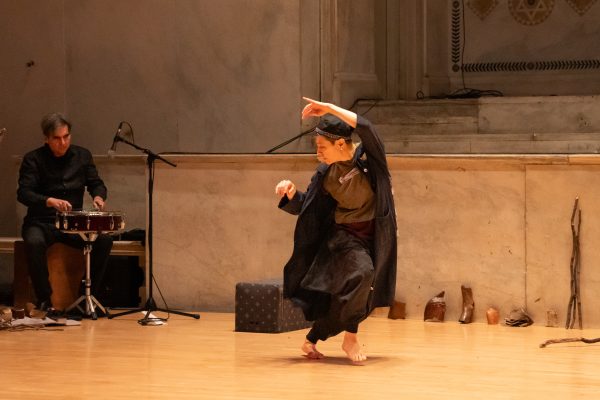

In a moment characterized by decay, destruction, and despair, it feels peculiar to find oneself in a place characterized by warmth, communion, and creativity. Out-FRONT! Fest., a week-long program of queer and feminist dance and performance produced by Pioneers Go East Collective, offers an approach to thinking through and being in the present that exists in contrast to the horrifying events taking place around the globe at a non-stop pace.
The historic sanctuary of Judson Church, where I saw jill sigman/thinkdance perform Re-Seeding (Encounter #4: The Seamstress) on the second night of the festival, has a tradition of including artists in its mission of providing for the poor and organizing around social issues. Before the performance began, Minister Micah Bucey welcomed us in from the cold and thanked the artists in the room for their work: “We need you now more than ever,” he affirmed.
As a cynical graduate student, I must admit I rolled my eyes. Art? In this economy? While wildfires burn through Los Angeles, and we stare down an imminent conservative trifecta? I prepared to write off ’s performance as a pat on the back for the self-congratulatory liberals who constitute the audience for experimental art. To my surprise, near the end of their concert, I was reminded why I care about dance; why collaboration is a thing of beauty; and how moving one’s body is a way to make meaning in a chaotic world.
Re-Seeding began with two slides of text projected above the stage, the first explaining a “Jewish tradition” of measuring a grave with a string, and the second sharing the history of Washington Square, known in the post-Revolutionary period as Potter’s Field, a mass grave for the impoverished and unaccounted for. Wooden stumps, some of which have been manufactured into sculptural trees with branches tied to their base, dotted the stage. Sigman and their partner, Vida Landrón, enter the space with a roll of twine to begin the custom about which we have been told. Gustavo Aguilar, one of three musicians accompanying sigman, brushes broomlike instruments through the air, symbolically clearing the space and producing a whoosh of wind fluttering through branches on a blustery day. He leads the way, and sigman and Landron unspool their cord around the perimeter of the performance area.
What followed was an exhibition of improvisatory scutters and play with various objects. Much of sigman’s movement is generated by their hands: fluttering fingers, rolling wrists, brisk shakes, offering gestures. Picking up a gnarled branch, sigman transformed the wood into a weapon, a horn, a crown, maybe even a propeller. About halfway through the performance, they unpacked a box of props, including a plastic challah bread, toy car, various bowls, cloths, and a rolling pin. At one point, they pushed the car, a plastic brown sedan, while crawling downstage. The image was touching; a human exerting control over a machine that otherwise governs our lives and dictates how we move through the streets.
Sigman engaged in a wordless conversation with the musicians surrounding them, Aguilar, Miguel Frasconi, and Kristin Norderval, stationed in both upstage corners and downstage right. The layers of sound resulted in a subtle yet lush score. Frasconi, manipulating various glass instruments—cups filled with water, tubes, textured plates—echoed the open-voweled song of Norderval. Their resonance seemed to fuel a kind of fluid groundedness in sigman’s movement. Aguilar relied on an eclectic mix of musical instruments and unconventional objects, like a garland of bells and a pile of kindling. He spun a cymbal on its edge, inspiring sigman to do the same with a bowl they were holding. They continued the spinning motif, turning the bowl into a chair and rotating themselves like a Lazy Susan.
The collaboration between sigman and the musicians was both meditative and exciting, full of thoughtful communication and lively jolts of energy. With their dancing, sigman showed that we can, in fact, transform ourselves by the way we interact with our surroundings. Objects can take on new significance and serve a new purpose when approached differently. If we move more gently, we welcome a softer, more caring way of relating to objects, other people, and our environment.
As the movement and music slowed, sigman turned to Landrón, who sat above the sancturay’s altar watching for the duration of the performance, signaling that it was her turn. Dressed in a slashed Chicago Blackhawk’s jersey and moccasins with a red hand painted across her face, Landrón began a poetic monologue that synthesized various historical wrongdoings and invoked individuals and social movements that fought against injustice.

Yet instead of providing punctuation to an otherwise moving performance, Landrón’s speech brought me hurdling back to my initial doubts about the power of art to do anything meaningful. Landrón briefly noted that we, those in the audience, are the future of the nation, but the overall tenor and message of her speech felt like a jumbled, transhistorical scolding underscored by an overwhelming sense of vagueness.
Though acknowledging the evils of the past is important, we must move beyond a mode of reckoning without redress. Everyone in the audience, it seemed to me, of Re-Seeding, agreed that atrocities against Indigenous and black people, women, to name a few, have challenged the United States’s supposed commitment to freedom and equality. The commitment has proven to be meaningless. I could tell because the room nodded its collective head throughout. What was the monologue but a pat on the back for its knowing audience, already guilty and ashamed? Where do we go from here? What do we do with this?
Sigman, however, demonstrated in their performance, that there is a way to use art to propose an alternative way of being in the world that is hopeful and points forward. I am grateful for their supple dancing, improvisatory spirit, camaraderie, and openness to chance and I’d celebrate more performances with these chosen qualities: more people moving like sigman.

Leave a Reply