
There are few things as infuriating as watching a choreographer attempt and fail at being original. I have often had this feeling while watching the work of Pam Tanowitz for New York City Ballet. In Bartok Ballet, her second commission for the company, Tanowitz breaks convention by sending a dancer– in this performance ballerina Miriam Miller– to the edge of stage right. Miller, dressed in a gold leotard, leans back blending into as she caresses the gold tassels that make up the stage’s perimeter. Standing there, she looks on as her fellow dancers envelop the space behind her. This scene, in serving no additional contribution to the piece, shows inclusion to be its only purpose. By using space predominantly reserved for pre-performance announcements and bows, the modern choreographer managed a bit of performance studies in the staid world of ballet. What does it mean for the ballerina to dance in uncharted territory? An interesting idea, but the smugness in Tanowitz’s insistence to be different made it hard to receive charitably.
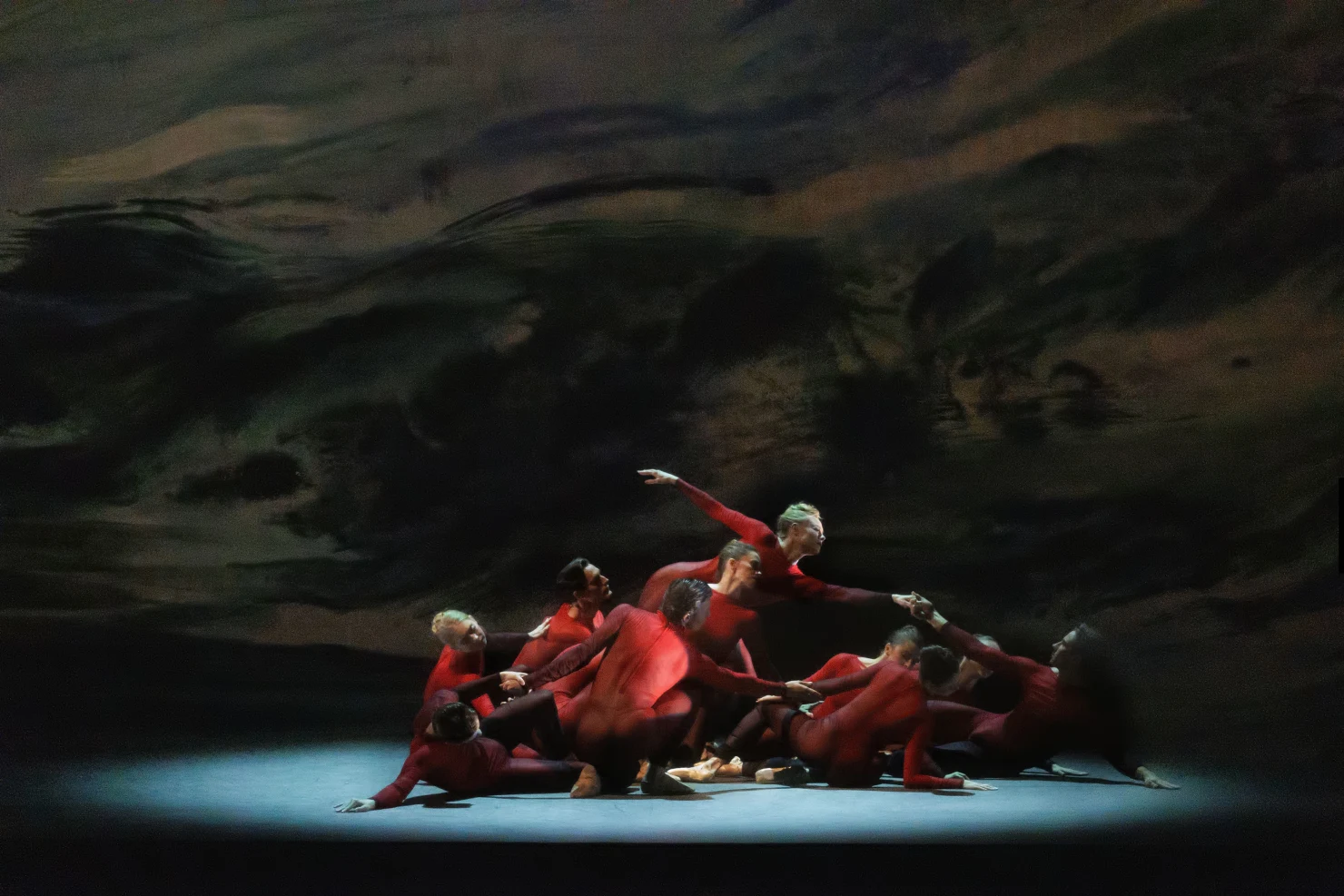
The latest piece to befall this fate is Christopher Wheeldon’s From You Within Me– a 32-minute ballet for a cast of 12 created in collaboration with the Alaskan-born painter Kylie Manning– performed on Wednesday evening as part of The New York City Ballet’s Winter Season. Wheeldon’s piece starts off the evening because of a logistical need, which greets audience members as they walk into the theater. In lieu of the familiar yellow curtains, one of Manning’s paintings– vivid turquoise and blues seep and bleed next to harsher black lines and flecks of unaccounted for white–covers the stage on scrim-like material. When the ballet begins, our first indications of bodies on stage is revealed when part of the front drop– a quadrant in the lower middle-right– starts to light up revealing many pointe-shoed feet. From there, more bodies are revealed as well as their costumes– red long-sleeved unitards also designed by Manning– and their initial formation: a huddled mass that moves circularly as individuals stretch their arms and chins pointing upwards, towards the ceiling. This formation introduces an idea engaged throughout the piece: the comfort of unity will always make the choice of separation curious.
This ballet plays with every configuration possible. From the initial mass, dancers surface and exit the stage, prompting others to follow. Partnerships form with a third person as an observer or acting as an aid in the creation of a pose. Sometimes this third person includes themself an already existing formation, like when principal Megan Fairchild stands to support Indiana Woodward’s shoulders as she, partnered by Jovani Furlan, balances in an arabesque. Consistent throughout the ballet is the use of mirroring. Sets of poses and movements completed by one group of dancers are often repeated on the opposing side of the stage by another group. Oftentimes the first group beckons the mirroring group back on stage. These moments are completed with an undercurrent of anxiety. Movement is done less from want, or to complement the ballet’s score– Schubert’s Verklärte Nacht– but out of fear of failing to do so. In a particularly endearing moment, principal dancer Sara Mearns– while seated on the floor at the top of a diagonal line– reached behind her head to re-insert a bobby pin into her French twist.
Wheeldon has a storied history with City Ballet. Selected as the first ever choreographer in residence, he knows the company, and its dancers, well. Many of the original cast members of From You, though it premiered two years ago, danced that evening, most notably Mearns, the unspoken– she has the most time alone on stage– protagonist of the piece. For Mearns, one of the most dramatic dancers in the company known for devouring the stage, I expected a continuous series of turns a la menage (in a circle), or swooped developés with arms to match. Instead, Wheeldon had Mearns stand still or walk slowly across the stage. At one point she stood by the wings and did a series of angular arm movements with her feet in parallel. The choreography, which seemed to accompany– and fail to accent– particularly demanding moments of the score, didn’t command enough of this dancer while asking for a precision for which she is not known. Mearns is a dancer whose limbs tend to be in constant motion and conversation. Without the use of her legs, she looked one-dimensional. While sometimes clunky, it is awfully exciting to see her at full blast.
But the problem with this ballet is not its failure to cohere– often the fate of pieces that make too big a deal of set and costumes, Manning’s artwork, (which can be described as a combination of the treacly hues of Renoir, the wistful expanse of Turner, and the composition of a Krasner) mostly hangs there– but its inability to accept itself for what it is: merely another ballet. Described in the program as “Wheeldon’s 22nd ballet created for the company,” the ballet spends the entire evening trying to reject such a bland description by doing everything possible to make the choreography make an impression. Dancers consistently exist on three levels, there’s use of unexpected pedestrian movements (running in place, for instance), and multiple dancers dance on stage all at different speeds. Every series of movements seem to have an additional step or accent even, or especially, when it isn’t needed. At one point of the ballet, perhaps in the middle, a male dancer (KJ Takahashi) ran back on stage to partner a woman only to run off again and then repeat this gimmick a few more times. Much of my viewing experience was spent scanning the stage to see if an explanation was hiding somewhere. The only consistency I spotted was the burden of this ballet’s limits.
There is a very fair question at play here: how does a maker, in this case a choreographer, produce a piece that may never amount to an epic, a work that may be received as minor? Considering the years it’s been since Wheeldon’s regular contributions to the company, and the passing of the baton to Justin Peck– and now Alexei Ratmansky– as choreographer(s)-in-residence, perhaps the sheer anxiety of his place in the company’s unfurling history took over any purity of artistic expression. But even the giants of New York City Ballet– George Balanchine and Jerome Robbins– whose lore and talent haunt contemporary choreographers– made lesser-received works. For Robbin’s there’s Concertino, a trio of two men and a woman, to Stravinsky that spends most of its time pretending to be by Balanchine. One could argue that Balanchine’s Swan Lake is less an exploration of the narrative or response to Petipa– the choreographer synonymous with this ballet– and more crossing off a checklist: “Ballets to Choreograph.” His version is, after all, only one act, compared to the three-act structure. Wheeldon has created sensibility-defining pieces for the company. Dancers aspire to perform in both Polyphonia (2001) and After The Rain (2005).The potential for less than mind-altering work is a real possibility at New City Ballet, where shorter pieces make up the majority of its repertoire.
The answer to Wheeldon’s anxiety, ironically, perhaps lies within this piece. The most moving section of the piece starts off with a pas de deux between two male dancers– Jovani Furlan and Chun Wei Chan– and then introduces an entire section danced only by the men of the cast. The pas de deux is marked by a tenderness that seems to both question a presumed understanding while introducing a clear aesthetic of male embodiment. Though there are still moments in this section where Wheeldon pushes a bit too hard– Furlan, for instance, loops his flexed foot underneath Chan’s calf as he bends backwards– he seems to be saying something here, clearly. Imagine if this ballet had been all-male all along, not only would this have made for a more distinct viewing-experience and precise artistic purpose. The ballet wouldn’t have to be the 22nd ballet Wheeldon made. Minor, or not, it could be known as the Wheeldon’s all-male ballet.
Photo by Erin Baiano.
Leave a Reply