
hope organ at Mews Art Gallery, Jan 16, 2025 | Choreographer Liana Zhen-ai

Tiny snowflakes fell through frigid air as I made my way to Mews Art Gallery in Williamsburg to see hope organ, a new staging of a dance piece by Liana Zhen-ai and co. A community of dance appreciators converged out of the somber darkness, first at the wrong address, each of us turning in circles wondering which sleepy doorway might be our safe harbor. My musings on what exactly a “hope organ” would look like became us…
Eventually we made it together to Mews and found behind the glass entry a couched audience watching a quiet performance space set with a small white table and two tiny pink chairs. Text projected on the back wall gave us a poetic monologue someone anxious would say in their sleep, “it was running,” and then “i was running” it continued as we waited.
The program announced the night’s players: Joëlle Antonia Santiago as the poised and imperious proctor, Theo Armstrong as the agile and bossy tough love and the exquisitely tortured and slightly masochistic Liana Zhen-ai as embarrassed. On the back of the program hid another poetic monologue on the destructive and generative implications of shame.


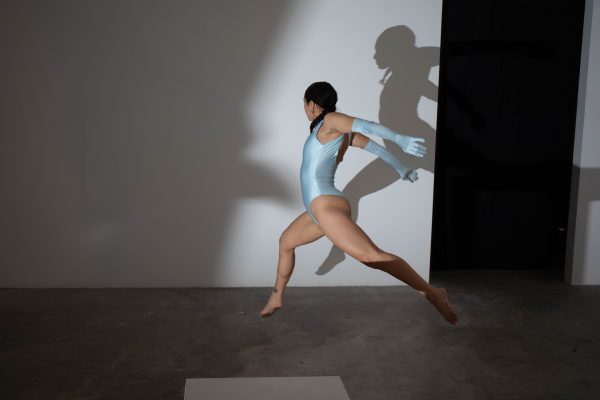
What followed was a pantomime of power-plays with the gravitas and sensuality of opera. In a geometry that will be familiar for all who have been raised to internalize shame, tough love and embarrassed moved as a pair. They wore leotards and long gloves in a light blue satin, they sat together at the small table deep in a conversation of gesture with their eyes sealed closed, movement sequences passed between them.
Here tough love and embarrassed are codependent, or perhaps even a single entity. They perform the complicated acrobatics of intimacy, most notably embarrassed running in perilous laps while biting the fingertips of tough love’s impossibly extended glove. There was humor too and a momentous pouring of sand that soon was meshed into light blue satin.
Meanwhile, the proctor sat at a small desk in the audience wearing black and white, scribbling notes and watching coldly from under a bright light. When the sand fell the proctor gave us a third monologue: the cynical aspirations of an artist who was recently scorned in love. Next the proctor entered the stage and they all moved together at the direction of an enigmatic voice. They faced the audience: voguing, hypnotized.
The last chapters centered embarrassment as our subject. First there was a striking domination scene involving the proctor, embarrassment and a bag of cherries (you just have to see it), and then a final cathartic dance by embarrassment. It was a coming-of-age operatic tour-de-force. I asked Liana some questions about the piece to flesh out our understanding of her take on politicizing shame, dance synesthesia and what hope organ has to say:
Emma: Liana! I loved this piece, thank you for making it. It really was such a dynamic show. What is the significance of the title for you? How does hope connect to shame? Does it?
Liana: Wow, first of all, thank you so much for coming to the show and for your gorgeous recap, it’s a really special and vulnerable process to put these fantasies on stage and have people reflect them back to me. The title “hope organ” came from a book called Naming Nature by Carol Kaesuk Yoon about the human tendency to classify, to create categories in order to understand the world. The chapter that the title comes from is on phrenology – specifically on how personality types were assigned to people from different heritages based on the over or undergrowth of different parts of the brain. There was an organ for anger, for lust, for virtue, and one for hope. It has an unsavory eugenic origin, but I thought that there was something really beautiful and redeeming about the idea that there could be a whole organ dedicated to hope.
In the work, Theo affixes a plastic bag full of cherries to Joëlle’s waistband, which felt like it referenced different kinds of medically mediated organs, like colostomy bags and IV drips. The visual was somewhat accidental, but ultimately, I think we all really resonated with the idea that hope could be a prosthesis, something that maybe the body couldn’t produce endogenously, but that could be strapped on nonetheless. For me, hope is one of the first things that I lose in states of shame. Hope is the feeling that there is possibility and future and goodness. When I am in my shame spiral, none of these things are there with me.
Emma: After the show Theo (tough love) and I came to a pop-Freudian reading of the piece that reads embarrassment as the id, tough love as the ego, and the proctor as the superego. In the blurb you say that “shame is politically important,” how does that all connect for you?
Liana: Absolutely, this is such a good read on the work. And I think it’s true that each of the characters are different facets of myself fighting to be a good person or fighting to look cool at the club or fighting to just feel like I deserve to be here at all. As I was creating this work, I was thinking about how these layers of domination contribute to the distinct flavors of shame that we experience. We police our behavior based on social norms that we learned from school, that come from factory life, that come from the prison industrial complex. Shame is a particularly good medium for tracing back where our expectations of ourselves come from, and those standards are deeply impacted by culture, class, race, sexuality, etc.
I struggle all the time with the ways that my shame keeps me from taking risks, from believing in my own value, or from feeling free and uninhibited in my body. But when I think about living without that shame, I don’t know that I would like the person on the other end. One of the things we were kicking around the hope organ group chat was this lecture that Zizek recently gave at Oxford. He ends the lecture with a commentary on the shamelessness of genocide, he says, “The question to ask is now in our era of this type of permissiveness, how to restore a basic sense of shame.” So the paradox within the piece is whether the pursuit of a realized self that doesn’t feel oppressed by shame is what the world needs right now.
Emma: The show was on the same day David Lynch’s death was announced and I couldn’t help but see your work through the lens of his legacy. You worked with a dramaturg (Sam Morraele), was blending the surreal and the mundane part of your narrative building?
Liana: Big yes, that blending was very fundamental to the work. I think what good surrealism does, be it Lynchian surrealism or otherwise, is take a really mundane human feeling and expose its guts. I might be having a totally normal, if a little awkward, conversation, but in my head the roof is caving in and the walls are splintering and the earth is opening up to swallow me whole. I think we all feel this way, and it’s been a deep part of my artistic practice to follow those feelings to see what stories they’ll tell me. Once I had pieced the images in the piece together, my work with Sam was to look up and notice there were other people in the room, and that in order to make my intention clear, I needed to think about how audiences would experience the work sonically, from different angles, and through direction of focus.
Emma: Other audience members I spoke with were really struck by the textural experiences in the show, namely the sand, the satin and the cherries. It felt like dance synesthesia, we were experiencing more than one sense at a time vicariously. It was visceral… What did you have in mind with that?
Liana: I love this take, and in all earnestness, I didn’t think too hard about it. Reckoning with the sticky, sandy reality of those parts of the work were things that we confronted as they were happening. Which I think says something meaningful about fantasy; materials become less messy and people become more one-dimensional and places become infinitely reachable and the perfect temperature in our minds. But when you really deal with those materials or have that conversation with a real person, there’s excess. I’m obsessed with how this excess makes enacting one’s fantasies prohibitive, or how the enacting of fantasy makes this excess suddenly tolerable.
Emma: Lastly, did your understanding of the meanings in the piece evolve during the process of making it? Do you feel like there is more it wants to say? What is next for hope organ?
Liana: Most of what shifted in the process of mounting hope organ were my relationships to the other characters. I’m again really lucky to work with a spectacular team and particularly performers who were so willing to make the thing work, even if it was duct taped together and only ran once and you kind of have to squint at it sideways. I felt walking into rehearsal that I had a good idea of how embarrassed functioned, but I needed to do a lot of work with Theo and Joëlle to make them their own people, and not just projections. We also learned that each of the characters existed along a gradient of shame to shamelessness; embarrassed being the most entrenched in shame, tough love existing somewhere between the two poles, and proctor being an emblem of shamelessness.
Emma: Wow, that is food for thought… Thank you!

Photographs by Talia Rudofsky
Leave a Reply