
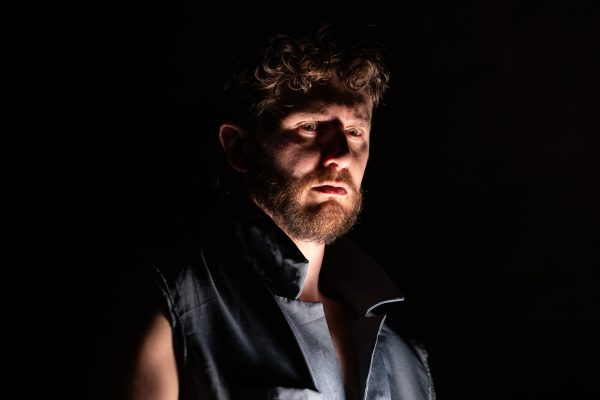


“Wild week to be mounting this work,” Brendan Drake writes to me in an email on January 29, 2025. Our exchange precedes the two-week run of Ghost Porn, Drake’s evening-length performance held at Kestrels (Brooklyn, New York) in early February. The email refers, of course, to then newly-installed President Donald Trump’s series of executive orders, which demonstrated unabashed cruelty towards queer and trans folks, immigrants, and other communities both national and global. Within Drake’s message is a sense of anticipation: an anticipation of oncoming political assaults on marginalized people, yes, but also the anticipation of Ghost Porn’s live performance, the public witnessing of long laboring hours past. The run at Kestrels follows Drake’s earlier engagements with similar themes, including an initial performance at the University of California, Los Angeles, where Drake earned their MFA in Choreographic Inquiry, and later showings of excerpts at Movement Research and The Brick in New York. Embedded in our brief discussion of Ghost Porn, then, are overlapping temporalities: anticipation meets memory — ghosts-of-dances-past — meets the liveness of the dancefloor.
It is within these porous constructions of time that Ghost Porn prompts us to parse, sense, and assemble its titular terms. As the program notes describe, Drake’s performance synthesizes “ghoulish apparitions” and “smut,” “horror cinema” with “cruising culture,” the movement of “go-go dancing” at queer clubs becoming the “exorcisms” of religious frenzy. The genre of horror and the atmospheres of queer nightlife in fact entangle the past, present, and future. Horror can manifest as haunting, the resurgence of past into present, directing characters and spectators to fear what is to come. The club invites us to navigate the sweaty presence of other bodies, the build-up to encounter, the afterparty, the comedown. If, as scholar Avery Gordon (1997) has famously articulated, “to be haunted is to be tied to historical and social effects,” Ghost Porn asks us to consider: by what or whom are we haunted — by the lingering stare, the fleeting moment, the text unanswered, the intrusive thought? What are the histories that we bring to bear on our desires, our actions, our moments of connection in all of their risks and chaos?
Within this broader temporal play, Ghost Porn develops according to a regimented structure: Part I (Slut Pop), Part II (A Room of Compartments), and Part III (Dark Room Gothic). Before its official beginning, the performance welcomes the audience into a video installation created by Ian Lewandowski. A film projects onto the wall of Kestrels’ bare, red-lit studio space as four go-go dancers (Ollie Iturrieta, Nikkie Samreth, Marcus Sarjeant, and Jace Weyant) occupy the outskirts of the room. Bouncing hips, reclining on the floor, and pressing their bodies against the walls, the dancers physicalize what scholars Kemi Adeyemi, Kareem Khubchandani, and Ramón Rivera-Servera (2021) describe as the “risky medium of the night,” a temporal arc and associated social structure that can “provide refuge and play” yet also remain regulated and surveilled, not unlike daytime (9). Ghost Porn’s audience is the surveilling force here, a facet of the installation that Lewandowski’s film magnifies further. Onscreen, masculine-appearing faces shift between expressions that read as joyful, terrified, fatigued, and embarrassed. Each body is mid-masturbation, the movement of a hand at times creeping into the frame’s implicitly-modest boundaries. In the installation, Ghost Porn suspends its audience in time: we wait, watching repetitive motions live and onscreen, delaying both conclusion (orgasm) and commencement (the performance’s formal start).
The house then opens into Part I: Slut Pop, a chorus of desire and its interruptive nature. Drake and collaborator Matthew Bovee are seated on chairs, positioned across from a couch. A dom (Nikkie Samreth) reclines on the couch cushions, hooded and holding two chains that stretch across the stage floor and attach to the collared necks of Drake and Bovee. Walking towards the audience, Bovee and Drake name each spectator: dad, daddy, mom, mommy, mother, baby, baby mom, potential mother, potential dad. The two performers then cycle through short statements, often repeating themselves, interrupting each other, and gradually increasing in volume and intensity. “I have this intrusive thought,” Bovee and Drake inform us, although the specifics of this experience are never made explicit. Meme-speak (“what if we kissed…”) develops into local humor (“what if we kissed at the Target in downtown Brooklyn? What if we kissed at the other Target in downtown Brooklyn?”) before commanding carnality (“fuck me,” “breed me”). Irreverence and eroticism intertwine, as a request to roleplay as an “Irish pirate” folds into an Angela’s Ashes reference and a joke about The Troubles. When Bovee and Drake finally unite in a rhythmic recitation of “dad’ and “daddy,” their expressions have become uncanny. There is the gnawing of something already amiss: just as familiar statements of desire become strange in their repetition, a disco ball sits on the floor, removed from its usual elevation.
Uncanniness follows into Part II: A Room of Compartments, which begins with a solo by a reanimated corpse. Marcus Sarjeant unfurls himself out of an object that resembles a body bag and spills out onto the floor. Sarjeant, a breathtaking mover, contorts his body between displays of hypermobility and exaggerated tension. In one moment, he is perched on a protruding ribcage, back arched with legs curled behind before rolling forward between limbs splayed so significantly that they appear dislocated or broken. The edges of Sarjeant’s body seem to blur in their unusual assembly of parts but, at times, normative logics of human postures reappear. Sitting comfortably on the floor, he looks posed for a studio portrait; it is these moments of familiarity that are the most frightening. In a collective crawl, Iturrieta, Samreth, and Weyant join Sarjeant onstage, gradually ascending into endless exertion. Caught in an energetic loop, the group transitions from individual scores highlighting athletic capacities (whirling limbs, a fast-paced run) to unison simplicity (a repeated high kick and jump phrase), set against the fading in and out of classical music and Kim Petras’s “Slut Pop.” Between tonal shifts and continuous motion, Part II questions: what is more frightening — the body out of control or in total control of itself and its impulses?
Part III, Dark Room Gothic, guides us through light. Green lighting marks Drake’s return to the stage before a total blackout plunges the audience into partial sensory deprivation. Drake, vocalizing into a microphone, narrates a dark room encounter with an absent partner, a ghostly presence felt but not seen. The language of sexuality becomes hyperbole: laughter and quiet muttering roar into an extended scream, as the audience sorts through sounds without the visual as an anchor. When lights come up on the stage again, we find three bodies in various states of dress. Bovee is on the couch, fully clothed and hooded; Sarjeant stretches on his side, nude; and Drake progressively removes different articles of clothing. Lights fade and come up again. The performers have shifted into new positions, each blackout reminding us of gaps in our respective knowledges, lapses in memory, and fantasies ruptured in the clarity of light. “I have this intrusive thought,” Drake informs us again. But what intrudes? What haunts us, recursively? Can we find answers to these questions in the final embrace between Drake and Bovee or in Sarjeant’s unraveling of tulle across the stage, perhaps a physical manifestation of such an intrusive specter? Or can we look to the final image of Ghost Porn: Drake huddled upstage, crouched above a bright white light, antlers resting upon their head?
Lights come up again and signal conclusion, inviting the post-nut clarity of the performance aftermath. In this moment, I reflect on and reckon with Ghost Porn as an exploration of the body at its extremes, an investigation into these experiences as joyous and terrifying, as conducive and disruptive to connection, and whatever else lies across and between. Collapsing distinct temporalities through the referenced genres of horror and pornography, Ghost Porn also collapses assumptions about desire. Like fear, desire can be excessive, often humorous, and represents a valuable state in itself — a totality of the sensation in which personal and social histories persist, and new insight can emerge.

References
Adeyemi, Kemi, Kareem Khubchandani, and Ramón Rivera-Servera. Queer Nightlife. Ann Arbor, MI: University of Michigan Press, 2021.
Gordon, Avery. Ghostly Matters: Haunting and the Sociological Imagination. Minneapolis, MN: University of Minnesota Press, 1997.
Leave a Reply