

In 2011, during the second year of the annual Fire This Time Festival, organizers produced the work of an up-and-coming playwright named Dominique Morriseau. The writer, now known as a MacArthur Fellow, an Artist in Residence at Signature Theater, and a Tony Nominee, still had another ten years before she would be called one of the most influential dramatists of a generation. Before that, however, she was a young Black playwright trying to break into a hostile industry. Fire This Time gave her a start.
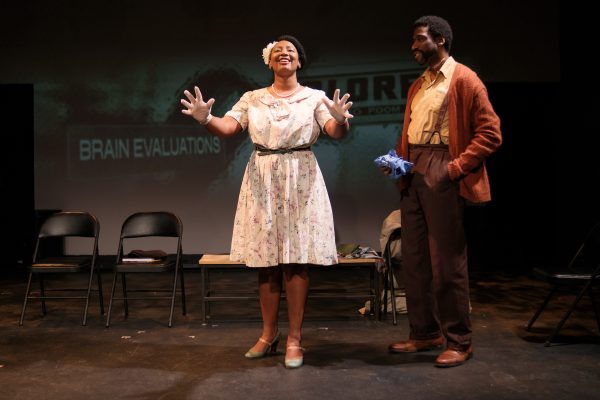
The festival is now in its sixteenth season and has done the same with countless other Black playwrights, creating a pipeline for their burgeoning talents. During their two-year residency program, the six chosen writers showcase ten-minute plays as part of The Fire This Time Festival and eventually produce a reading of a full-length show. For two weekends this winter at Wild Project in collaboration with FRIGID NYC, the cohort staged diverse scenes of Black life, covering everything from pre-fame Billie Holiday at a brain evaluation to factory workers undergoing a Marxist revolution. In her artist bio, cohort member Jeanette W. Hill writes that she strives to “tell our stories in our voice.” Now, as an established institution within the city, The Fire This Time Festival has told these stories far and wide, bringing African American voices to stage and print anthologies alike. The next great American playwright could be right under our noses. FTTF may help us find them.
A ten-minute play presents challenges and risks to its creator: if a play must have exposition, conflict, and resolution, the plot is forced to advance with superhuman speed, leaving us with little room to breathe. It’s unsurprising, then, that many of FTTF’s short scenes are claustrophobic, overflowing with information, and emotional ebbs and flows in just a few short minutes. In the first play of the night, FELISPEAKS’s OUT, a mother and daughter sitting at a bus stop cover miles during their brief talk, traversing therapy, their loved one’s suicide, and the reveal of a long-kept family secret. The exposition that has to be established so quickly – “I was the one who found him” – ends up feeling forced and for the audience’s benefit rather than the scene’s. We can’t help but wonder why, of all times and places, this life-changing information is coming out here and now. The answer is, of course, that this is a play, and something dramatic must happen. That, however, doesn’t make it any less grating.
The scenes that end up standing out are the ones able to walk the line between informative and emotive, writing characters that could exist outside of the ten minutes we find them in. Tylie Shider, in his Security Watch, showcases a deft understanding of craft, writing a couple that carry their shared history with ease and speaks to each other freely. The two call to each other from separate rooms, putting on makeup and buttoning up shirts as they prepare to go out for the night. The dynamic between actors Rebecca L Hargrove and Dante Jeanfelix goes a long way to making the first section of this script so engaging, and by the time we get the dramatic turn, their relationship has earned its complications. It would, however, be easy to lose yourself in hours more of Shider’s work. One wonders what he might do with a full evening-length reading or work.
This, however, is only one approach to the festival’s challenges, and different playwrights employ different strategies to make their ten minutes last. In a later play, Immanentize the Eschaton, author Garrett Turner largely ignores the problems of character or plot, sidestepping theatrical conventions in favor of an industrial politicized message. We never really know who his five factory workers are – when they’re identified, it’s by number rather than name – but we do know that at least one of them has read Marx. The entire scene reads as a staging of a proletariat revolution, in references to worker solidarity and alienation. This framing, however, isn’t enough. Without either character or originality, the play falls to manifesto levels of flat, and nothing more than a hyper-abridged version of Marxism: The Play.
Brittany Fisher’s Pound Cake, on the other hand, is a deliciously tight meditation on whether it’s worth remembering the good and bad. A period piece – ending with the puzzling reveal that our protagonist is actually a young Billie Holiday – Fisher makes every line matter, writing with a precision that allows audiences to lose themselves in the scene. Billie, going to erase memories of a lynching, meets a man in the waiting room desperate to regain his. The dichotomy is straightforward, which is what allows for its complications. When you have ten minutes, it takes a special talent to say something profound about your characters, let alone revelations about our shared human experience. Fisher accomplishes the impossible, packing memorable gut-punches of lines into a bite-size format.

Up-and-coming playwrights do not always necessarily mean young ones, and this year featured two writers over the age of 50 writing about complicated black families. Jeanette W. Hill’s play, Just One Good Day, follows the crushing struggle of a woman taking care of her husband’s deteriorating Parkinsons, and … But Not Forgotten by D. L. Patrick is based on the true story of a sister who goes missing in the 1970s and is only properly investigated 50 years later. Both emotionally sobering subjects are heavy weights to carry, ambitious in their scope, and would benefit enormously from more time. Just One Good Day suffers from the same exposition problem as OUT, and the decades-long span of … But Not Forgotten flies by in an instant. I’d imagine further development of their writing would allow for more subtlety.
This year’s Fire This Time Festival, like every other, gives the theater community a gift: emerging Black voices writing their own stories, as diverse and unique as they may be. When organizers 16 years ago first settled on their festival’s name, they took inspiration from James Baldwin’s seminal 1963 book of essays, The Fire Next Time. Ever since then, they’ve demanded immediacy, shifting focus to the here and now. The next generation of Black playwrights is here. Why wait until next time to give them the stage?
Leave a Reply