
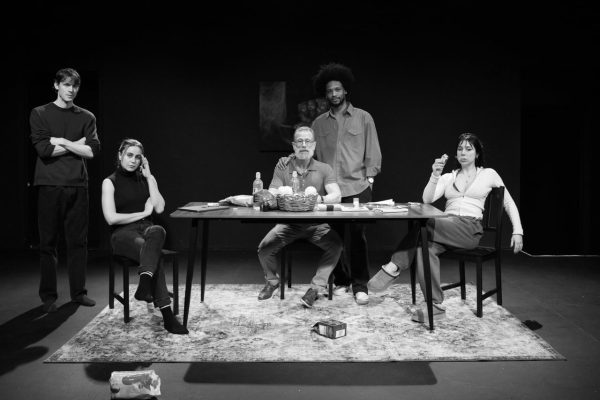

Sartre was right when he said that “hell is other people”. Nothing can encapsulate the feeling of purgatory like a family vacation at a rented lake house. Sartre’s full quote should actually read, I think, something like, “hell is other people, and so are AirBnBs furnished entirely from IKEA”. There is something uncanny about occupying a house that has never been lived in, only staged to feel lived in. Homes like these add another layer to the already impending senses of doom and liminality that holidays bring, especially among families precariously stitched together. It’s enough to cause irrevocable damage. And it does, in Dan Blick’s Lake George produced by the Telos Ensemble at The Chain Theatre.
Alana, with her husband Tom and baby Madison, is joined by Clara, Alana’s younger sister, father Jonathan, and Jonathan’s boyfriend Matthew at a rental in the Adirondacks: a sprawling, secluded dwelling on Lake George. They’re there to spend the weekend away from the hustle and bustle of New York City, trading in honking and sirens for the peace and quiet that comes with a lakefront property. Despite their attempts, peace never manifests, and quiet is quickly punctured in this packed if overstuffed, drama that runs only 70 minutes. Here, emotions seem to run higher and deeper, relationships contract and contort, simple decisions take on herculean meanings, adults become children and children become pawns. This is the beginning of the end for Clara’s sobriety, Tom and Alana’s marriage, and [father] Johnathan’s hope that all it takes to fix a broken family is a trip to a lake and a stay in a nice house.
Why are they at this lake house? What are we doing here? It’s clear that no one is expecting to have a good time, and no one thought this would be a good idea. And then I realized it. Behind the yelling and the tears and the exasperation is the desperate need for people and the hope that shared space and experience is all that’s necessary to set aside differences. No one is excited to be there but deep down everyone hopes that this vacation will genuinely restore. This house is a blank slate for the family to begin again, with each other and with themselves. Each character craves connection, whether physical or emotional. The real tragedy of the play is that they’re never going to get it. “Fuck” is used, time and time again—probably more than any other word in the script—but often without any passion. Sex is discussed, and demanded even, but one doesn’t get the sense that anyone wants to have any. I think they just want a hug, and for someone to tell them it’s all going to be alright.
The cast—including Mitchell Pope, Tora Hallstrom, Samantha Positano, Gil Cole, and Saadiq Vaughan—are well aware of the play’s melodramatic foundation. They huff and puff across the small, black box stage. They wail. They whimper. They whine. And just as it becomes almost too much, Blick’s dialogue reminds us that the house is very far away from civilization. Tucked in the woods, with no neighbors to bang on your door, it only makes sense that these New Yorkers will fill every crack and orifice with their personalities in a room that’s big enough to contain them all but still too small to let them breathe. Pope’s performance as Tom in particular was full of loud and deep feelings, while Vaughan’s Matthew juxtaposed the family nicely with a grounded essence that only comes from outsider objectivity.
Blick could have helped the audience and the cast work a little less hard had the design been more realized: firmly planting us in the desired location. Or, he could have gone the other way, and embraced liminality: less concrete ideas of tables and chairs and bad AirBnB artwork. The stage lights emitted a certain hum that created a soundtrack for the entire evening, never once letting me forget that I was in a theater. But perhaps this can work in Blick’s favor. There is something inherently theatrical about the setting, as though everyone was already entering a sort of playing space once crossing the threshold of the front door. Throughout the play, Alana is upset and furious because no one in the family refers to her baby by her given name. They all call her “the baby”, an apt metaphor. Though to themselves, these characters are their names– Alana, Clara, Tom, and Johnathan– to each other, they are simply sister, wife, husband, and father; actors, fulfilling a role.
It’s hard to see this play through the lens of anything but Sarte’s No Exit, mainly because of the characters’ repeated reference to it. But I agree with Blick’s determination that Sarte could have placed his timeless story in a large cabin in the middle of upstate New York and it would likely have achieved the same effect. Hell is other people, and hell is also the realization that family is included in that sentiment. Lake George explores the tragedy inherent in any familial drama: where“family” is defined solely by obligation instead of love.
Leave a Reply