

“I feel like…” initiates the disclosure of a thought or conviction, substituting the comparative confidence of “I think” or “I believe” with something hazier. “I feel like” expresses a vague intuition, maybe an instinctual opinion or a gut-response. Within this phrase, there is also a blurring of thought and feeling: a positing of sensation as the key underpinning of a developing intellectual stance.
TAQ Dance’s I Feel Like You Don’t Trust Me centers us within such sensory knowledge-making, exploring the qualities of sincerity and deceit for their felt, somatic dimensions. Choreographed by Sasha Marlan-Librett (Artistic Director of TAQ Dance), I Feel Like You Don’t Trust Me is a trio for dancers Lucia Flexer-Marshall, Tori Mazzacone, and Megan Siepka. The dance, which ran from February 28-March 1st, 2025, represents the culmination of TAQ Dance’s participation in Marta Miller’s Certain Bird Residency (Vermont) and its New York City premiere at PRIV.Y GALLERY in Manhattan. Described as “existential, playful, and empathic” in the program notes, I Feel Like You Don’t Trust Me builds an architecture of feeling throughout its forty-minute duration, translating the intangibility of trust and honesty into verbal, sonic, and gestural languages that the dancers exchange between themselves and with the audience. Far from representing a linguistic hedging, the “I feel like” of I Feel Like You Don’t Trust Me foregrounds the generativity of sensing oneself and each other within the complicated mechanisms of discerning, expressing, and conversing across what we understand our own truths to be.
We observe the dance as if we have stumbled into a familiar domestic scene: the set, designed by Miles Bettinelli, resembles an apartment warm with potted plants, stacked books, dark wooden chairs, and a clothing rack filled with varied textures and patterns. Each dancer enters the stage at her leisure, perusing the clothing, picking up a book, or lighting the candles atop a small table. Sitting on one of the chairs, Mazzacone braids the hair of Flexer-Marshall, who reclines just below on the floor. This opening sequence evokes what scholars such as Rizvana Bradley and Laura Marks might describe, respectively, as a “haptic” sensibility, representing an experience of touching—and being touched by—the visual scene. These haptic qualities enable the audience an imagined point of entry into the onstage sensations, inviting vicarious feeling of the braided hair, the waxiness of plant fronds, the lightness of linen clothing against bare skin. Heightened senses soon channel towards a focus on the hypersensitivity of the performer and, more specifically, her awareness of being observed. Mazzacone answers a phone call and asks: “did you already see me? Did I look helpful?” It is less important that Mazzacone was truly helpful to Flexer-Marshall when fulfilling her request for braided hair; what matters is the external perception of her benevolence, the recognition of “doing good” more valued that the good done.
Proceeding into a series of fragmented scenes that Marlan-Librett describes as “non-linear” narrative, I Feel Like You Don’t Trust Me continues to play perception against intention. The dancers assert a need to be seen and, at the same time, recoil from this impulse or struggle when it does not “match” their desired understanding. Re-entering the stage following Mazzacone’s phone call, Siepka informs the audience that she “just got out of the shower” and then reprimands us for not believing her. She towel-dries wet hair to prove the veracity of her statement but quickly confesses that she lied before claiming emotional injury: “it hurt my feelings when you didn’t believe me when I lied.” She spirals, this time literally, towards the ground and begs Mazzacone and Flexer-Marshall to help her stand. Although Siepka insists that she “keeps falling,” her falls are precise and structured, resembling a planned descent rather than an uncontrollable collapse. The movement portrays an artifice relative to Siepka’s statements, evoking a manipulation of peer and audience responsiveness that I Feel Like You Don’t Trust Me extends further. Dancing together, the trio opens their arms to the audience, smiles, and quickly retreats; in a later solo, Mazzacone demands that the audience remember the “good parts” of the performance (specifically, her triumphant middle split), rather than its “bad parts.” There is a nervousness to these interactions, a shaky undercurrent to each spoken and physicalized plea. The dancers guide us towards what to see (and not see) yet they are never entirely certain about what to show (and not show), restricted by a lack of trust in themselves and a wariness of our capacities to discern adequately.
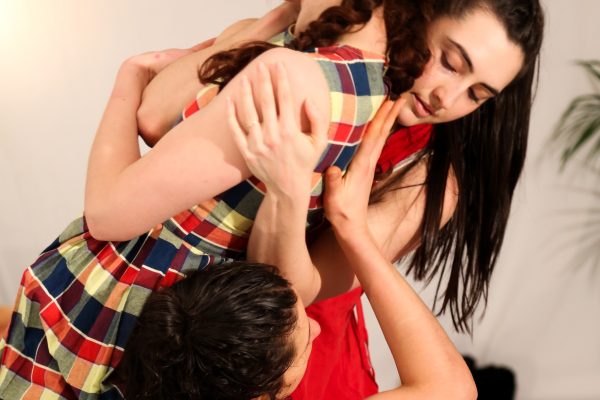
And yet, trust develops, slowly. In each monologue, there is a trust in the body’s training: movement accompanies speech, stabilizing the performer within her familiar bodily practices as spoken language activates her emotional extremes. One-sided requests develop into dialogues: after Flexer-Marshall repeatedly asks an unresponsive Mazzacone to validate her outfit choice, the two performers fall into a duet, entangling tenderness and control. A trio develops from careful negotiation: when Siepka wedges her head between Flexer-Marshall’s arms and asks if this arrangement of bodies makes sense to all involved, the dancers initiate a process of relation-building. The trio rehearses methods of being-together, establishing trust as something gradual, iterative, and only sustained through continued attention. Taking time to figure out each point of connection—a lift over a shoulder here, a supported lunge there—they find a near-seamless continuity. Something clicks. They know where to go, how much effort to offer, how much support the other bodies need as the choreography repeats, several times over, pushing the dancers towards exhaustion—itself a state alleviated by trust in others, trusting that they will provide the encouragement needed to continue.
The trio then quiets, arriving at a gentle pace. With their eyes closed, the dancers unite in simple, sensory exploration. Siepka begins a slow body-roll, inviting her peers to join and similarly experience how the movement “feels good.” Flexer-Marshall explores a head massage and Mazzacone offers an arm scratch, each of which initiate “good” sensations that all three performers partake in. Sensations are therefore communal and distinct; each dancer can only truly understand her own “good” feelings, but she can recognize that her peers feel something both similar and slightly different. Closed eyes are a signal of trust in each other to share such sensory experiences, to know without obvious validation of such knowledge. Dragging a metal tub filled with water to the stage, the dancers take turns standing in its depths as the other two pour water down onto the standing figure. What is the feeling of trust — is it the cool relief of a shower? Does it feel like an inner warmth, brought on by sharing in communal experience?
Good feelings resonate beyond the stage, scattering into haptic experiences for the audience: water trickling, body scratching, the calm of stillness after physical exertion. There is good in holding tight to feeling, good in “feeling like” in order to know further.
References:
Bradley, Rizvana. “Other Sensualities.” Women & Performance: A Journal of Feminist Theory 24, no. 2–3 (2015): 129–33.
Marks, Laura. The Skin of the Film: Intercultural Cinema, Embodiment, and the Senses. Durham: Duke University Press, 2000.

Leave a Reply