
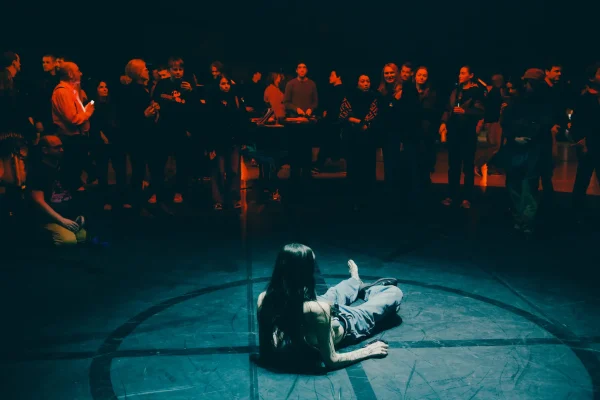
Anne Imhof, DOOM: House of Hope
Park Avenue Armory, March 3-12, 2025

The night before Election Day last November, I found myself killing time in the Financial District. I’d just seen Emilia Perez at the Alamo Drafthouse, which is not the story of trans representation that some of its acolytes have bizarrely said we need, but is maybe more of a movie about how nonprofits will not save us from our societal and personal ills. With several hours before my next engagement, I wandered past the Federal Reserve on Maiden Lane. I visited The Gap on John Street, gazed through the portal of the Noguchi cube across from Zuccotti Park. The sun set, and I wandered across the concourse of Calatrava’s World Trade Center transportation hub. Its structure is allegedly supposed to mimic a dove taking flight, but underneath its curving white columns I always feel as if I am trapped in the belly of a whale.

I walked around the mall, past the John Varvatos and the MAC, up the escalator to the H&M, thinking I might buy a new sweater — the weather was getting colder and I feared an especially harsh winter might be coming. I entered the men’s section and looked for a knit in a red or an orange, but was shocked to find that the World Trade Center H&M had no colors in stock — only beiges, blacks, and grays, rack after rack of neutrals. I walked to the back of the section in search of, maybe a green? I found some white and more beige, but no yellow, no pink, no periwinkle. A chill ran down my spine. Nothing good could come from this.

About two weeks later, after the election, feeling a great sense of foreboding in my heart, I was scrolling through the New York Times, a memo had been sent to the Trump transition team that said that Pete Hegseth, the president-elect’s selection for Defense Secretary, had committed a sexual assault in 2017 in Monterey, California. Hegseth claims that the interaction was consensual. In either case, he was confirmed on January 24th. Another news story told of planned sweeps of homeless encampments in purportedly progressive Berkeley, California, where politicians were emboldened by the Grants Pass Supreme Court decision, which made it legal for municipalities to enact bans on camping on public property, effectively criminalizing being unhoused. Desperate for relief from the churn of the news cycle, I navigated to the arts section, where I saw that the Park Avenue Armory had announced its 2025 season. They’d present Yoko Ono’s Wish Tree, a Diane Arbus exhibition, a concert featuring 50 micro-tuned pianos, and a 60-performer work by artist Anne Imhof titled “DOOM.” I quickly sent a link to the announcement to a friend with the eye rolling emoji. In this time, DOOM is everywhere, why should audiences pay $50 or $60 to experience its imitation at the birthplace of the NRA? Shortly after this, I received a glossy magazine advertising the Armory’s programming in the mail; the four big letters of the title felt like a threat.
In January 2025, the work’s subtitle — “House of Hope” — was unceremoniously tacked on in press releases and on the Park Avenue Armory website. (Based on captures on the Wayback Machine, some time between January 14 and January 17.) But even before the addition of the subtitle, the description of the performance on the website promised a “[fusing of] space, performers, sound, and scenography in response to our present in which anxiety and hope find a fragile balance between apathy, activism, and resistance.” The prospect of seeing a dancer fused to a stage flat filled me with more anxiety than hope.
I first became aware of Imhof in 2017, when she presented her work, Faust, at the Venice Biennale. The pavilion featured lanky dancers slithering around underneath a glass floor to look at their phones or allegedly masturbate, loud industrial music, and frightful dogs behind a fence that performers occasionally climbed. It looked sensorially overwhelming in the videos I saw on Instagram and YouTube. I didn’t have money to fly and go see it in Venice, so I can’t tell you exactly what it was like. Imhof won the festival’s prestigious Golden Lion, so it seems the art world thought there was some there there.
That same summer, the “Unite the Right” rally descended on Charlottesville, Virginia; white men carrying tiki torches shouted racist slogans on Friday night. On Saturday, over 1000 anti fascist counterprotestors showed up to meet the 500 white nationalists protesting the removal of a Confederate statue. The proceedings turned violent, with fighting in the streets. In the early afternoon, white supremacist James Alex Fields, Jr. rammed his car into a group of counter protesters, injuring 35 people and killing Heather Heyer, a paralegal who worked with clients going through bankruptcy. Remarking on the events in Charlottesville, President Trump said that there were “very fine people” on both sides. In the years since, he’s doubled down on those remarks.

Faust, at least as witnessed through my phone and computer screens, seemed to re-enact the very violence that was happening elsewhere on my social media feed. But the fighting here was slowed down, and embodied by chic looking dancers, ready to be photographed.
Back here in the present, with my interest piqued by the promotional materials, which promised a “culminating happening” that “serves as a seismographic meter of our times while projecting into our own possible futures to find a new form of hope,” I decided that I wanted to see, and write about, “DOOM: House of Hope.”
Two days before DOOM, while visiting my family in Cleveland, Ohio, I visited the art museum there. I saw a painting by British artist John Linnell of the night before the deluge in the story of Noah. Noah and his family look down into a valley below them, and above, dark storm clouds gather over a blazing red sunset. The cities and towns in the valley look expansive: so many tiny houses and streets, illuminated in that amber light of day turning to night. But they also look so vulnerable. We know what is about to come: something horrific that we ascribe to the wrath of God. The didactic panel tells a different sort of story. The curators note that after the Victorian era, paintings like this — large, brightly colored Biblical scenes — fell out of favor in the art market. How helpful to remember that a painting is an thing that can be bought and sold — literal oil on literal canvas. But looking at it, I couldn’t see it for the object it was. All I could see was an omen.

In any case, I finally went to see DOOM on Monday, March 10. Waiting for the doors to open, I hovered in the lobby, near a step-and-repeat with the show’s snarly-looking tiger and wolf logos interspersed with the show’s sponsors: Bloomberg Philanthropies, CitiBank, and Cadillac. Much like in real life, this DOOM is sponsored by billionaires, banks, and car companies. Next to the photo op was a poster from Park Avenue Armory encouraging us to “Spark A Conversation” by tagging them on social media.
After briefly perusing the DOOM gift shop (long sleeve t-shirts would run you $70), I wandered into the Armory Drill Hall. There, barricades blocked us audience members from entering most of the space, which was filled with a Jumbotron and a ton of black Cadillacs. The audience, feeling cramped and kettled in, pushed past each other for a better view of the space. Performers darted between the cars, howling like wolves, eventually chanting “We’re fucked!” “We’re doomed!” “I think I made you up in my head.” “We’re doomed / we hope / we’re doomed / we hope…” The barricades came down, and I, along with the rest of the audience, began to wander through the performance space, which felt a lot like a Cadillac showroom.
Over the next three hours, with dozens of performers, something was nearly always happening, usually many things at once. Two young actors mumbled text from Shakespeare’s Romeo and Juliet — while Romeo used a normal headset, Juliet for some reason held a tiny microphone up to her face as if she was filming a TikTok. One person got a tattoo in the bed of a pickup truck. The rapper ATK44 did several songs in French. A riot grrrl-esque band gave a concert singing: “Too young to live, too young to die.” One twink-y dancer kept putting on and taking off a bear mascot costume. When she wasn’t singing one of her numerous original songs, artist Eliza Douglas scrawled words onto her torso with permanent marker and poured hot candle wax onto herself. In two bright spots of the evening, members of the FLEXN ensemble would stand atop the Cadillacs, slowly contorting their bodies into unsettling shapes, and the performer Perla Haney-Jardin held forth at a grand piano, simply reciting snippets of dance criticism. If this all sounds chaotic, it was. But if it sounds exciting, it wasn’t; it was actually quite boring. Sometimes, the cast, consisting mostly of Balenciaga model types (during the Demna years, not the Cristobal times of yore), just wandered around the room vacant-eyed, looked at their phones, and vaped.

While the evening had clear focal points throughout — especially in the later part of the performance, when a new cast of virtuosic ballet dancers took to a stage at the back of the drill hall — the crowds of audience members and large Chevrolet cars often made it hard to see what was going on. In the absence of a clear view of the proceedings, many audience members eventually began to chat with their friends, sit glumly at the Bar Mitzvah-esque tables that were part of the set, and scroll on their phones. Those people who were lucky enough to be able to see the performers were usually on their phones too — taking photos or videos. At one point, blocked by a tall person in front of me, I watched the show through someone else’s cell phone screen — I saw that he was live-streaming to his followers.
The promotional materials of the show promised: “This sequential durational performance takes audiences on a journey to ultimately find a sense of community through our own shared experiences.” Putting the nonsensical “sequential durational performance” language aside — what performances do not have things that happen in a certain order over a duration of time? — I can say for certain that I did not find a sense of community at DOOM. I attended alone, and at the rare times I would lock eyes with another audience member, they would quickly look away. The performers would sometimes hold my gaze, but with a look of suspicion, contempt, or derision. But mostly, people retreated to their phones. I looked at mine and found a stream of articles — Trump’s tariff policies, the gutting of the IRS, people abducted off the street in Syria, the unrenewed ceasefire in Gaza. Whatever hope I was meant to find in the evening, whatever community, was supplanted by doom-scrolling.

DOOM leaves one with the impression that the performance is maybe not so much what lives in the room. Maybe this performance is actually a digital object, something to be replicated and shared online. (One prolonged section, when an actor decried the evils of photography, was ironically recorded with glee by many people around me.) Or, judging from the line of audience members attempting to buy posters and hats after the show, maybe it’s meant to live on as a nihilistic line of DOOM merchandise. Or, maybe it’s all an elaborate ruse to sell paintings — three of Imhof’s oil on aluminum works were on display in a side room with a dingy mattress and aggressive strobe light, courtesy of Imhof and her blue-chip gallery, Sprüth Magers. It’s an uncanny feeling, that perhaps the core of DOOM is somewhere else besides right here and right now.
Back to where we started, in November, the evening before Election Day — a night of uncomfortable anticipation — an overall sense of doom slowly overtook what small bits of hope I still had within me. I walked from the Financial District up to the West Village, where I was meeting my husband to see a play.
The Beastiary, which played at Ars Nova’s Greenwich Theater from October 7 – November 9, 2024, tells the story of the last remaining people on earth after a compounding series of disasters — plagues, famines, tiny blue demons, large mythological beasts. In scene after scene, the play’s characters — a cohort of five actors taking on multiple roles, all in medieval garb — are brought down by their vices. A merchant and his daughter plunder the homes of the dead for things to sell — the merchant is eventually crushed by a giant creature. A knight lusts after a gryphon, who later murders him.
As I watched plagues and deaths and the fallibility of humans play out before my eyes, the feeling of impending doom that I had experienced earlier in the day was magnified. The stories of medieval people, struggling to subsist on crops that won’t grow, wandering around a hollowed-out earth, felt close to home, like a possible near future. Three or four years from now, who knows what unforeseen horrors we may be experiencing?
I wept. I still weep when I remember it.
I’ve carried that scene with me over the intervening months, as I’ve read about targeted ICE arrests of political activists, the oppressive price of eggs, senators caving, war, and suffering. It’s very easy to feel small, to feel helpless. But even in the midst of this dark time, we have the capacity to be present with each other, and through caring for each other when we are in pain, suffering, and fearful, to redeem ourselves and our sinful world. In a world where a feeling of DOOM is pervasive, maybe there is hope to be found in the here and the now.
Leave a Reply