

TRADITION: it’s what survives into the next generation, what parents and teachers pass along to their children, and what we find ourselves replicating for better or worse. If the present is obligated to honor the memory of what came before, what flexibility, in turn, do our traditions owe us? How can customs repeat if they’re unable to adjust to new circumstances?

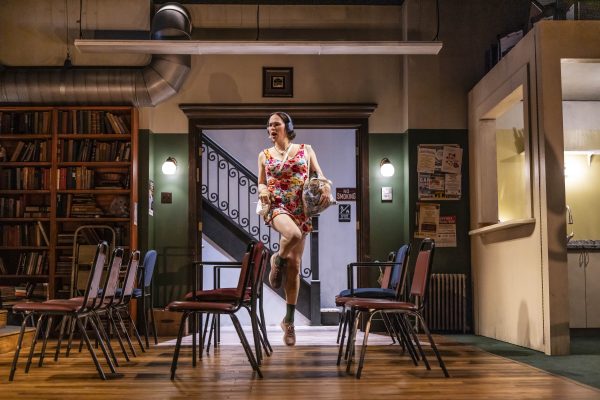
Adapted from Abby Chava Stein’s memoir of growing up trans within Hasidic Orthodox Judaism, Emil Weinsten’s “Becoming Eve” asks whether keeping tradition and faith has to mean following the ‘straight and narrow’ path prescribed by others. The play follows Chava (Tommy Dorfman) as she tries to get ahead of the rumors of her life as a woman in Manhattan before they reach her strictly Orthodox family in Williamsburg—where social scrutiny dictates even what color of tights a woman should wear. Chava throws together a meet-up with her estranged parents at a trans-denominational synagogue to reveal to them who she really is. She enlists the help of Jonah (Brandon Uranowitz), a meek but caring rabbi and new father, who hopes to mediate between the generations. Once Chava sets up chairs and sprints to a (literal) closet to swap her dress for a hoodie and jeans, the stage is set for the dreaded coming-out discussion that will frame the rest of the play. A trained rabbi herself, Chava hopes this unconventional synagogue can work as a middle ground for helping her rabbi father (Tati played by Richard Schiff) understand how becoming a woman doesn’t mean she’s lost her faith, even if it’s taken a different trajectory. However, from the get-go, things do not go well. The outright refusal of Chava’s mother to attend the meeting signals that this isn’t going to be easy. After some awkward set-up, tension increasingly grips the theater.
Weinstein’s play animates tensions between a parent’s expectations and a child’s agency, between a father’s wish for a firstborn son, and the burdensome obligation of following the path already laid out before you. From the start, the conversation between the three rabbis is also a conversation about Abraham’s attempted sacrifice of Isaac. We gradually learn how Chava finds a mystical, Kabbalist explanation for her transgender experience in a distant ancestor’s interpretation of Isaac being born with a female soul. As the conversation returns again and again to the story, the sense of anxiety only mounts, even as much of the dialogue explains to us the story of Abraham and Isaac again and again as a foil for Tati and Chava.
Structured in my mind like a zipper waiting to get caught, the play’s pressing conversation is regularly interrupted by flashbacks of Chava’s experiences from early childhood to the near present. The audience receives intimate access to the lifelong history of Chava’s attempts to meet her parents’ expectations as their oldest ‘son’ before she is unable to bear it anymore. The strength of Tyne Rafaeli’s direction helps to make sense of everything that’s bubbling underneath the play’s tough and heart-wrenching—but still often humorous—central conversation.
Following family tradition, much of Chava’s life has been arranged for her to become a rabbi, like her father, like her father’s father—like all the patriarchs in family history. Though these flashbacks do not always seem relevant to the dialogue that triggers them, we see nonetheless how all the right strings were pulled to lead Chava where her father wants.
The play’s most striking aesthetic choice is using a series of puppets to represent the younger Chava while present-day Chava still lends her voice. We watch present-day Chava watching these memories play out from the sidelines, though she takes an increasingly active role as we approach the present. I felt an uncanny sense of disidentification between human Chava and puppet Chava, between someone who confidently knows herself now and someone unable to take agency over her life. The puppet design of Amanda Villalobos combined with adaptive puppetry lets us see how Chava has always bucked against how she’s been told to act since she was a toddler.
A good share of these are bad memories of family trauma and gender dysphoria, but the staging of several lighthearted moments of care and self-discovery felt off, tonally. The dramatic lighting and sound cues that transition us between the coming-out conversation and Chava’s memories exist somewhere between a subway train barreling through a tunnel and a horror movie jump scare—it’s as though Chava can’t help but return to them. Not every memory, though, shows us the ‘return of the repressed,’ but many serve to contextualize the relationships that have made Chava who she is today.
It’s through these memories we receive glimpses of other characters lingering around in Chava’s mind, such as the standout performance from Tedra Millan as Chava’s ex-wife Fraidy. The puppetry adds a disarming and comic woodenness to their scenes as we witness their awkward/adorable first meeting as well as the birth of their son. The pair share a sweet but ultimately tragic love scene in Chava’s new apartment before Fraidy makes it clear that she cannot leave the rest of her extended family behind to join Chava’s new but isolated life as a woman.
All of this insider information helps us to see the limits of love and care in a separatist world that children don’t choose to be born into. It helps us to see how a loving and romantic marriage is made impossible by a wider community that is unwilling and unable to accept Chava for who she really is. Chava’s Tati blames the outside, secular world (specifically the viciousness of Midtown) for what he thinks is his child’s madness. For Tati, who wants nothing to do with non-orthodoxy, who (a bit randomly) offers a short speech critical of Zionism, and who bears the weight of his parents’ experience in the Holocaust, the most important mission is preserving his family and its long line of rabbis.

Still, Chava is not without hope that some kind of mutual understanding is possible. To Chava, the story of Abraham and Isaac offers the lesson that sometimes one must actually say “no” to God, that over and above what others tell you is right or wrong, you should save your children from the horrors and unfairness that you may have already experienced. Chava understands her Jewishness as the ability to live in paradox, ponder ambiguity, and question everything. She conceptualizes her trans experience within the family history of rabbis who challenged convention. The larger conversation feels doomed to fail—and somewhat anti-climatic—but the three rabbis can all agree on at least one thing: your parents stay with you, if not in person, than in your head.
The play itself ends without a clear resolution, a sort of paradox. Really, the main action of this play is one incredibly overdetermined episode in a story with a long history and much uncertainty left for the future. As Samuel Beckett wrote, in a far different context, “You must go on. I can’t go on. I’ll go on.” Things are far from over, but with everything finally out on the table, there is a chance to at least take a breath.
Leave a Reply