
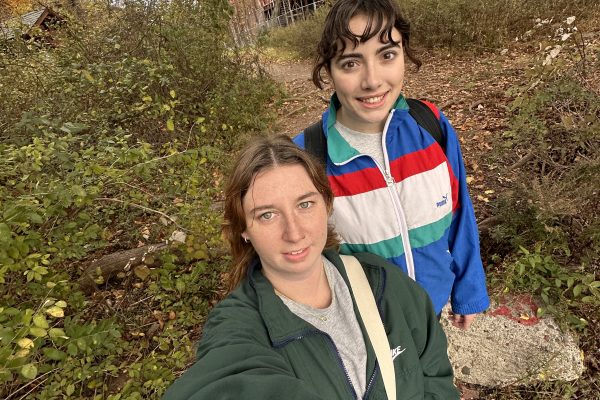

When I moved to New York in 2022, I was twenty-two, and I wanted to make dances. I knew a lot of artists my age and was lucky to have lots of great friends who had other great friends. (Maybe this is what our dance professors meant by “networking.”) When I started an internship at Movement Research, for instance, I was already familiar with one of my colleagues because I had worked at Gibney Dance Center with two of their friends from college (who went to college with one of my friends from a different internship). Their names were Taylor Schmuelgen and Kayla White. In my mind, a map was forming, a web connecting all of the people I knew and was meeting with each other, and with me. I added new threads to it at work, at my MR internship, at parties, at bars, on Instagram, and sometimes in class.
Less than two years after we met, Schmuelgen and White founded THAT SHOW, a community gathering and showcase of early-career performance artists. Informed by a shared vision of a performance space that provides financial and operational support for risk-taking and collaboration, their curatorial style has been described as “rooted in TLC: tender loving care” and one that “makes room for unbridled expression.”
I spoke to them about the condition of the early-career artist, balancing artist and audience centered curatorial practices, and the origins of their emblematic disco ball.
Our conversation has been edited for length and clarity.
Hannah Lieberman: What conversations were you having as friends and peers in the dance field that led to the founding of THAT SHOW?
Taylor Schmuelgen: In November 2023, we went on a hike and we started complaining. We made a list of things we hate that Kayla can read to you if you want.
HL: I would love it if you read it.
Kayla White: Okay. Things we hate. Artists paying to present; presenting for free; having to pay to rehearse in studios; first-come-first-serve applications; no curation; long applications; lack of diversity of movement; really long shows; 20-minute pieces.
TS: Then, we made a follow-up list of things that we like.
KW: Which are: paying artists; rehearsal space stipends; list of resources for finding affordable space if the program can’t cover it; the option to create brand new work; administrative support; communication efficiency; an audience that isn’t just your friends; marketing; sliding scale ticket prices; connecting artists with collaborators; curation that places pieces in conversation with each other.
I was still seriously pursuing a performance career at the time, and we were talking about what an “early-career artist” or “emerging” artist is in New York. We were watching these presenting entities advertise opportunities for early career artists, and then they would go to somebody that’s been known for five to ten years. That’s not really “emerging.”
HL: They’ve emerged.

KW: They’re “mid-career.” We were thinking about our age group—our friends who are moving here to pursue a performance career, looking for dance work. Nothing is really available for them to create and be presented, except for these entities that are asking you to “pay to play.” And the benefit of doing those performances is so little. You invite maybe two friends, because you don’t know if it’s going to be good, because it wasn’t curated.
HL: And the friends had to pay twenty-five bucks. What interests you about the “era” in someone’s artistic career of being an “emerging artist” and how do you address that with your process?
TS: Actually, we pretty explicitly never use the word “emerging.” We use “early-career” instead, because like Kayla said, some people still identify as “emerging” even though they’ve been supported in the past, or have funding. That period of emergence doesn’t really have an end point. Most of the people we support have a budget of $0—
KW: —because those are the people we know. To watch our peers make such cool work and to see their potential is inspiring. And there are so many people we don’t know who also have that potential; nobody is capitalizing on their potential in the way we’re trying to.
We want to allow [the artists we present] to dream as big as we’re all able. If they want to make a mess on the floor, we are going to do our best to let them. If another presenting entity has already told them an idea is not allowed, we are going to try our best to make it happen for them if it’s going to help their work come to fruition.
HL: How do you see THAT SHOW fitting into the context of other producing entities in New York?
TS: Our goal is that it doesn’t. It’s something different.
KW: It’s operating as a really good entry point for people who are new here and looking for community. One day, when I was teaching Pilates at Gibney, I walked the whole square of the building and every time I turned a corner I ran into somebody who had presented at THAT SHOW. We always joke that this has been one big bit for us to make friends.
We’re trying to offer the resources for artists to make something they’re interested in, that they can continue to develop elsewhere. We’ve had artists continue their research and their pieces because they’ve shown [the work] in a place that feels safe to show something unfinished. And they get to have conversations about the work with people who have just seen it.
HL: What does your process look like in terms of creative support? Especially for artists who apply without a concrete idea.
KW: It varies. Johnny [Mathews III] submitted a beautiful video of them doing a solo with cinder block. Actually, I don’t know if they submitted it or if we found it on their website. But we were obsessed with it. When we told Johnny we wanted to produce them, we asked them to work with an object with some kind of weight or weighted experience to it.
TS: There’s been a couple other times when we’ve hinted at what we like. Such as, “we love your use of text.”
HL: That kind of feedback and level of engagement with early-career artists’ work is so huge. It must make them feel so seen, that a producing entity likes something specific about their work, and wants to present it and support it. I feel like that usually doesn’t happen until you’ve surpassed the “early-career” stage, so to speak. An artist might really like working with text, but they have no idea if it’s coming across.
TS: I see a lot of people getting stuck in this “chicken or egg” situation. Do you invest the time and effort into making a piece first, or do you apply for opportunities that will support you in making a piece? That’s why we curate the artist, not the work. People will say, “I want to present something, but I don’t know what to submit.” So in our submission form, we ask, “what are you interested in working on?” not, “what are you interested in showing?” Help us grasp what you make, but we don’t need to have a vision of your finished piece. We want to take away the burden of needing to know everything at the beginning.
HL: That’s interesting, because every time I’ve been to THAT SHOW, it feels… polished is not the right word. But it feels like the work is ready to be presented. So when you talk about curating the artist and not the work, how do you balance that so the work that appears onstage is ready? Is it just trust?
KW: It is a lot of trust. And we do a lot of research. We’re creeping on every single available website, social media, Vimeo, YouTube—we’re lurking. We get a pretty good sense of what they have made previously, or just their general vibe. The other half of that is getting them to trust us that we’re going to make a show that they want their work to look good in.
TS: There is a lot of care that goes into the program order. I think that helps the evening feel a little more concise than just, “This piece had to go first because they have a complicated setup.” We’re not afraid of a five-minute pause if we think the works should be presented in a certain order.
HL: How do you decide on the order? What do you consider?
KW: We pick [a show order] before going into tech. Then when we watch the pieces, we flip-flop something if we think it makes more sense that way.
TS: We prioritize the tone of the work.
KW: And the audience. Having watched a lot of performance… [laughs]… the first piece coming back from intermission is usually more upbeat. Then we transition to something more subtle, or something that requires more focus. It’s difficult to get somebody who isn’t a performer hooked into what’s happening, so we try to make it as engaging as possible.
HL: When you’re curating, how do you balance form, content, and aesthetic… What are you looking for, if anything? How do you balance what’s “trendy” [contemporary tendencies in dance] with your personal tastes?
KW: As a curation duo—I don’t wanna say we have a short attention span—but we like things to look different. We’re looking for pieces that can both sit next to each other and stand on their own. We like to give people as many opportunities to like something as possible.
TS: We have different tastes, and because of that, we ask more questions when we’re looking at work. We ask, “I didn’t like this, but why?” Something that didn’t grasp my attention will grasp Kayla’s attention immediately. We do a good job of thinking about what’s engaging, and not just what’s “good.”
HL: I’d love to know more about your personal tastes and interests, and what makes a work—for you—“good.”
TS: I want to be engaged the entire time. When it’s over, I want to be like, “Why is it already over? That felt like five minutes.” I want to be so invested, whether because of shock value, maximalism, or because someone has been staring at their pinky finger for five minutes.
KW: I like to be surprised. When I’m watching a work and I can tell how it was made, it loses my interest. I love when they switch it up on me and we take a left turn. I love when things are not connected. Storylines within storylines within storylines. Maybe that’s because my artistic practice these days is leaning more towards dance theater than concert dance. What is unfamiliar to me is exciting. Whereas watching really hard, rigorous dance doesn’t always capture my attention [anymore].
TS: My little brother came to the show in December. I was thinking, “What would my little brother like? What would keep his attention? What would he want to talk about after the fact?”
KW: And it’s never what you think.
TS: It’s never what you think! My grandparents are also coming this weekend, and I am so invested in their opinions. I don’t think you should have to have a BFA in dance to watch dance. Our friends that aren’t artists have been huge supporters. My roommate brought her coworker from two jobs ago, and now that coworker has come back. People ask people to go to things with them.
KW: Yeah, who wants to go to something alone?
TS: Who wants to go to “that show?” Are you going to “that show?”
HL: Where does the name come from?
KW: That was also on our hike. We were just spitballing dumb names. One of them was “forward fold.”
HL: Wow.
KW: We kept saying to each other, “when we come up with the name for that show we’re doing. When we do that show.” And we both love a good pun, or a good bit.
TS: We just committed to the bit really hard.
HL: Where did the disco ball come from?
KW: I don’t know.
TS: Me either.
HL: Okay.
KW: Oh wait! I do know. We were talking about fundraising at the very beginning—how to get people to send us money if we didn’t have anything to show them. We were coming up with tangible line items that people could subsidize. One of them was $20 to buy a disco ball. I think five people sent us $20 to buy the disco ball.
TS: We had to ask them, “is it okay if we use your money to buy, um—
KW: —an artist fee?”
TS: There’s probably like five or six people in the audience who think, “I paid for that disco ball. That’s my disco.”
HL: That’s such a great fundraising tactic. You’re putting in so much work as administrators and producers, and having long-term contact with so many artists. How do you see the field evolving? What changes do you see or anticipate in the way the field is operating?
KW: That’s a tricky one. I don’t know how I see it changing, but I can tell you what I’ve noticed. There are more small, DIY presenting entities than I was previously aware of, and I’m really excited about that. In September, we presented Stephanie Shin who produces The Craft, and I’ve performed in The Craft before. The people who are doing this small-scale presenting work are similar to me and Taylor. They’re young artists trying to make space for other young artists.
TS: I think early-career artists are taking back some of the power and control over how their work is presented by being in community with one another. In the past decade or so, I’ve noticed a trend in how big institutions support early-career work—it’s opportunity presented as education. That’s not necessarily bad, but I’m noticing that artists are growing more by being in community with one another, than by learning from someone from “up here.”
The overarching arts and culture funding scarcity is always going to hit young, unestablished artists the hardest. If a program can’t self-sustain by generating revenue or with the support of a foundation, it’s the first thing to get cut. When we think of THAT SHOW as a business, we don’t want the tickets to be the only thing that makes money for the artists. What is the bar doing? How are we negotiating a contract with the venue so that we actually keep more of the money?
KW: We’re teaching Pilates classes as a fundraising opportunity. We’re reaching outside of the actual event for financial support, so it doesn’t have to sustain itself in order to survive.
TS: We’re not asking the artists to sell enough tickets to fund their own artist fee.
Leave a Reply to Charlyne Turner-whiteCancel reply