
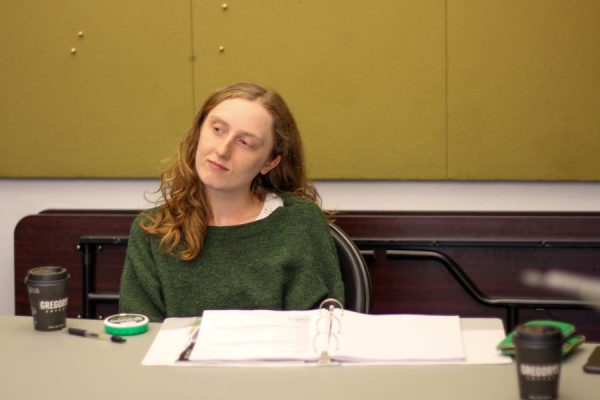

Kallan Dana is a playwright, producer, theatermaker, and aspiring novelist from Portland, Oregon. Her work has been developed or presented with Clubbed Thumb, New Georges, The Hearth, The Tank, Bramble Theatre Company, Dixon Place, Northwestern University, and Lee Strasberg Theater & Film Institute. She is a New Georges affiliated artist and 2025 Audrey Resident. She received the 2025 National Theatre Conference Paul Green Award.
We discussed collaborations in theater, what it means to craft a so-called “language play”, and the cleansing humiliation of writing about high school. This conversation has been edited for length and clarity.
Lee Folpe: You’re a founding member and leader of the artist-led collaboration group TAG at the Tank, and you also make work with your two theater companies, Needy Lover and Trove. What does it mean to you to work with other artists in this way, and have you always embraced the idea of theater as a collaborative medium?
Kallan Dana: The Tank is a really special community. That and The Brick are the two places where I know that people my age and people in our group of theater artists are doing the most stuff. TAG is a more casual artists’ group that is basically modeled off of The Jam at New Georges that my friend Hanna and I founded. It’s casual, and we’re still kind of figuring out how to lead it. Last fall, which was just after I had moved back to New York after finishing grad school, Hanna and I had a meeting with Meghan Finn [The Tank’s Artistic Director] about projects that we wanted to do, and then we were talking about how many artists’ groups are shutting down because they don’t have funding or resources. And many of these groups are also getting more and more exclusive and competitive, and we talked about how every single group shouldn’t be the most competitive thing to get into. People need groups in order to be able to share work and have peers. Needy Lover is the group that Hanna and I and our friend Zoe sort of founded-slash-started a few years ago. It just became a really nice way to compile resources, to help each other out, and also to help us get a very very small following of people who are interested in what we’re doing. Our friends Emma Richmond and Jonah Harrison are now part of the company as well and help us run it. We work super well together, we have so much fun together, and it’s really just the point of doing theater, that you should love hanging out together.
LF: That’s the dream!
KD: Yes! And then we have a wider community of actors and friends who we like making work with. And then Trove—sorry, I’m giving such long answers, I’m going to be more succinct.
LF: No no no, I love it.
KD: Normally I’m more succinct, but not this morning. Trove was founded by Emma and Ian Reid, and they asked me to be part of Trove right when they were getting it started. I think it’s just a similar kind of ethos to Needy Lover in terms of wanting to make as much work as possible and also a fundamental belief that theater is supposed to be fun and you’re supposed to be doing it with people who you really enjoy spending time with. It’s supposed to be fun, and it’s supposed to be rigorous because art is really important right now. I feel like that’s the shared ethos of both companies.
LF: Can you speak a little bit more about the process of producing LOBSTER at the Tank and how you developed that show?
KD: Yeah! We had self-produced a reading of LOBSTER at the Tank in summer 2023, and then we found out we got the Core Production last spring. We spent this past year just working on it every single week. And obviously there were some weeks where that was really light work, and then there were other weeks where it was like “this is my full-time job, in addition to my other full-time job, so I’m working two full-time jobs”. Everyone who helped produce knows that it’s really really exhausting, but also so fulfilling. I honestly find it really addictive.
LF: Yeah, I bet. It was such a fun show. I had a great time watching it.
KD: Oh, thank you! Can I ask you my favorite question to ask people who come to see the show?
LF: Sure!
KD: Who did you identify with most in the play?
LF: Ooh…I think I identified with, like, sort of every character in different ways, which I think is great. But definitely Nora as an angsty teen who wants to make art and wants to embody this punk rock aesthetic that she doesn’t necessarily understand fully. And also Imogen being like “our relationship is bad and we need to stop doing it,” definitely felt that.
KD: I definitely have been both Nora and Imogen in different relationships.
LF: So when did you start working on LOBSTER?
KD: I wrote the first draft of it in my second year of grad school, for a class where we worked with undergrad actors. You work on the play once a week for the entire semester, and then do a public staged reading of it at the end. The first draft of it was really different. I think my kind of interest in writing the play has changed so much, while I still feel that the conceit is the exact same. Oh, and the memoirists have been there the entire time. There’s always been an element of the other characters sort of jumping forward in time and looking and reflecting back.
LF: That was one of my favorite parts of the play. I thought that it gave it a lot of weight—we felt sort of the thrust and the weight of time in addition to being enthralled by this high school comedy. But also, the high school comedy is so effective.
KD: Thank you for saying that. I really appreciate you saying that.
LF: How do you feel like the thematic and philosophical interests of the play have shifted?
KD: I think that I started to think more about, just, what does it mean to desire an artistic life? Initially, I was thinking about the play and I was really focused on Nora and her pain. And I think that through working on the play more and getting a lot of time to really focus on each character in this deeper way, I feel like it became so much more about the way that we narrativize our own lives and other people’s lives, and the gap between our perception of how things went versus someone else’s perception. And so I think I just became interested less in Nora as an individual and more in the ecosystem of the relationships, which is how I got to this ending, with Imogen talking directly to the audience. Which became one of my favorite parts of the play, and something that was really meaningful to me.
LF: I really liked ending with just her. And I also loved the moment when she first came onstage, because the whole audience gasped and knew exactly who she was—that was so effective.
KD: We worked so hard on that moment, it really took a long time.
LF: In LOBSTER, Nora is kind of idolizing Patti Smith and the counterculture movement of the 1960s, while the other characters struggle to embody the aesthetic she desires—do you feel like that is something that you think about in your own work, like trying to incorporate a sort of punk or counterculture ethos?
KD: I wish. No. Not really. In the way that that kind of thrust of the play is really me thinking about other people in my life in certain ways—I certainly have a lot that I idolize. I would say that I really idolize novelists. My big dream is to write novels. That’s more important to me than writing plays. And I kind of fixate on certain novelists more—but despite the fact that I wrote this whole play about a character who’s really fixated on the period, I think I have a much more superficial connection to 70s counterculture and punk and that sort of thing. I was interested in Nora both having a deep experience of feeling really connected to this period of time, and feeling like she is connected to it in this deeper way that the other teenagers are not, and also, I was interested in her really selectively viewing this period of time and these movements and getting some things wrong.
LF: I’m interested this idea that what you really want to do, what you’re really obsessed with, is novels. How did you make the decision to go to grad school for playwriting rather than fiction writing, or was that even a consideration?
KD: It wasn’t a consideration. This is like a slightly new thing, of me being honest with myself about what I really want to do. I also would like to write plays. I’ve always done theater, and I’ve very much wanted to be a playwright since I was like eighteen, and that is still totally true. But I think that when I think about the kind of writing practice that I really romanticize, it is writing long-form fiction. Because I think that that is the kind of reading and it’s the kind of artistic experience that I most enjoy having. Like, I feel the most—this is so cheesy—but the most, like, spiritually deep and open spending hours reading a novel.
LF: Totally! There’s nothing better.
KD: I love the collaboration of theater and I know for a fact that I will continue to do it for the rest of my life. It’s so connected to who I am and so energizing and meaningful to me. But I think that working on something where it’s actually not a collaborative writing project feels like a really appealing experience to me right now, and an appealing contrast. And I feel like the plays I’ve written so far are very language-driven, and I am kind of like, maybe I should just try writing something that’s all about language to see what that’s like.
LF: Wow, that leads directly to my next question!
KD: Oh great!
LF: So, I saw your play RACECAR RACECAR RACECAR in December, and I know that that play has been called “a language play” and has been compared to Erin Courtney’s plays and Mac Wellman’s plays, and that Erin Courtney was also your advisor at Northwestern. Do you identify with this idea of the language play, or what does that mean to you? And when you write a play, are you thinking about structure versus content and how the structure impacts the content?
KD: Such great questions! Erin is definitely one of the most important theater people and mentors in my life. And I was intentionally trying to make a language play with RACECAR. I love it being called a language play. Although I wonder if the language is good enough for it to get that comparison? But I love that people are willing to lump it into that category. I thought a lot about Jenny Schwartz’s play God’s Ear and her work in general. She was also my mentor through Clubbed Thumb. I love her writing. And I feel like my thinking has been shifting, because I think that when I was in grad school I was like “I really just want to write plays that have electric language, and where the thrust and propulsion of the play is totally coming from how the language evolves”. I was also really inspired by Will Arbery’s play Plano, which I love and was a play that I saw in college that really shaped my taste and interest. I think that Liza Berkenmeier’s plays and James La Bella’s plays have really incredible language. And many other writers working right now. And I think that’s part of the appeal of seeing a play, is that you should get to hear amazing language. Although, also, like, Annie Baker’s language sounds amazing, and her plays aren’t described as “language plays” but I think her language sounds amazing.
LF: Agreed! I’m obsessed with her.
KD: Yeah! And I think that right now, I am thinking more about story than I ever have been before, and I think I’m thinking about how to write story and plot in a way that makes people feel compelled to keep watching. And I think that that was something that was really helpful with working on LOBSTER, where I was like, this isn’t like, a plot-driven play in many ways, but there is something that’s changing in the story every single scene. That was a big goal of mine, and that’s something I’m thinking about for my next projects, where I’m wanting to challenge myself to kind of think about story more from the get-go and let the language emerge out of story more.
LF: It’s such a strange balance to try to strike as a writer.
KD: Yeah! Do you identify as a language-y playwright?
LF: I don’t know! I don’t think that I do, actually. I think I identify as a word-vomit playwright.
KD: You should put that on applications. That’s so good.
LF: Thank you! But yeah, I don’t know. I am super interested in this idea of beautiful language as part of the impetus and the reason why you go see the play in the first place, and moving away from just plotting things out. But I’m also sometimes like, okay, I need to give myself more structure so that I’m not just writing pages and pages of people talking.
KD: Totally! Because, like, we’ve all seen plays where it’s like, people are talking and I’m so frustrated and bored, because what is the point of this conversation? And why am I watching it? And I also think that something that’s really sunk in for me in a different way recently is that you actually do need to know what you’re writing toward and what’s going on. There are many ways to figure out what you’re writing toward, but it is really helpful to be like, this is the situation that’s happening between these people. Like, I feel like Paula Vogel does super weird stuff in her plays, and also it’s very clear what the given circumstances are.
LF: Paula Vogel is such a good example of that.
KD: She’s the best.
LF: Do you feel like you have certain sources of inspiration as a playwright, or are there certain themes that you return to over and over in your work?
KD: I feel like I am really interested in perception and subjectivity and distortion, and the intersection of those three things. I am interested in unreliability, unreliable narrators, I guess, and how to theatricalize that—I feel like that was part of my hope, with both RACECAR and LOBSTER, that we would have this kind of central character whose perception of reality becomes more clearly distorted as the play goes on. And I think I’m also interested—I was thinking about this, and I was like ugh, that’s so boring, but I do really think it’s true—I am so interested in family. Family and memory. And this is so boring and so square of me to say—but how childhood really messes with us, and it stays with us in a deep way, and it becomes the lens through which we experience every other relationship. And obviously everybody who writes knows that, but I think it’s really true.
LF: Are you counting adolescence or teenagerhood as part of childhood?
KD: Yeah, I think so. I think it’s part of childhood. But I think that it’s an interesting time period—I think I am going to continue writing about teenagers until I’m older. I’m twenty-seven right now, and because I’m so interested in memory, and reflecting back, I don’t have that much of my life that I can reflect back on. Because I’m young. And so hopefully when I’m older, I’ll be able to write more plays that are really about memory and are shaped by memory, but I’ll have more distance from more of my life, that I’ll be able to look back on. And I think right now, the time of my life that I can really look back on is being a teenager and an adolescent. And I think that’s true—like many people are—I assume you’re also in your twenties.
LF: Yes, I am also in my twenties!
KD: But I feel like that’s why a lot of people our age end up writing plays that are connected to high school, or have high school characters, because that’s really a time that we have distance from in a way that I don’t have distance from my twenties.
LF: Totally. I feel like sometimes I worry about, ugh, am I writing yet another high school play? Do you ever have that thought?
KD: Totally I do, of course! I’m humiliated by it! But I’ve been thinking about it, and I felt that way about LOBSTER. I felt like I really want to write this play and it feels meaningful to me, and I’m also so embarrassed that it’s set in a high school. So many people write high school plays, and what is there that’s new to say about it? But for me, I felt like I had new stuff to say and to reflect on through working on it. And also, I don’t think that you only have to write what your experience is, at all. I don’t believe that. But I think that writing is really meaningful to me when I feel like I’m asking myself deep questions about my life and things that I’ve experienced. Ultimately, I’m only writing for myself really, and hopefully other people end up liking it.
Leave a Reply