
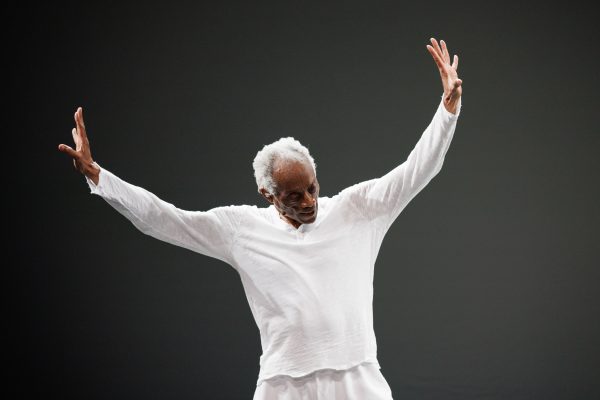

At the opening of Memory Piece: Mr. Ailey, Alvin…the un-Ailey?, we catch glimpses of Bill T. Jones dancing in and out of darkness. His flowing white pants and matching shirt caress his body´s sinewy strength, and he practically prances in and out of the various squares of light that flash on to the floor before vanishing, as if unseen forces were attempting to place him in a box. Behind him on the wall is a quotation in Latin from St. Augustine: sedis Animi est in Memoria (“the seat of the mind is memory”).
Performed in repertory with his world-premiere Curriculum III: People, Places, & Things this spring at New York Live Arts, Memory Piece is a dance that both reflects as well as interrogates, resulting in a kind of memoir told through movement, storytelling, and dance history. In this evening-length solo, Jones considers key moments in his own life as a dancer and choreographer, especially in relationship with Alvin Ailey, who served as mentor, inspiration, colleague, and friend. Over the course of his performance, Jones details some of the parallels and distinctions between their artistic visions, in particular examining the double-standards African-American artists face when evaluated by predominantly white critics.
Memory Piece is structured according to theme and feeling rather than linear chronology, allowing Jones to strut, leap, and glide through time. He speaks with feeling about “discovering dance” in 1958, witnessing a woman’s bottom swaying to the music of a jukebox, as he looked through the legs of his tired parents in upstate New York. This is then linked to a meeting with Ailey in Los Angeles in the 80s: a journal entry Jones wrote in 1978 is projected behind him while his present day self does a soft shoe downstage.

Having turned 73 earlier this year, Jones imbues a level of fluidity and effortlessness to his movement that younger dancers should study. The sequences of live performance are only enhanced when simultaneous archival footage of a young Ailey performing come in and out on the upstage wall, almost like we can “see” Jones´ recollections. The two dancers, separated by both time and media, exude muscular elegance, and the piece links their vocabulary in personal and aesthetic ways. Jones riffs off of history here, making the past alive and present again, much the same way a jazz musician reinterprets a familiar tune through their own instrument. Later, when the projected footage shifts to images of a younger Bill T. performing, the shared qualities between Jones and Ailey becomes even more apparent: their boldness, their fusion of classical technique twinged with acrobatics, gesture, and theatricality. If one is new to one or both of these dancers´ works, Memory Piece makes a convincing case that Jones and Ailey originate from a similar lineage of creativity and innovation.
The two have also withstood similar criticisms. Jones confronts the discrimination and dismissal critics have aired about Ailey–that his dances are “about the Negro” and nothing more, reducing his innovations and cutting him off from a larger place within modern dance. Similarly, Jones has had his own work condemned for being too abstract, lacking the outrage expected from him “as an African-American artist.” Using voice-over recitations, projected quotations from various critics, and passages from his own journal, Jones makes a compelling argument about this hypocrisy endured not only by him and Ailey, but by all Black men in America who have the nerve to step outside the box. In addition to its personal bent, Memory Piece is a social project, inviting us to examine bias, and consider how we see art. Why, for example, was Jones criticized for his choreography being “abstract,” while Merce Cunningham was heralded?
Memory Piece also chronicles key moments within Jones’ emergence as a dance-maker. He cites some of his training while studying at SUNY Purchase, from Enrico Cechetti to West African dance. “You should consider Graham technique,” one of his teachers told him. “That´s better suited to Negro bodies.” We feel some of the significance when, in 1983, Jones was invited to join a small workshop within the Ailey company “dedicated to the new.” When commissioning Jones to create a new work for his company, Ailey cautioned the young choreographer to “not hurt my boys.” As Jones discusses his process working with the dancers, passages from Yvonne Rainer´s The Mind is a Muscle (1968) appear on the upstage wall. The result was the task-oriented sextet Fever Swamp (1983), a rather radical departure for the Ailey company in terms of vocabulary and vision. New York Times dance critic Jack Anderson panned it.
Despite the brilliant use of various media onstage, from archival footage and projections of writing to a soundscore which blends various musical tracks with voice-over narration, Jones never lets his audience forget that this performance is live. The evening I saw this performance, I watched Jones spot someone in the audience and stop to shake their hand or greet them fondly. A brief moment of exchange, before diving right back into the choreography. At one moment, noticing someone in the front row who seemed visibly upset, Jones stopped to ask how she was doing. Reflexively, she inquired after him. “I’m just barely getting by,” he replied.
Jones’ employment of a “break” from the formality of performance served a simple yet potent strategy to remind us that memory and archive don’t only exist in the past. Through a rich array of images, words, and movements, Jones situated us right here: in this uncomfortable present.

Leave a Reply