
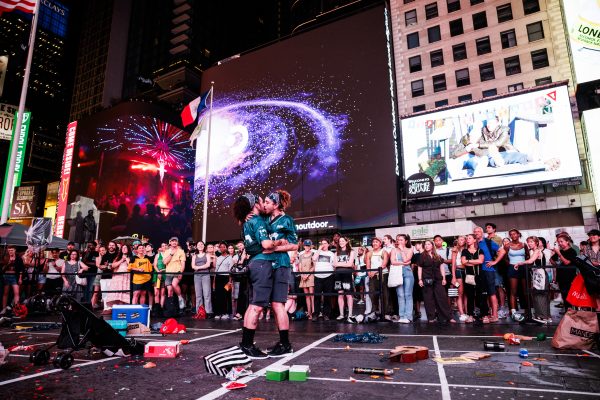
American Idle was performed three times on July 9, 2025 in the middle of Times Square. Two grids and two casts of one set of characters danced through the mundane (but made strange, broken down, and looped) movements of waiting in line, taking selfies, searching for a friend, cheering, putting in eye drops, and kissing at midnight. Maia Chao, Times Square Arts’ second public artist-in-residence, directed the piece, collaborating with Lena Engelstein, who choreographed. The two come together with Nora Raine Thompson, dance artist and writer, to discuss how projection and reality, symbol and intimacy, meet in the busy hyperreal zone of Times Square through a performance of doubles.

Nora Thompson (NT): I’m curious about your relationships to Times Square, the center of this work. I visited the city a lot as a kid (I grew up in New Haven, Connecticut), and we would basically only go to Times Square. So, I had this understanding of New York City as Times Square. And I hated the city, because I hated Times Square, and I felt like I always had to go to the bathroom there. Now, of course, my perception has changed. But Times Square is still this concentration point of symbols. And now I only go there for theater, and strangely, to see my therapist.
Maia Chao (MC): Oh my god, I had a therapist in Times Square, too!
NT: Why are they there?
MC: Maybe because by the time you get there, you need to process.
NT: Maybe physically moving through a series of projections gets you ready for the work of projection? In any case, tell me about each of your associations or assumptions about Times Square you came into the process with.
MC: I grew up in Rhode Island and also visited as a kid with my family and on field trips. Times Square always felt overwhelming—your energy drains fast. Like you, Nora, I associated it with basic bodily discomfort and overstimulation and nowhere to pee. It’s an environment that just can’t meet so many bodily needs, designed intentionally to distract.
Lena Engelstein (LE): It’s a place that polices bodily need. If you sit somewhere you’re not supposed to, if you lay down… There’s a criminalization of the body that doesn’t conform to what the place demands of it.
MC: As part of my research, I was initially shadowing sanitation and public safety workers. And their informal motto is “clean and safe.” So much of that work is to make people who are sitting down or stationary, move. Usually, unhoused folks or street vendors. So, in my head, the mantra became “clean and safe and moving.” Of course, the workers are just doing their jobs, but this attuned me to the violence of always having to be moving, especially for certain people. It serves to uphold broader systems of displacement, particularly the erasure of queer cross-class contact that Samuel Delaney describes in Times Square Red, Times Square Blue.

LE: It’s like taking the things that don’t fall into the clean and safe and general symbolism of the place and pushing them out of sight. But then that movement becomes such a big part of that place too.
I came to Times Square for this project with some nostalgia, actually, because I’m from New Jersey, a cute little 30-minute bus ride away. I have all these memories of running through Times Square to catch the last bus. Or, coming through here for ballet intensives. So I think what showed up in the piece was the desire not to simply critique and condemn and moralize Times Square as a capitalist symbol, but also trying to feel the optimism that is also here, or the optimism I had here when I was passing through, feeling it as a port of entry to the city, a city that I now feel installed in and related to.
MC: Yes, and to touch on this kind of intention of curiosity we had… Times Square is such an intense symbol of consumerism, but the physicality of the billboards actually feel like a kind of outdated or retro symbol of capitalism now that we’re in techno-feudalism, or wherever we are. So not only did it feel kind of pat to simply critique the site, it also felt inaccurate to treat it as a symbol of now.
NT: And of course now we all have our tiny billboards, our phones.
MC: Lena was calling her phone “Times Square!” We all carry that sensory overload now. Phones are eroding attention, sociality, and privacy, and it disturbs me deeply. But we wanted to hold onto all that, to somehow be with the distraction; to find connection in the disconnection; to try and regard it with some compassion and curiosity that I find so hard to access alone.
NT: How did you move from that phase of observation to the performance–the grid, the doppelgangers?
MC: I was researching public safety, crowd movement, and crowd psychology. I downloaded “Crowd Risk Awareness,” an app that trains security and public safety workers on measuring the density of a crowd in order to manage it. It shows you a little floating grid of people, and you guess the density of the crowd. That image really stuck with me and inspired the gridded structure of the performance. As I was reading texts on crowds (Crowds and Power by Elias Canetti and The Crowd: A Study of the Popular Mind by Gustave Le Bon) I was thinking about how these technologies are used to deal with the absolute fear of the critical mass, the fear of what people can do together, and then deployed to prevent political power from building, to eliminate revolutionary movement.
I was also looking at crowd simulation software with my artist friend Elijah Ober, who works with 3D modeling. This software is used to populate a stadium in a movie, for example. It produces these Sims-like characters with built-in looping activities – idling or waiting (that’s where the title American Idle came from), but also other “acceptable” behaviors crowds do, like clapping or cheering. But if you zoom in on them clapping, their hands are going past each other in this wave. And they are clapping on the sides of their hands. That was a source for the choreography.
LE: My approach wasn’t to smooth out the AI glitches but to treat it as a choreographic assistant. We zoomed in, and we asked, what is the angle of the fingers? Is that a Graham hand, or is that an open cup?
I was interested in exploring the space between the intended functionality of a technology and what it actually does. The simulation has no need for actual clapping, it has no need for hands to meet to make the sound, because that’s not the point of that software. But then it gives us this odd new gesture that we’re able to mine as artists–a strange iteration, a mimetic drift, of a thing that once had purpose and now doesn’t.
MC: And in terms of doppelgangers, I was thinking about Times Square as a place of the hyper-real, where simulation becomes so vivid it can replace reality. The more time I spent in Times Square, the more I noticed how everyone becomes the girl posing for the photo. The dominant social priority for visitors is to get the image of one’s likeness captured at the site. And that image is one of thousands of nearly identical photos produced by visitors every day. So your firsthand experience becomes subordinate to its representation, which itself is a copy. It’s quite dark but there’s a real tender and human impulse to belong by acting symbolically in a place that is itself a symbol. Mimicry and repetition are deep social languages embedded in the site. So the concept of the double arose naturally.
LE: In digging into the doppelganger, we were thinking a lot about the issues of deciding who looks alike or not, alongside gaps in machine learning. We felt like we could use those gaps to subvert them. I’m thinking about how Maia and her friend will share her university ID when the friend needs to go to the library, and the implicit racism operating in that working, with security looking at the ID and seeing the same person. There’s dark things here, and there are interesting beautiful things. We tried to stay close to it all.
Also, this choreographic task was different from others. With dance (big capital D dance) there can be a real risk of cruelty in teaching choreography. There’s a disparity between what your body can do and what my body can do–a loaded space. But this was different as we were teaching gestures that came from the cast and required a kind of lover’s eye… I remember watching the way someone held their backpack and wiggle their knees, attending to the detail of that. Attention is the basic form of love, they say.
There’s a tight rope we’re walking in this work. I think that identity politics, in an important way, is teaching us to see difference and the specificity of individuality. But there is also something healing and powerful about identifying sameness and collectivity, and seeing someone in order to find what unifies you without erasing difference. And maybe that can point to what differences are really important?
NT: A collective practice doesn’t have to smooth out or attempt sameness, but maybe it can act as a way of seeing textures of difference more finely.
MC: Definitely. And it was fascinating to see how characters emerged. The cast ended up naming their characters, unprompted by us. They were like, well, this is Dimitri, and Jenna, and Claire. And this is Patricia, but you can call her Patti. The cast also developed loving relationships to the objects and the way they functioned as part of their characters. I watched a pair in the cast poking their little studs through the mesh of their bag in the exact same spot. It melted my heart.
LE: Maia’s background in sculpture was integral to this character-building. We both wanted the work to head toward the surreal and maximal, to embrace the scale of Times Square in a theatrical sense. Times Square has so much stuff and so the prop work was integral to the impact of the show.
NT: The props read to me as both normal and not normal, real and surreal. These are characters I know, but where are they going? I’m thinking of the basketball and the flowers. Where are you going with those things?
LE: Well, we actually took a picture of a man on the street who was holding a pair of sneakers, a basketball, and flowers! If you look, people’s hands are clutching an incredible collage of objects at any one time.
NT: It’s real!
LE: Real and sculptural. And the objects can bring a certain emotionality.
MC: I was drawn to the life embedded in the objects. The need to hold too much. The collision of dissonant symbols coming together through the act of being carried. By the end, of course, all the objects are scattered on the grid. It became a sculpture with a whole life that preceded it.
NT: And that gets back to dealing with sameness and difference, and moving towards the possibility of noticing internal difference and what can’t be contained in a single square or body.
I think we’re circling around the hyperreal. The slippage of the real and the simulated, or performed. Realizing the absurd, like the person holding a basketball and flowers, is totally based in reality. This is the huge question of performance for me, and its utility. I’m thinking of how Baudrillard argues at one point in Simulacra and Simulation (although walks it back a bit later on), that a simulated hold-up at a bank might be more politically dangerous than a real one, because it “attacks the reality principle itself” and maybe shows that “law and order themselves might be nothing but simulation” (21). This proposition, that simulation can be a threat to a simulated world, is exciting to me. Like a tactic to expose that some things that seem so brutally real, like the police, or capitalism, also operate through construction.
So, what does inserting this performance into Times Square, into a super constructed space, do? What did it do to audiences or performers?
MC: One very simple desire at the heart of this piece is probing how simulation might affect our experience of reality. We hoped it could augment our experience of the world afterwards–a defamiliarization achieved through looping and abstracting. There’s a Dean Spade quote about riding the subway and gazing at the person across from you through the eyes of someone who deeply loves them. Maybe this is a romantic spin, but we rarely give ourselves the time and space to appreciate others this way. How do we create that in performance? When the performers come out from the audience and onto the grid and when they go back into the crowd are important moments that let those boundaries between performance and real life dissolve. It’s all quite simple, but it can really do something to our relationship to reality, albeit fleetingly.
NT: I’m interested in this meeting of the loving and optimistic with the darkness of how simulation is wielded for control and harm. This piece helped me think about the fact that loving and surveilling use some of the same practices. That performance can be used in all sorts of ways.
MC: I’m thinking of Ree Bradley, an artist and collaborator who helped me in the early research stage of my residency. He investigates the uses of simulation by corporations trying to predict or rehearse for the crises their profit-seeking has caused—the “negative externalities.” There’s the possibility that simulation is actually constitutive of reality, it can bring about a certain reality.
LE: Presenting the surreal is a way to get closer to the absurdity of reality. We are rehearsing the present, we are rewriting fictions as we go. And it makes me wonder about how we can rehearse more effectively for political action, how to organize and rehearse our protests. It feels like a ripe time to consider the possibility of the collective in that way.
A video version of American Idle will be shown through Times Square’s “Midnight Moment” project in 2026.

Leave a Reply to Billy McEnteeCancel reply