
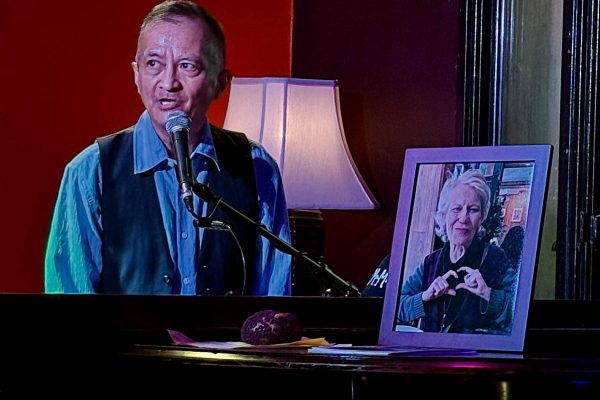

As he stepped up to his piano at the beginning of For Morgan, Nicky Paraiso looked out the intimate audience at Pangea restaurant. “It feels like family in here,” he said.
Sometime in the fall of 2023, Morgan Jenness (she/they) told Paraiso that she wanted Paraiso to sing and perform an evening-length cabaret for her birthday. Even after Jenness died on November 11th of last year, her old friend was able to keep his promise. The single performance of For Morgan on Saturday, August 23, fell on what would have been Jenness´ 73rd birthday.
Over the course of nearly half a century, Jenness collaborated with countless playwrights as a dramaturg, not only nurturing new voices in the theater but also indelibly changing the process of new play development. Oskar Eustis, artistic director of the Public Theater, told the New York Times that she helped define the “midwife and support system of the playwright”; while theatrical agent Beth Blickers noted that, for Jenness, “just telling good stories wasn’t enough” (1). According to a profile for American Theatre Magazine published after their passing, Jenness met Mother Teresa during the 1970s (2). When Jenness told the living saint that they wanted to help her feed the poor in India, Teresa said no. “There’s a spiritual famine in New York,” she said. “Your work is there.”
In addition to working with playwrights such as Maria Irene Fornes, David Henry Hwang, David Adjmi, and Taylor Mac, Jenness was a beloved friend to Paraiso. He and Jenness met in the early nineties while both working with Jeff Weiss on his Obie Award-winning epic Hot Keys (Paraiso was the show´s Musical Director, as well as one of its performers). “The title refers to the keys usually worn around the waist in the bathhouses,” Paraiso explained to the audience with a wink. “This show was Jeff’s way of responding to the AIDS epidemic. Every Friday and Saturday at midnight, we would perform this serialized soap opera at Naked Angels, with a new episode every week, and then later went to PS 122. Members of ACT UP were often in the audience. The show became a kind of church for us.”
Paraiso then launched into a version of Where or When, the 1930s Rodgers and Hart classic that opened those Hot Keys performances. Before his moving rendition was even halfway finished, nearly everyone in the audience joined in. Like me, some were at one of those Hot Keys performances from 30+ years ago; others seemed lost within their own private memories. Less than five minutes into For Morgan, everyone was practically moved to tears. Paraiso ended the song somewhat raucously, as if his emotions were but barely contained during the song.
Except for a few brief interludes of special guests–Melanie Joseph, talking about how much Morgan enjoyed going to Coney Island by herself on her birthdays, read a poem by Edna St. Vincent Millay; Yoshiko Chuma did an improvised dance solo–Paraiso single-handedly carried out For Morgan. The song selection paid heartfelt tribute to Jenness´ memory, exposing the deep friendship the two shared over many years. “Morgan loved this song,” he offered at one point, introducing Far Away Places (1948); later, Paraiso dedicated a Kurt Weill tune to Lola Pashalinski, another renowned downtown theater artist and friend to Jenness. At one point, the audience silently sat listening to a recording of Jenness singing “Happy Birthday” for Paraiso’s 70th birthday, a moment both tender and haunting.

Paraiso is a compelling storyteller, a living chronicler of Off-Off-Broadway´s ongoing history. Even without knowing all of the names he mentions during his spoken interludes, the heart of these stories is their meaning, is crystal clear. “I feel like I got to know who Morgan was,” my companion tells me afterwards.
As a musician and singer, Paraiso displays a fiery intensity, one that folks may not expect from his charming demeanor or his modest physical frame. He poured passion into each of For Morgan´s musical numbers, especially the three Bob Dylan tracks. Paraiso’s version of “A Hard Rain’s Gonna Fall” felt just as urgent as it must have sounded in the 1960s, especially because of he introduced it with a quote by Toni Morrison reminding the audience that art is dangerous.
For Morgan blends personal reflection within a collective space to grieve, a celebration that was a not-so-subtle call to action. The evening was a belated birthday gift to and from Jenness, for friends and colleagues as well as anyone wanting to listen. After the show, leaving Pangea and walking through the East Village, the streets felt crowded with memories and ghosts, I thought about the “political funerals” of ACT UP. Beginning in 1992–right around the same time as Hot Keys, when Jenness and Paraiso met–the AIDS Coalition To Unleash Power transformed the death of David Wojnarowicz into a political event, an outpouring of grief as a display of resistance. Like For Morgan, loving and grieving can be political, and art can be–should be, especially now–dangerous.
Leave a Reply