

As a writer, my primary focus is the infrastructure – social and built – of New York City. This summer, I found myself in a predicament. I had the opportunity to interview one of our preeminent immigration activists, Ravi Ragbir; the problem was each day that passed, my introduction became more and more out of date. When I first wrote it, there were a few rumblings of ICE agents arresting immigrants at court appearances, and one week later the horrifying practice was widespread. Shortly after that, President Trump deployed the National Guard to respond to protests against ICE raids in Los Angeles. Things kept escalating, and I found that my piece, with each passing hour, was being rendered quickly irrelevant by the rapid pace of the Trump administration’s cruelty. When we experience a dramatically new normal every day, how can we write about our current moment?
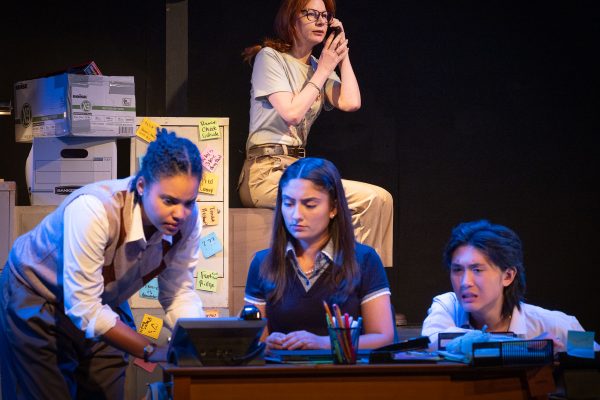
Sitting in 59E59 Theaters’ uncomfortable chairs and watching Nina Kissinger’s “This Is Government,” I was struck that the play, though having its first fully-staged production, too felt out of date. The play centers on three underpaid/unpaid Congressional staffers working the phones in the hours leading up to an important vote on a healthcare bill that would increase funding for rural hospitals and also some other things that the play doesn’t really focus on. Our three characters work for a representative from California: something of a Joe Manchin “moderate.” He is a politician thrilled by press attention even if it means gumming up the wheels of progress instead of actively improving the lives of his constituents.
But then, in shades of 2021, the office must enter lockdown. Someone with a red Toyota Camry parked outside the building is threatening to blow everything up. The three staffers rifle through rusty filing cabinets looking for snacks, complain about having to miss open-mic nights, and melt down. They learn that the bomb threat is actually coming from a constituent, one of their most frequent callers, a mentally unwell woman named Stevie (excellently played by Susan Lynskey). Stevie’s political beliefs are unclear. She sometimes abhors violence. Other times, she calls for the military to take out the government. In every call, she proclaims that she cannot stand the Congressman, but loves when she gets to speak with his staffers: “I love you phone people.”
Recently, however, Stevie’s stopped focusing on general diatribes about astrology or nonbinary teens, and honed in on a single issue: the upcoming vote on the healthcare bill. Our three staffers spend hours listening to Stevie’s voicemails, trying to piece together just what could have radicalized her? Watching the play, one’s immediate impulse — and a correct impulse — is that Stevie must have some sort of tragic life experience that has led her to be invested in the bill to the point of taking violent action. It takes the staffers a while to come to this conclusion — scribbling random biographical details on an ever-growing mosaic of Post-It notes. The truth, eventually revealed, is that Stevie lost her job two years ago when the rural hospital where she was a nurse shuttered. And then, her daughter died from a car accident she would have survived had she not been sent to an emergency room an hour away. Stevie’s anger is very understandable, especially when her attempts to contact her elected officials are stymied by interns who disingenuously say that they’ll pass her message along.

Sitting in 2025, the bill at the play’s center feels almost unimaginable. Just months ago, Congress passed a budget that would strip many Americans of healthcare coverage. (The “Rural Health Transformation Program,” designed to manufacture consent for the healthcare cuts, will ultimately not make up for the funding lost through the budget.) It almost feels nostalgic to hear discussion of lawmakers seeking to expand access to healthcare, especially for underserved populations, and even more so given Robert F. Kennedy, Jr.’s constant stoking of distrust in public health institutions. After public town hall meetings became a political flashpoint over the summer, it strains credulity that someone would escalate from phone call to bomb threat without ever stopping into an office or event. The phone also barely rings, which seems unlikely given the impending vote, and the increasing volume of calls that Congressional staffs field as of late. The play feels like it takes place in another timeline: bomb threats aside, one less suffused with political division, unrest, and violence. .
If the play’s politics feel like they’re from the recent past, the costuming and design feel distinctly 2025 — one character carries around a Labubu dressed in his likeness. The set, however, feels from an older time. Despite having access to online databases, characters sometimes rifle through file cabinets looking for recent press clippings. These same filing cabinets also have ancient granola bars in them. There’s a level of anachronism that feels unaccounted for in the staging.
Theater artists and companies constantly insist that performance is essential for democracy, that all theater is political. But, as I sat in the theater, the ostensibly political play in front of me seemed unaware of the political reality in the world outside of itself. USAID has been eliminated. Cuts to public broadcasting have resulted in the loss of over 100 jobs and counting. Library and museum funding is under threat. It feels that at any moment, everything and everyone we hold dear — even our family and our spouses — could be yanked away. In this play, no one seems concerned about any of that.
This Is Government had its first reading in 2022 in Evanston, Illinois, and has since gone through roughly a half-dozen developmental workshops. Such programs are central to how theater is produced in the United States, giving artists time to reflect on their work, and reimagine and rework the material to (hopefully) prepare for a full-scale production down the road.
In a time of accelerating fascism, are these production pathways able to serve us stories that feel relevant? The play feels like it was set in political amber in 2022: liberal policies promising inadequate and incremental change are ultimately voted down, not by “conservatives” but by Kyrsten Sinema-esque “moderates.” At off-Broadway and regional theaters, seasons are planned years out. (I don’t know if this is the case for this show’s two co-producers: r New Light Theatre Project and Pendragon Theatre). But this model cannot lead to new work that speaks directly to our current moment. And if the theater can’t be responsive, what help can it possibly be in saving democracy? With the rate of political change happening all around us, the new play development process results in works like this one that seem to respond not to a completely different context, but one that is a bit too far away to matter: not so much This Is Government as This Was Government.

Leave a Reply