
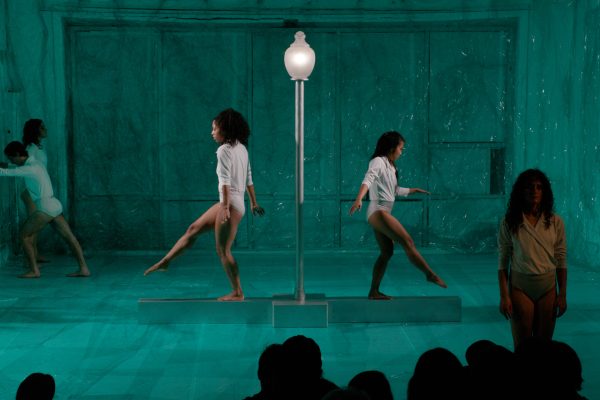
Sitting cross-legged in the long, enveloping loft of Pageant’s performance space in Bushwick, I’m surrounded by walls and floors wrapped in industrial green cling film. A full house awaits. Fluorescent light seems to seep into the flesh of the room, conjuring a gooey Atlantean enclosure. The green film, chosen by design house Charlap Hyman & Herrero, renders a spatial transfiguration unmistakably “Alexa West”. The piece, Jawbreaker Part 1 Part 2, turns Pageant’s stage into something dangerously fecund. West’s sensibilities, ranging from the hilarious to the austere, regularly feel yet-to-be-cool rather than fashionable. The afterglow of viewing her performances often lingers like an electrical hum, a thing felt in the body before it can be named.
I’m defamiliarized by a space that, on my visit just months before, had been a lightly air-conditioned and forgettable rehearsal and performance space above a nail salon. I was there to attend a weekly rehearsal session, and West confided that she wanted Jawbreaker to evoke something “hard and pretty”—a candy to be cracked through, both alluring and resistant. A lurid obstacle that makes reward or ruin beside the point. Yet the atmosphere of the performance on this night, now debuting in September, was soft—as if the entire room had been turned inside out. I glance around, trying to read whether anyone in the audience knows what we’re in for. Even with some insider information, I cannot claim literacy in this world. West is about to challenge us—to ask us to labor with her. Though we won’t be sweating like her performers, we will not be simply watching. And that’s exactly where the piece begins: an invitation to step inside its difficulty.

Audience seating, sealed inside the same green membrane that encloses the walls and stage at Pageant.
photo: Sharleen Chidiac
There’s something alarming in the frenetic motion of bodies meeting precision in Part 1 of Jawbreaker. The five performers appear to become both worker and workpiece across a scattered shop floor. They become tool and operator, loom and shuttlecock, the cloth and the hand that makes it. Their bodies contort toward the demands of their own production, a demand that borders on Cronenbergian, defying both teleology and Darwinian logic. In an attempt to order bodies as if they were machines who manage resistance to the time study [1], they flail and they clamp down. West’s insistence on “doing choreography wrong” folds this control back on itself, making visible the strain and error that virtuosity usually conceals. For the viewer, the dancers sweating before them exhibit a spectrum of fluency and failure within the inscrutable system they navigate. Their bodies shift between reaction, synchronization, and anticipation of the logics of a world the piece imagines into being. In this, they recall David F. Noble’s claim that “such machines are never themselves the decisive forces of production, only their reflection:[2]” the choreography mirrors the very social relations that produce it.
Part 1 moves with immediacy: marches, lunges, gestures driven by a rhythm that never quite adheres to its looping soundtrack. The beat itself skips like a scratched CD or a misfiring piston—pressing forward and soaking the crowd in bass. West’s choreography draws from a bricolage source material, including pep rallies, oil-field fields, military marches, and other rituals of labor built on mechanical alignment. It’s difficult not to project narrative onto a scene that oscillates between the assured familiarity of watching rehearsed scores of modern dance enacted by skilled performers and the implication of witnessing what, in moments, bends toward self-annihilation. Eventually, the system seems to overheat.
The soundtrack shifts to the hiss of depressurization, conjuring a steam engine or perhaps the decontamination chamber of a space vessel. The performers seem to wind down, yet maintain their freneticism, holding transitions between impossibly demanding poses with stillness. It makes my own muscles ache in my seat. The soundtrack devolves into the beat of a single drum, now more of a procedural metronome than a driving pulse, they begin to fold along a diagonal, bodies gradually collapsing toward the ground, each finding motionlessness in their own time.

From left to right: Isa Spector, Amelia Heintzelman, Cayleen Del Rosario, Benin Gardner, Molly Ross
video still: Kayhl Cooper
Part 2 begins like a reset. The dancers move to the sides of the room and start noisily peeling back the layers of green plastic stretched across Pageant’s walls. Beneath the film are stashes of water, packets of electrolytes, grooming tools, and uniforms—items meant for maintenance, for keeping the body functional and regular. One by one, the performers drink, wipe, and reassemble themselves, as if on a locker-room break during shift change. While the moment of rest seems completely necessary to the performer, by making this recovery visible, West recognizes rest as a part of work, and by making its banal intimacy public, she insists on rest as part of the work. Though laid bare for the consumption of the audience as a continuation of spectacle; this choice also marks an uncommon ethic.
In their matching jumpsuits, a pair turn toward the looming metal structure at the back of the room and gently free it from its plastic. They push the tall, spindly form forward toward the audience. This relic of civic infrastructure—lamppost or conduit—is repurposed by its own inertia into a siege weapon. Upon coming to a stop, the bulb at its peak glows with a shared touch. In this second act, the presence of the apparatus makes the score of the performance feel less mysterious. The choreography grows more codified, bound by the apparatus’s spatial constraints. In Part 2, competition now emerges in diametric opposition, as a pair of performers mirrors and counters one another, hopping on and off the narrow metal base. The metal itself joins the exchange, its timbre reverberating with an industrial coolness, ringing with each slap of the feet. The apparatus seems to become the object of affection here, if not the judge of performance. After a refrain of near-touching and the smacking of lips (a smooch directed at whom?) one performer leaves the platform and moves to face the audience at the front of the stage. The cycle continues until each performer faces the audience.

From left to right: Isa Spector, Molly Ross, Benin Gardner, Cayleen Del Rosario, Amelia Heintzelman
video still: Kayhl Cooper
Watching Jawbreaker, I keep thinking about games and the ways rules are enforced. West’s choreography conjures a familiar loop: the pleasure of learning a set of rules to the frustration of finding those rules have shifted underfoot. The moment of disorientation becomes its own kind of play, a test of how quickly one can reorient, adapt, or pretend to understand. Her performers improvise within an invisible and capricious score. The fantasy of equal footing is one of the most enduring mechanics of play, and one of the ways games are quietly designed against many of those who find themselves playing.[3]
This question of fairness and transparency in rules shifts, in West’s performance, from outcome to process. West’s rehearsals are truly non-hierarchical: performers freely interpret and suggest movement as they go, shaping the score together rather than executing a fixed plan. Collaged gestures and personas gleaned from videoclips are filtered through practice until an experiment becomes a score. In rehearsal, playful portmanteaus take shape as a shared vernacular. In performance, that language continues to evolve; dancers tighten the piece during the show, not at West’s direction, but through some kind of “commitment to the bit”. Fairness here isn’t a rule but a relation, one continually renegotiated through the performers’ mutual attention, trust, and play. To West’s credit, it’s an ethic she fosters not only in her choreography but in her collective projects, such as Pageant itself.

From left to right: Molly Ross, Amelia Heintzelman, Isa Spector, Cayleen Del Rosario, Alexa West, Benin Gardner, photo: Sharleen Chidiac
By the end of Jawbreaker, the dancers are slick with sweat, their feet darkened by contact with brushed aluminum. They stand facing the audience, forming a barrier, an image of defiance, even in their restrained panting. Jawbreaker doesn’t name its workers as such: there are no Amazon couriers, Uber drivers, or loom operators. It does not call for the smashing of machines. Instead, it materializes instability, even among this diverse, youthful, agile group of able bodies who perform. From strain, the work presents a strange, albeit familiar, less-than-sustainable world. The production itself—one matinée and three evenings of performance runs, and months of rehearsal and fabrication—mirrors that exhaustion. West, her performers, and her team have already sweated plenty before this one hour performance began.
Jawbreaker metabolizes the language of work: the drills, the rest breaks, the shared fatigue. At a moment when so much of life feels managed by platforms and precarity and constraint, West’s choreography aestheticizes labor. It shows us the quiet violence of having to keep performing inside a system that no longer holds. Yet, Jawbreaker does not valorize bootstrapping resilience or overcoming hardship. Her performers “do it wrong” together; they fall out of sync and prop each other up but they also compete and use one another like tools. There is refusal in this piece to showcase individual mastery, heroism, or victory. Jawbreaker doesn’t preach how to live or work within the systems many of us inhabit. I search for a word free from the violence of “discipline” and “rigor” that could drive a future, a force to fuel a shared practice of care negotiated between bodies, between exhaustion and rest, toward a project larger than the individual.
Jawbreaker pushes me to imagine how representations of interdependence might interrupt the contemporary aesthetics of relation. The gestures of staged togetherness we’ve inherited too often reproduce the networked, mobile, and adaptable logics that relational art set the table for—logics that would come to define gig work as we know it.[4] Actual transformation will generate friction and call for care; work will require rest, and resentments made will require dialogue. West’s piece doesn’t resolve such tension so much as keep it in motion, reminding me that relation itself is a practice still being learned.
An adaptation of Jawbreaker Part 1 and Part 2 will be presented in November, 2026.
Acknowledgments:
Choreography and Direction: Alexa West
Dancers: Cayleen Del Rosario, Benin Gardner, Amelia Heintzelman, Molly Ross, Isa Spector.
Set Design by: CH & Herrero, Architecture and Design Firm, https://www.ch-herrero.com/
Sculpture Design: Harrison Milne
Sculpture Fabrication: Wyatt Accardi
Lighting: Chloe Friend
Photography: Sharleen Chidiac
Videography: Kayhl Cooper
This project was supported by Movement Research AIR program and FCA Emergency Grant
Notes:
- Noble, David F. Forces of Production: A Social History of Industrial Automation. Oxford University Press, 1984, p32.
Noble describes a 1955 meeting at the Lycoming Engine Division where management lamented that workers were “fighting our time study”.
- Ibid, p324. Noble argues that automation’s evolution is never purely technical but mediated by “social power and domination, by irrational fantasies of omnipotence, by legitimating notions of progress.”3
3. Trammell, Aaron. Repairing Play: A Black Phenomenology. The MIT Press, 2023, p55-56. Trammell shows that even seemingly neutral games reproduce hierarchies—turning some participants into objects of control rather than equal subjects.
- Relyea, Lane. Your Everyday Art World. The MIT Press, 2013, p124. Relyea observes how poststudio and relational practices’ “mobility, flexibility, and networking echo the new model worker” of post-Fordist enterprise.
Leave a Reply