
Dear friend,
Were you concerned I had not made it alive? What with the travel and the turmoil? I assure you I am fine, and have found myself as safe as anyone safely living in the west (I don’t need to expand this thought, do I?). Your care package has not arrived, however, as promised, my dear, here is my first dispatch which I certainly hope makes its way to your eyes.
Yes, it is very true that London is still a place of intersections. When Rome initially invaded them, they certainly took it to heart, incorporating Roman governance and circular roads. And, all roads do seem to gather here between the Global Majority and the girded West. What lives on the roads? People, artists, writers, musicians, photographers, sculptors and filmmakers are all moving as quickly as this time. New centers have opened, the parks are filled with voices, emerging: a waking up if you will – some speaking directly to power, others cautiously walking around the scene. I know – that is opaque! But you try to nail down something evolving in front of your eyes while you attempt to “look right” while crossing every street (I am starting to wonder if forced views to the right have not been a political scheme all along? I digress.)
This past weekend I attended the opening of a new art center – Ibraaz founded by Lina Lazaar, promoting global majority voices that aims to be a space for “difficult, urgent questions” alongside civil debate. It is funded by the Kamel Lazaar Foundation, the philanthropic organisation named after Lina’s father, the Tunisian businessman who has championed North African and Middle Eastern art. Now, as one from Brooklyn, I wondered what a difficult conversation might sound like in London. Would there be throwing of jabs? Would there be hard truths? Would people walk out grabbing their umbrellas aggressively to flee?
What I found, as I entered their elegant, 10,000-square-foot space in Fitzrovia, central London looked downright respectable. However both the smells and the words were immediately different: to the left, beautiful watermelons stacked a high wall to a deep, terra cotta cafe. To my right, Maktaba Bookstore, curated by Writing Gaza in collaboration with Ibraaz Publishing, had stacks upon beautiful stacks of books, humming, waiting to be read.
As we walked deeper into what was once a private club, later a synagogue, now Ibraaz’s heart, its vaulted ceiling shaped as a communal listening space is filled with the work of Ibrahim Mahama. The great Ghanaian sculptor, and his piece, “Parliament of Ghosts” – is a reflection on the impact of colonialism on the social histories of Ghana, but something deeper: a new place to gather within the context of the past.


Mahama’s piece, permanently placed now in Ibraaz, brings the ghost of place, of Ghana, into a tactile “archive” – everything in his piece was transported from the colonial railway and he has built what might feel like cubbies, or a stockroom for culture to the very tips of the walls. Chairs too, found in the modern homes of families of Ghana, have been recovered with differing fabrics, and positioned into a semi-round, what Mahama calls this ‘reverse restitution’– and what Ibraaz defines, “Once signifiers of authority within patriarchal structures, they are here reassembled into a parliament that privileges presence and dialog over power.” Recycled chairs, ancient cloth, and shelves overpacked with the “stuff” of the colonial past – folded old jute sacks that carried the materials of Ghana up into the empire, empty now – but not disappeared.
The chairs were filled with people Ibraaz had invited for an early sneak peek: friends, artists, those whose work was to be shown in the coming year. Many of us sat on the floor, the room filled to capacity, and looking at this official gathering, a parliament of people, the room held a serious and focused intent. We listened to the Maronite Choir of Our Lady of Lebanon, words were offered by Lena and Kamel Lazaar – nervous, excited and expectant for what a new space may bring. The great Naseer Shamma, Iraqi oud musician played dazzling pieces that vibrated in the room, and the legendary Patrick Chamoiseau read from his Cosmopoetique de la Mondialite. Serious, focused, the group was held with like stillness throughout.

And, when Ibraaz’s Hammad Nasar, Director of Programmes and Content, stood to speak he posed, “How do we treat our ghosts as guests?” There, in that Parliament of ghosts, the presence of the past had forced focus. And, I felt that the “difficult conversation” had little to do with words, but sitting in that stillness, one moving away from Britain’s long history of rationalism/control and into this moment of 2025: a bringing forward, and sitting in a layered practice of the presence of ancestors.
Nasar’s comment stuck with me as I walked home into the cold night – who are the ghosts whose visitation we hold? I thought of the photographs of Misan Harriman in his new show, The Purpose of Light (at Hope 93 Gallery). His images of people holding placards at five years’ worth of public protests have grabbed the city by the heart; images are stacked between two floors with a constant stream of visitors traveling far and wide to sit with them. As only the English might, language, humor, irony pack each image and the show is just as much a lesson in poetry as it is of community portrait: renegade language captured by his lens.


I can’t forget to tell you — Nigerian Modernism at the Tate Modern is about to open. It traces five decades of artists reshaping the modern through a Nigerian lens — Enwonwu, Yusuf Grillo, Ladi Kwali, Bruce Onobrakpeya. The show moves like a long echo, revealing how African modernism didn’t follow the West; it informed it.
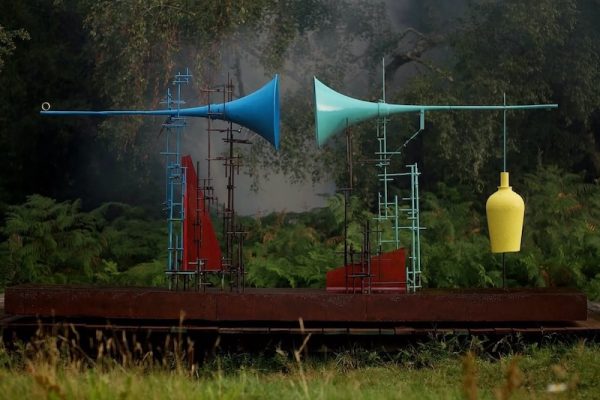
And then Frieze Masters opens its fields to In the Shadows this month, curated by Fatoş Üstek — sculptures that lean into fragility, humor, and the invisible pressures that shape us, Ustek states, “Sculpture can be humorous, unruly, fragile; it can resist the expectation of permanence and instead lean into the reality that change is the only constant.”

Among the artists there, Abdollah Nafisi’s Neighbours feels almost like a response — a meditation on presence and listening, perfectly of this London moment:

So, my friend, you ask what is happening here? Women curators rising. Artists reframing a language of listening—and the space of the past is being curated to physically inhabit all of it. Yes. There is a presence of ghosts. And all this unfolds at the crossroads of a strange new history. It’s not “difficult” like New York—no rudeness, no perspectives roasted on orange spikes. It’s quieter, more haunted, and I find myself changed here, my friend. Time itself seems to be shifting.
Ah well. Tell everyone I send my regards, and to keep an eye out for my next dispatch – and please do remember to look up at the sky – the clouds are leading somewhere.
Fondly,
Sarah
Featured Artists and Institutions
- Ibrahim Mahama, “Parliament of Ghosts,” permanent installation at Ibraaz, London. Courtesy of Ibraaz.
- Misan Harriman, “The Purpose of Light,” Hope 93 Gallery, London.
- Nigerian Modernism, Tate Modern, London.
- In the Shadows, curated by Fatoş Üstek for Frieze Masters, with quote from her interview in Art Plugged.
- Abdollah Nafisi, “Neighbours,” presented at Frieze Masters, Regent’s Park, London.
- Patrick Chamoiseau, Cosmopoetique de la Mondialite
Photography
All photographs © Sarah Kornfeld, 2025, unless otherwise credited.
Misan Harriman, for Hope 93 The Purpose of Light (at Hope 93 Gallery).
Abdollah Nafisi photo: Guy Bell | Alamy Live News.
Additional References
Leave a Reply