
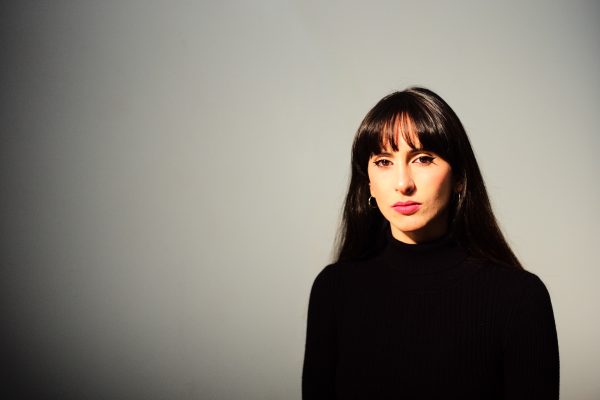
Claudia Hilda is a dancer, choreographer, and creator of visual narratives from Cuba. Creating highly gestural scores, Hilda relies on the body to bring narratives. The body becomes storyteller.
In Neither Here, Nor There – The Migrant Body, currently on view at CARVALHO in Williamsburg until November 1st, Hilda utilizes her multidisciplinary practice to create an immersive exhibit where projected images of bodies move, in front of a view, along an illuminated screen. Dedicated to questions of displacement, migration, geography, and movement, this piece highlights the extremity of changing locations: how an attempt at change does not always beget improvement, and in fact can lead to further danger. Culling from her background in dance– Hilda was a principal dancer in The Cuban National Company of Contemporary Dance– and her inclination towards the visual, Neither Here, Nor There is a timely genre-expanding project where the process of making produces a work of art. Hilda has previously shown work at BAM, and in Venice as part of the Architecture Biennale. Read on to hear about Hilda’s process of creation, an explanation of Neither Here, Nor There’s place in her larger body of work, and her identity as a multi-genre artist and maker of work.
This conversation has been edited for length and clarity.
Eve Bromberg: To begin, can you describe what the experience of traversing the gallery is like? Do the bodies in the installation seem to follow or move with the viewers?
Claudia Hilda: Neither Here, Nor There. The Migrant Body, is a 24-foot-wide, 9-foot-tall video installation exploring memory, migration, and the experience of living between cultures, languages, and geographies, between “HERE” and “THERE.”
The installation offers an immersive and intimate experience, inviting the audience to approach the piece closely and actively connecting in dialogue or just to gently engage with the gestures of life-sized human silhouettes that slowly emerge across the surface of the screen in front of you. These figures reach forward, delicate yet quietly urgent, as if seeking contact, reunion, or recognition from the audience on the other side.
Their movements speak to separation, longing, and the impossibility of existing fully in two places at once. Most of the performers are Cuban, some still living on the island, others who have emigrated and built new lives elsewhere. Their bodies, joined by friends from New York’s Latin American community, form a collective embodiment of shared history and resilience.

The projected figures moving within the composition were created through a carefully gestural direction process that moves through a cycle of pedestrian and performative movements transforming the wall into both surface and threshold: a division, yet also a conduit of invisible connection. Beneath them, a darkened reflective pool evokes the Rio Grande and other bodies of water crossed by migrants, extending the installation into a meditation on passage and transition.
Accompanying the visuals is a 40-minute sound composition drawn from interviews with Latin American migrants living in the U.S., the U.K., and across Europe. Their voices, in Spanish, with subtitles, recount on their perpetual transition state when continuously crossing geographical, linguistic, cultural, and emotional zones. Together, the dissolving bodies and layered soundscape mirror the fluidity of memory: vivid, fragile, and persistent.
Ultimately, The Migrant Body installation piece collapses the boundaries of time, place, and identity, creating a space where what seems to vanish insists on being remembered. It reminds us of our collective desire to connect and to bridge the distances that divide us, between one another, and between the selves we were and the ones we are becoming.
EB: Did you grow up dancing and studying visual art?
CH: I grew up as an artist in the broadest sense of the word. In Spanish, artista refers not only to visual creators (as I’ve noticed this semantic relation-assumption in English language), but to anyone who lives through creativity. That’s how I’ve always understood myself: curious, daring, and driven to express ideas in whatever form they demand, sometimes through choreography, sometimes writing, sometimes visual composition or film.
My formal background is in dance. I trained within Cuba’s exceptional dance school system, which merges contemporary dance, ballet, Afro-Cuban traditions, “flying low,” and Cuban modern techniques rooted in Cunningham, Limón, and Graham. The result is a language of extraordinary versatility and physical and emotional range.
I later joined Cuba’s National Contemporary Dance Company, performing as principal dancer internationally for over a decade. But at the height of my career, I began to feel the urge to move from interpreting others’ choreography to creating my own. At the time, choreography in Cuba was still heavily male-dominated, and I wasn’t seeing work that inspired me. A friend once said, “If you’re not seeing what you like, it’s your responsibility to create it.” That became my turning point.
I applied for the Chevening Scholarship, a UK government program for emerging leaders, which allowed me to pursue a master’s degree in choreography and the arts in London. There, I encountered creation through a new lens, one of creative freedom and interdisciplinary thought.
My practice has since evolved into a cross-pollinated, multidisciplinary form. Though not trained as a traditional visual artist, I’ve always been a visual thinker, inspired by Cuban masters like Wifredo Lam, Amelia Peláez, Ana Mendieta, and Belkis Ayón. For me, art has never been confined to a single discipline. It’s something layered, heterogeneous, and alive, like life itself.
EB: How did you transition from performance to visual media? What did that process look like?
CH: The transition was very organic. Even as a choreographer, I’ve always been drawn to the visual elements surrounding movement, costume, space, and objects that act as extensions of the body and that allows me to approach choreography as a living, complex action.
Costumes are integral storytellers and collaborators in my creations. They hold conceptual weight and shape movement sometimes by restricting it purposefully, sometimes by amplifying the dancers’ flow by acting as a brushstroke in the space. Often it sparks the conception of a piece as in my piece Merits, for instance, a dancer begins covered in countless heavy golden medals representing political honors that gradually become burdens and are eventually removed in a ritual of release and self liberation. While in Podium, a forty-pound garment designed by Celia Ledón dictates the choreography, exploring power, resistance, and transformation.
Creating theatrical, and scenographic worlds where performers and audiences engage immediately within familiar, magical, or even unreal landscapes set onstage, fascinates me. The intersection of dance (which can be highly abstract) with physical structures and objects on stage; humanizes the performative action in ways that deeply interest me.
This exploration of objects and visual compositions began in my stage work and kept expanding, even when I was not actively making a dance piece. Since producing a large-scale performance production is often costly, I began experimenting in my studio, creating visual installations that explored the same ideas through digital media, objects, and natural materials.
Across all forms, the constant is the body; archive of memory, experience, and survival- I cherish and respect deeply and to which I am devoted to. After a lifetime in the performing arts, even when I explore new mediums, it feels natural to return to what I know best and from there, expand.
EB: Were the dancers following a choreographed score during filming?
CH: There was no fixed score. I rather guided each performer through a process rooted in physical and emotional memory activation, prompting them to recall the sensations of crossing, transition, and belonging.
The work holds an anthropological dimension. Not only through the oral history component, interviews and shared reflections but also through the understanding and realization that our performative bodies are cultural bodies first- carrying the memory of others in the movement of our own.
I pursued an authentic and intimate movement composition through each performer’s oral and physical narration. At times pedestrian, at times performative, chaotic, yet sensual. Individual yet collective. The movement had to feel lived, not choreographed. Filmed behind a translucent screen, the dancers inhabit a metaphorical border, that space between presence and absence, time and memory. Their gestures are intimate, fragmented, and shifting, like memory itself.

EB: Can you speak about the paradox built into this piece?
CH: I wanted to create a work that only comes to life when the audience enters the space, a piece completed by presence. When visitors walk in, they encounter a dark, theatrical environment. Life-sized figures move across a fog-like surface, ghostly, luminous, unreachable.
Beneath them, the reflective pool mirrors their movements as an inverted cosmos. Only then you realize: there are two worlds, one above and one below, both real, both searching for one another.
That moment of recognition, when viewers stand face to face with the projected bodies, separated only by water, is the heart of the piece. Two groups, divided yet connected, reaching silently across a somewhat abstract-physical border.
Water, also carries ancient symbolism. Civilizations once used it as a “stars mirror” to study the heavens, to look down in order to see what is above. Reflection as revelation.
Another paradox lies in the use of canvas, the traditional surface of painting. By projecting onto it, I question what belongs in a gallery. Here, the canvas holds not pigment but living, moving bodies. It becomes both painting and screen, both border and portal.
EB: Do you see your performance and visual practices as separate?
CH: Not at all. They intersect deeply. My process is increasingly fluid, a convergence of intuition, cultural memory, critical thinking, body knowledge and something divine that always accompanies creation. Every idea arrives with its own rhythm and material form. My task is to translate that vision into the world. There is always performance in my visual work, and always a visual sensibility in my performances. They exist in constant dialogue.
EB: Has your visual practice changed how you think about archiving performance?
CH: Because performance is inherently visual to me, my choreographic ideas often begin as images, settings in my imagination. My performances become visual art in my mind even before they are translated into movement and space. The processes of creation, experimentation, documentation, and performance all exist as part of a single, continuous flow, different expressions of the same artistic impulse.
Archiving, for me, emerges from the ongoing research and reflection that take place throughout this process. In my recent project Realismo Mágico, presented at the Brooklyn Academy of Music in February 2025, I worked as art director, choreographer, and producer. I incorporated video projections and stage settings and documented the entire evening, which featured a full one-hour dance piece performed twice in one night. The event expanded into a multidisciplinary experience as we curated the entire building with visual art installations alongside artists José Parlá, Ricardo Cabret, Cassandra Mayela Allen, Afro-Cuban percussion ensemble Clave y Cuba, and photographer Stefan Ruiz. The night also featured a rare vinyl DJ set by Parlá, highlighting the rhythms of Cuban and Puerto Rican music, Rumba, Salsa, Guaguancó, Bomba, Plena, and more.
Working across disciplines is, in itself, a form of archiving. Each collaboration, medium, and layer of expression becomes part of the living archive of the work.
EB: Where does Neither Here, Nor There – The Migrant Body fit within your larger body of work?
CH: This work represents the “now” of my practice, the truest expression of my life as a Cuban migrant in New York City.
It embodies duality: communism and capitalism, past and present, scarcity and abundance, rawness and refinement. It also continues my exploration of merging organic materials with digital technology. In earlier works like Sacred Grounds, I combined stone, wood, and screen to create sculptures that placed the female body at the center. I’m drawn to paradox, to finding intimacy in impossible unions between the natural and the virtual.
The inclusion of real water in this installation was essential. I’m grateful the gallery trusted that vision. Ultimately, this piece exists at the intersection of performance and visual art, the organic, the human, the digital; worlds that now fully merge in my practice in a kind of magical realism expression that shapes how I live and create.
EB: Are you still dancing yourself?
CH: I dance when I’m awake and when I sleep. I danced today, and I’ll be dancing tomorrow and always! If the question means professionally for a company, then no. I no longer perform for a company. My focus is on creation: gestural, visual, and conceptual. Each day in the studio feels like a return to the body, to imagination, to endless possibilities. Through that process, I continue learning about myself, about others, and about the world that holds us.
Neither Here Nor There is on display at Carvalho Gallery until October 25th. See more information about the exhibition here.
Leave a Reply