
After seeing Nazareth Hassan’s visceral and experimental Bowl EP at Vineyard Theatre, I knew that they were an artist I wanted to follow. Bowl EP, a surrealist drama, follows Kelly K Klarkson and Quentavius da Quitter– both rapper cum skaters– as they freestyle rap, develop a romance, and slay their personal demons. The production included an elevated, in-the-round stage with an empty bean-shaped pool carved into it, as well as live skateboarding and original music. I’ve yet to see anything like it. With Practice, I expected to be similarly surprised, disgusted, and engaged and I was not disappointed. Keenan Tyler Oliphant directs this expansive, beautiful monster of play with humor, deep understanding, and risk. This production is an ambitious and epic examination of the conditions of abuse within artistic spaces during creation.
In Practice, Asa Leon (she/they, played by Ronald Peet), a contemporary, famous Black performance artist in their early thirties, auditions a company of actors from around the world to devise an autobiographical new work where the cast must rely on their own experiences for performance inspiration. Rehearsals take place in a Brooklyn rehearsal space that Asa has purchased with the help of massive grants like the MacArthur and her trust-funded husband and business partner, Walton (Mark Junek). For this eight week rehearsal cycle, the performers are sequestered to the space, which will eventually culminate in performances in both Berlin and London.
Practice starts without a curtain. The set is a retrofitted church: a sparse black rehearsal space with school desks, stone masonry, and a DJ set up. Stoic Ro (Opa Adeyemo) is the first cast member-hopeful to enter. He tells us about his experiences being charismatic, having no trouble getting laid, frequenting bars, and yet, being deeply lonely. His monologue appears to be a direct address to the audience, until we hear a disembodied voice from the stage manager’s booth say, “Why?” and realize Ro is at an audition and delivering his lines to Asa. Upon hearing this voice, I immediately swiveled my head to look for our God for the evening. Ro completes his audition, and we then watch all the other character’s auditions, in which they approach the material in different ways, some hilarious, others quite touching. Asa continues to interrupt the auditions with prying psychological questions: “What parts of you are exacerbated in Spanish? Rather than English?” Asa asks Mel (Karina Curet), a white Chilean actress. “Do you feel…that you need to work to deserve companionship?” Asa asks Tristan (Omar Shafiuzzaman), an insecure 22-year-old British-Indian actor. As the auditioners start shielding their eyes, and looking up towards Asa, more audience members clued into the fact that the play was also taking place in the booth. This queering of the theatre social contract, a signature of Hassan’s work, made me alert. I, as a viewer, would be implicated in this story. I would be part of the rehearsal occurring before me.
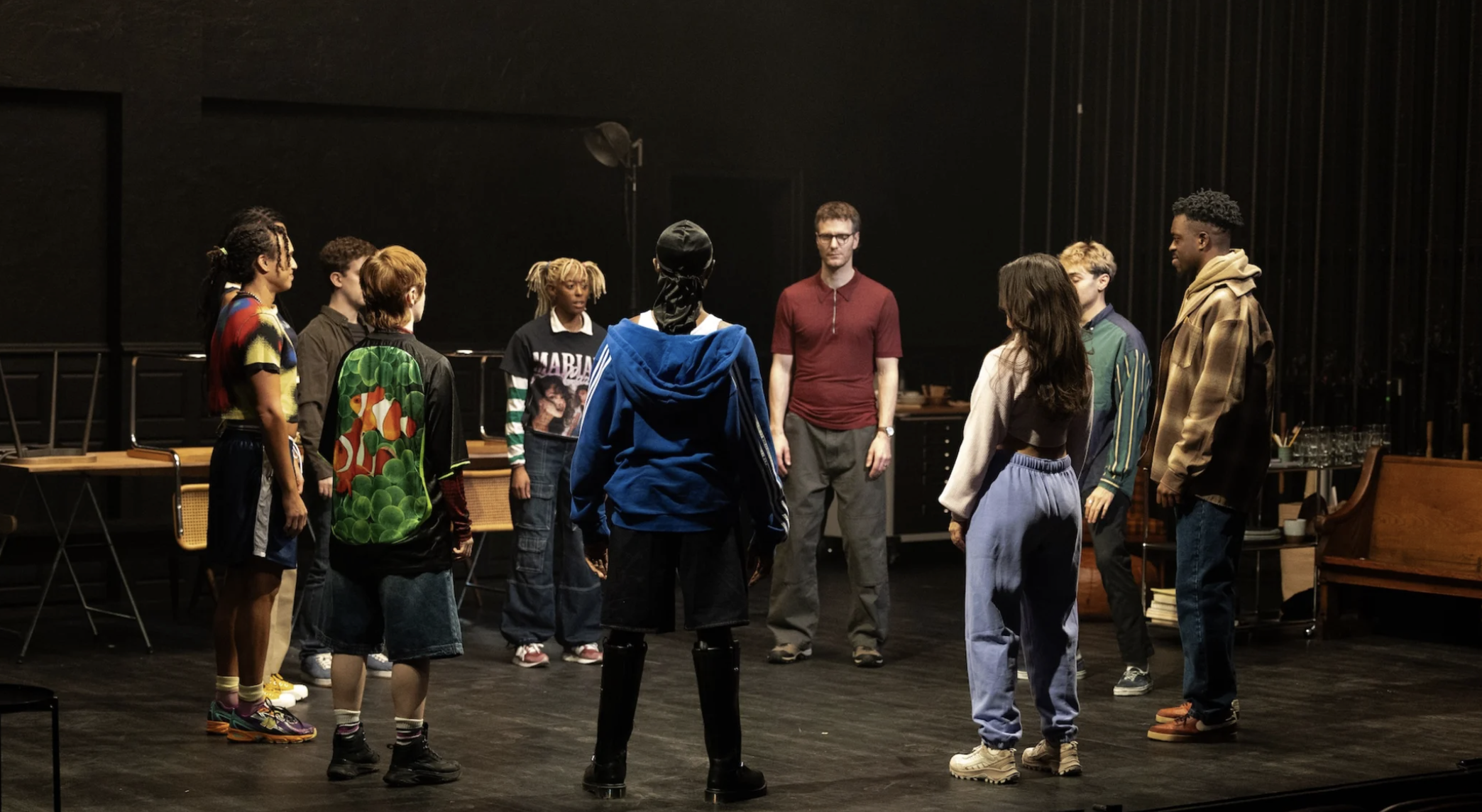
Once the auditions are over, we jump to the selected company’s first rehearsal where they do two truths and a lie and a jumping exercise. The cast is stumbly, awkward, but hopeful: Ro, a 26-year-old Black American actor; Angelique (Maya Margarita), a 24-year-old Black trans actress; Rinni (Susannah Perkins), a 23-year-old German sculptor turned performance artist, Tristan; Mel; Keeyon (Hayward Leach), a 23-year-old Black American gay dancer and performer; and Savannah (Amandla Jahava), a 21-year-old Black American actress with Jamaican heritage. At dinner, we officially meet Walton and a hapless white 32-year-old male dramaturg named Danny Barron (Alex Wyse). Walton, we learn, not only funds the company but acts as their set designer. The company eats on a long table on the old church’s stage, where they also rehearse. During the dinner, the company creates an accountability system with their shared values they want to focus on during rehearsal: rigor, vulnerability, honesty, respect, and curiosity. Danny writes these values down on a dry erase board, after which Asa casually adds that they will tally themselves and each other weekly from 1 to 5: 5 requires readjustments, while 1 points towards “a need to reassess [the company’s] needs”, a code for failure. Danny quickly, almost imperceptibly mentions, “Oh, and please turn in your signed releases if you haven’t!” The entire eight week rehearsal (even non-rehearsal hours) will be recorded.
Practice unspools week by week, showing us the drippy, trippy ways abuse seeps in. Over time, the company gets better at the jumping exercise– an attempt for them to jump in unison– and be in unison. About three fourths into the first act, the company begins to move at the same pace and sit at the same time, as if they are one body and mind. And yet, this unity is not all harmonious. It erases individuality, punishes conflict and differences, and creates factions. Keeyon begins to sleep with Walton. During a party, where the company takes shrooms, Ro uncovers a buried child sexual assault trauma. He is forced to share this memory with the group, but receives neither support nor acknowledgement of this information shared. He’s not alone. Each character’s deepest secrets, and trauma, are teased out of them and then manipulated in some way for the sake of the devising process. Here is where the recordings become quite sinister.
While the company is aware of them, the recordings are later weaponized and used during questionable states of consent, like the shroom party. The characters never know how many cameras and microphones are actually in the space. During an exercise where the group is divided into partners, each one must recite a secret of their partner mimicking their partner’s mannerisms and speech patterns.
Rinni and Angelique are partners, and Angelique does not want to share. Rinni and the rest of the group egg her on. Asa tells the group to give Angelique space, and tries convincing her first by revealing a secret, but to no avail. Asa, in response and retaliation, then plays a recording of Angelique confiding in Mel during the shroom party. In the video, Angelique states that she does not trust Asa and doesn’t like that they make them do exercises without also participating in them. Angelique, publicly shamed, doesn’t respond. The group continues the exercise, and a few scenes later, Angelique escapes in the middle of the night. This shaming is one of the sharpest moments of Practice, alongside what I’m calling the jelly bean incident.
Asa munches on jellybeans throughout the play, and Danny is the handler of the beans, bringing Asa jars whenever they ask. One day Asa starts dinner by saying that someone has robbed their jellybean cabinet. The cabinet is in the basement, a location without cameras or sound recordings. There is no way to know what happened. Asa gives the company an ultimatum: the jellybean thief must reveal themselves or they will withhold $400 from this week’s company wages. When no one speaks, Asa commands Danny to play back interrogations Asa led with every company member but Mel. Each names Mel as the potential thief because she likes jellybeans and had asked Asa for some a few weeks prior. Mel is stunned, and denies the theft, until Asa threatens her. “Don’t give up your visa,” which Asa is sponsoring. Cornered, Mel says she wanted to try some jellybeans and spilled the can on the floor, so she threw them out. Asa thanks her for her forced confession. Then makes her wear a dunce hat that reads “thief”. In the next scene, Mel jogs in place, dunce cap on, as the company and Asa, eating jellybeans, sit and watch her.
In the next scene, Asa introduces a phrase she’ll force the group to recite repeatedly: “I’ve taken up residence in the minds and bodies of my company. They would do anything for me.” The actors do it over and over, Asa stopping them if even one breath or consonant is out of place. In the next scene, Asa giggles as they run in place, sweaty and spent. Asa, like a drill sergeant, does not let them stop. Blackout.
At intermission, the house lights slowly turn on. The production’s actual stage hands start building the set for Act 2: a huge double-sided mirror-box that Walton designed. We can see the actors, but the actors only see themselves. Asa enters on stage and stares villainously at their mirror-box set, which protrudes from the upstage wall. When I left the theater to stretch my legs, the box was at center stage. By the time I returned and act two began, the set was at the lip of the stage, as if ready to knock Asa off her pedestal.
Featured in Practice, and at the start of Act 2, is a play within a play. Called SELF AWARENESS EXERCISE 001: HOW TO START A CULT, the play is a performance piece in which the company– minus Angelique– wears white clothes and eye masks while dancing in the mirror-box. When they speak chorally, they are the voice of Asa. The company chants the ominous phrase Asa introduced earlier. What was previously unsettling is now damning. Asa’s goal for SELF AWARENESS EXERCISE 001 and in selecting this company, has been singular in focus the whole time: to build a cult, an artistic hive mind with Asa as queen bee.
During this performance, performers mime Asa’s narration and take turns reciting monologues of each other’s deepest secrets (Rinni plays Ro, Ro plays Keeyon, Keeyon plays Savannah, Savannah plays Mel, Mel plays Tristan, and Tristan plays Rinni). Rinni, embodying Ro, wears a blackface mask and speaks in a blaccent. Tristan’s posh accent turns into a Cockney one by Mel. Ro plays Keeyon with a gay lisp. These small details reflect the play’s overall strength in the analysis of how queer, multiracial progressive spaces are still plagued with abuse, misconduct, and bigotry.
In one vignette, the company and Asa confess that they gaslit Mel into believing she had stolen the jellybeans, which never actually were missing. Asa engineered the situation to see how the company would react. This felt quite obvious and inevitable to me, as did the rest of the monologues. Asa eagerly professes that they are “a huge narcissist” who has dealt with years of artistic teachers who have taken advantage of them: “my mental breakdowns became my craft…and when the harvesting was done, [my teachers] would put me on their lap and fuck me to sleep.” Asa wants this experiment to be proof of the psychological damage that they were subjected to in their twenties while documenting the damage they continue to wage on their subordinates: proof of her narcissism, proof of her pathology. At this point of Practice, I felt we had spent far too much time engaged in Asa’s psyche. Because I am interested in the conditions of abuse– power, access to money and people, isolation, a reputation, name recognition– I wanted more attention paid towards these questions toward the end. I believe and understand Asa when in the performance they say, “I was destined to be hazed by [the theatre industry],” but I cease to care, as we watch Asa put their performers through a humiliation ritual that financially benefits them. Rather than clarifying, Asa’s monologues felt heavy-handed: attempts by the writer to soothe the audience and justify both Asa’s performance and Practice itself.
Earlier, after Angelique’s departure, I found myself curious about the decision to have her escape. While I was glad that Angelique was protected from the worst of it, I wonder if her removal signified a certain amount of narrative exclusion brought on by Hassan themself. By her exile, is she also exiled to us as an audience? During SELF AWARENESS EXERCISE 001, Angelique is represented by a puppet that the performers attack as a punching bag. This action demonstrates Asa’s sadism but also implicates the audience as voyeurs that felt unproductive, especially compared to earlier parts of Practice. We were forced to watch her stand-in be decimated. What does she get from this? What do we?
What of the three hour run time? I understand the impulse. As Asa seduces her actors, so does the production attempt to seduce us. The length worked for me. A play about practice needs to show a lot of it. However, showing all the stops and starts, got a little recursive, even for me, and I am a theatre-maker. But I welcomed this tension as this play feels like an urgent conversation with and about theatre artists. And for non-dramatists there is much to chew on, even if you get lost in the details and theater games of it all. If there are cuts to be made, I’d suggest any monologue of Asa’s where their speech results in them getting what they want. I wanted to be surprised and unable to predict the consequences of Asa’s speeches. A moment like this did happen when Asa reveals to know Keeyon has been fucking their husband.
Practice shows the artifice of power and prestige in our art world, and how its hollowness facilitates situations in which people must cling to abusive conditions in the hope of connection, financial security, artistic success, or spiritual wholeness. Is Asa working alone? No. Of course not. Their white husband and main benefactor Walton, as well as Asa’s standing in the performing arts world, co-facilitate this abusive experiment. The company sacrifices and alienates its most vulnerable members to avoid punishment and keep their jobs. Practice reminds us abuse is not created in a vacuum. Each of us has a role to play in either letting it fester, being at its clutches, combatting it—oftentimes this is all being done at the same time. Asa’s final words to us are “This has been a self awareness exercise.” So, now we’re all aware. What will we do?
Photo by Alexander Mejía, Bergamot.
Leave a Reply