
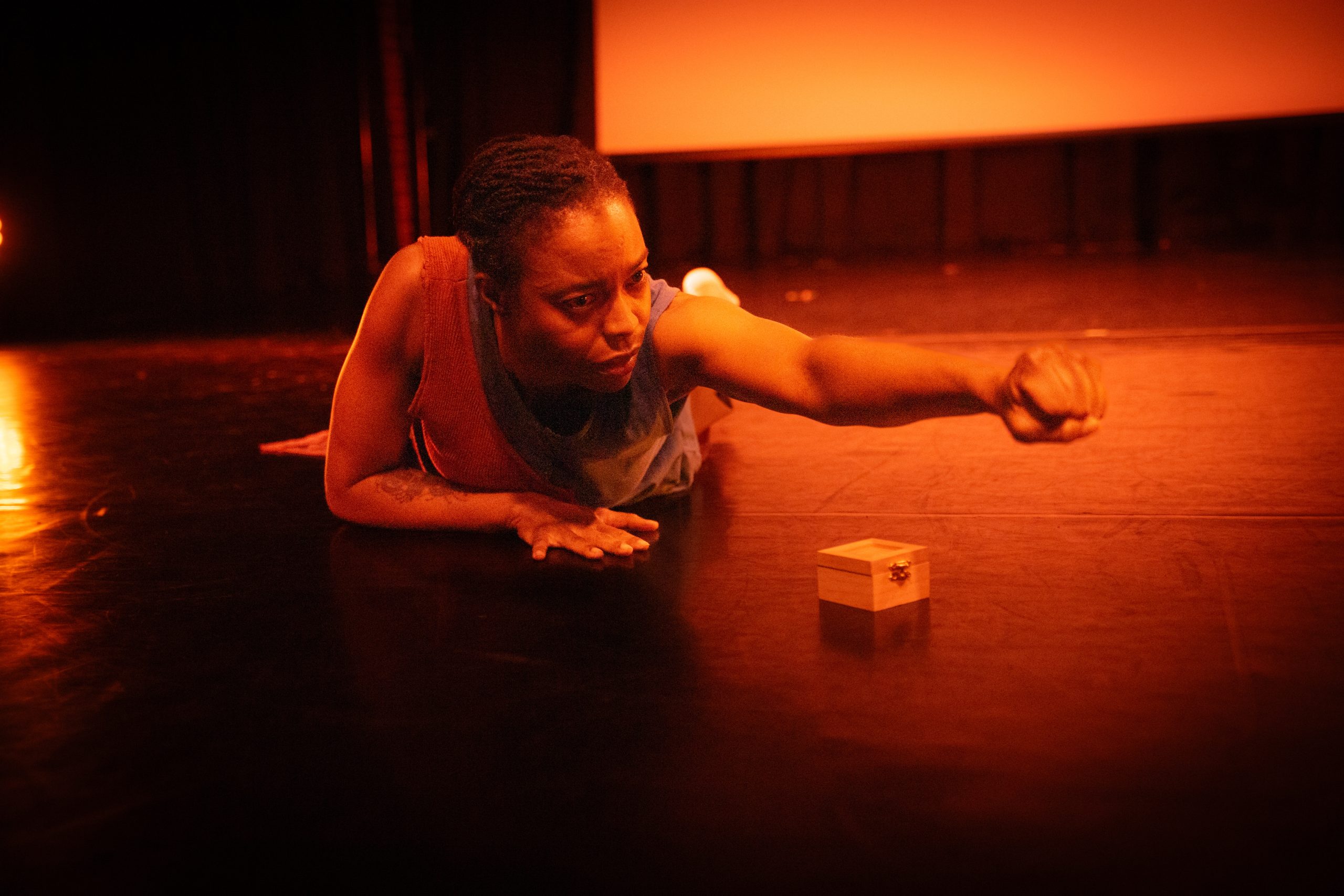
The Irish poet W.B. Yeats wrote that “Things fall apart,” and about “mere anarchy (being) loosed upon the world.” More than a century later, his sentiments in “The Second Coming” remain uncomfortably prescient. We are so fragmented and polarized today that agreeing on a shared set of facts seems impossible. What is real and what is not? Is there any way to sift through the debates and the misinformation, and approach a more coherent collective experience?
Dance artist Alessia Palanti attempts a response with All In Your Head, using the vocabulary of non-verbal performance and art to create a temporary shared reality. The piece features six commissioned dance solos and duets, a rich example of contemporary dance´s diversity, with the entire evening linked through images by visual artist Candice Kail. Projected onto the back wall, Kail’s visions appear like portals into a microscope, or like the experience of squinting in the dark while trying to see something move. Kail’s green, black, white, and russet-colored lines are but one theatrical element gluing Palanti´s artificial world together.
Throughout the unfolding narrative of the performance, the dancers move a tiny box from one location to another, creating a small mystery. Palanti´s sound design leans heavily on the Haxan Cloak and the films of David Lynch, making All In Your Head both cinematic and surreal. One musical cue at the start and end of the piece referenced a song from 1977´s “Eraserhead,” hinting that a dream-logic frames the entire evening´s structure.
In “Requiem Pro Vivis,” the opening solo choreographed and performed by Palanti, movements are precise and expressive. Palanti mourns the loss of her relationship with her father–who has fallen down the rabbit hole of conspiracy theories–through her arms and hands. Wearing a veil, she repeats sequences of devotional gestures to a soundtrack including fragments of quotations from Charles Manson and other cult leaders. While Palanti spins across the floor, the music grows more ominous and sinister; the sound of a rotary phone incessantly ringing adds a note of loneliness to the score, and to the piece.
The following duet “Unsaid, Still Understood” also explores a parent-child relationship in relation to a significant loss. When the lights come up, we glimpse dancer Sara Pizzi carrying Aika Takeshima on their lower back. Pizzi’s gesture made me think they were wounded in some way. They then later looked as if they were holding a defenseless infant (Takeshima). After beginning slowly, with measured and restrained movements, their choreography becomes increasingly athletic and dynamic, the dance becoming a silent game composed of playful attacks. The two conclude the duet with a sequence of push-pulls of the other´s limbs, a brief portrait of harmony and potential injury.
Palanti then returns onstage in Chris Johnson’s “Riven,” this time performing with dancer Ashley Brunning Jones. Incorporating a movement score reminiscent of Contact Improvisation, together the two seem to be negotiating balance, strength, and support. Who will embrace whom? How can we work together to avoid futility or failure? Jones and Palanti both embody rich feeling in their dancing, particularly when the sound score by Helen Gillet shifts to vocals and strings.
Up to this point, the themes of All In Your Head seem to be about struggle: each dance embodies tension between opposing forces. When “Explore, Love, Create” begins, though, a joyous interlude unfolds, momentarily shifting us away from the preceding darkness. Choreographer & performer Jazmin Davis lights up the room– practically shining with hope and positivity– with her exuberance, her arm gestures, and hip-swings. But with Nicole McClam´s “UnFinished Object” following, All In Your Head returns to a heavier state of introspection and wrestling, with inner demons.
With a magnetizing deep presence, McClam revisits a fragment of an earlier choreography she made in her 30s. Each repetition of her movement phrases is a retracing of her steps. She is witnessing her dancing through the corridors of memory. By the end, McClam has moved the tiny mysterious box–which has been on stage the whole time, witnessing–an object in All In Your Head that has now become infused with meaning.
All In Your Head concludes with “Sapía,” another piece created by Palanti reuniting her with Brunning Jones. Inspired by Canto XIII from Dante´s Purgatorio, Palanti hides her eyes like the dance´s titular character, moving with regal elegance through the space to a haunting soundscape of whispered Italian. Unlike the relative minimalism of the evening´s previous sections, “Sapia” contains the most theatrical elements. At one point, she punches through a small screen before crawling through it. Brunning Jones pulls a long ribbon from Palanti’s mouth. The climactic moment comes when she mimes sewing Palanti’s eyes shut.
All In Your Head speaks in the language of sensation, image, and sound. While we may crave clear definitions in our confused and chaotic world, Palanti instead offers a mystery that’s too captivating to look away. This vivid evening of moving bodies is a dream-journal written by multiple authors, with Kail´s visual art serving as chapter headings. While what each dance/entry “says” is open to interpretation, All In Your Head contains a significant magnetic pull, its opacity leaving emotional impressions long after the performance concludes. Palanti’s various talents–as choreographer, performer, designer, and commissioner–are beautifully braided in this mysterious evening of dance.
Photo of performer Nicole McClam by Keven Almanzar.
Leave a Reply