
Queer art is not monolithic. Just as the LGBTQIA+ community itself is rich with diversity, so too do their creative expressions assume multiple forms: irreverence, playfulness, seriousness, contemplative, and vulnerability. The Pioneers Go East Collective emphasizes this point with its Out-FRONT! Fest, a weeklong event curated and presented in partnership with Judson Church. During one week in January 2026, audiences experienced fifteen radical queer and feminist artists working in dance and film, capturing some of the scope of contemporary queer art today.
I attended a split-bill which started with Selections from: Tapestries, a world premiere by Queens-based choreographer Suzzanne Ponomarenko. Created while in residency at the Baryshnikov Arts Center last year, Ponomarenko describes the piece as “an embodied archive…of the subjective history of queer Ukrainian culture.” In the piece, Ponomarenko reimagines the mysterious narrative of the seven “Unicorn Tapestries” housed at the Metropolitan Museum of Art at The Cloisters, creating a suite of vignettes whose movement vocabulary blends American modern and contemporary dance with Ukrainian folk dance. Each episode opens with a projected illustration by the talented visual artist Emmy Castellani, who draws inspiration from the 15th-century source material before transforming them through the prism of her imagination, creating stunningly original images which are cosmic and dynamic in their impact.
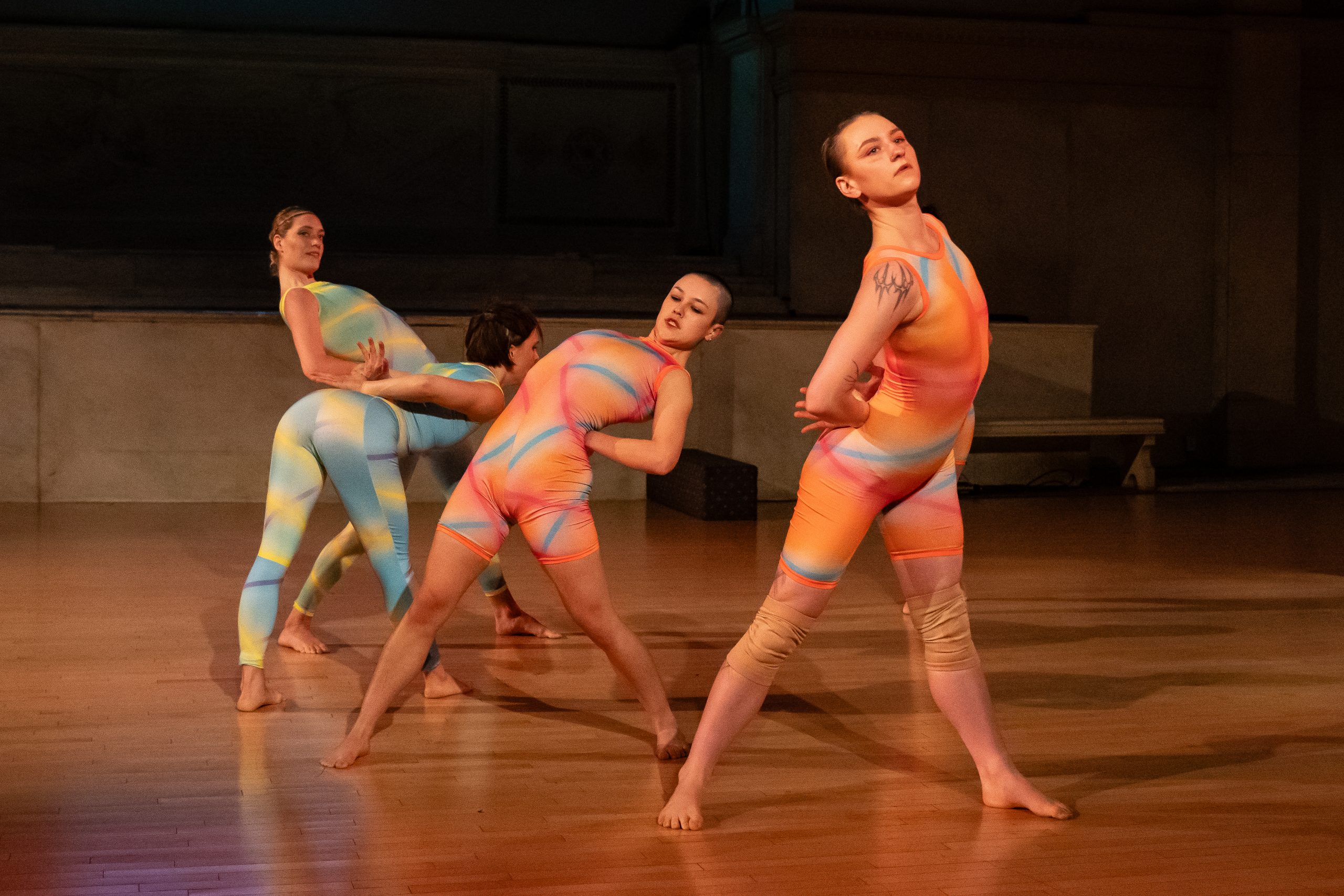
The opening duet of Tapestries (performed by Piper Makenzie Dye and Dalton Young) introduces the audience to Ponomarenko´s distinctive style of moving. Wearing tight multicolored body suits designed by David Quinn, the dancers move with a mixture of precision and play, with a quality of presence that is both inviting yet sharp. The dancers demonstrate exceptional skill and strength–maintaining balance on an extended leg past what feels humanly possible, before one slips into the arms of the other and soars into the air in a complex lift. There´s something ceremonial to this opening choreography. The slow pace and their bodies’ linearity evokes the very makeup of the source material: perhaps these dancers are hunters of the unicorn, wielding their weapons? Later, they create lines of such geometric precision I feel them becoming, perhaps, the fences used to imprison the magical creature?
With the entrance of dancer Pilar Mellon-Reyes, the subsequent vignettes of Tapestries grow increasingly complex in terms of form, movement quality, and spatial composition, and Ponomarenko´s choreography will gain more and more emotional depth. Flashes of movement onstage echo the original tapestries–the hunt, the betrayal of the unicorn by a maiden before its capture, and so on. Perhaps Ponomarenko, in this physical interpretation, is inviting us to consider the unicorn as a metaphor for queer identity: rare, utterly beautiful, and in danger? Like everyone in this company, Mellon-Reyes possesses a striking stage presence: powerful but capable of smoothly turning into infectious fun when later joined by Kate Reyes. The two incorporate swiveling hips and spinal articulations into their vocabulary alongside their deep lunges. When the rest of the dancers enter and fill the space (Laure Marie Jaeger, Larissa Asebedo, Paige Barnett Kulbeth, and Jay Beardsley), the range of physicality and emotion expressed onstage seems to point towards the mythic unicorn itself. The musical score composed by Katie-James Rushin tracks Tapestries’ tonal shifts, moving from lilting strings to harsh electronic beats. These dancers move with casual grace, slithering along the floor in sensual anguish; they practically seduce the audience with their embodiment of Ponomarenko´s intricate choreographic designs.
After a brief pause, the Out-FRONT program continues with openings, a second world-premiere by Dominica Greene. Wearing simple and unassuming black clothes, she takes a moment to look at the entire audience in one slow sweep immediately before activating the space with her body’s muscular grace. Greene tumbles, slides, and arches backwards from standing, while an audio recording of herself plays, a choice inviting us into the inner terrain of her thoughts. Greene wonders aloud how we can smash the epidemic of loneliness (especially in a big crowded city like New York) and connect with one another. The audio itself creates an intimate bond between Greene and the audience, but she isn’t content to let the relationship stay there. She wants us to feel our interconnections, and transform openings from a solo performance into a communal happening.

The pre-recorded voice of Greene invites volunteers to join her onstage in a series of activities that start simple but then grow in complexity. Will someone join her onstage to join her in a trust walk, allowing Greene to move them slowly through the space while keeping their eyes closed? What about switching roles, and moving the dancer herself? Would anyone be willing to attach strings across multiple pillars inside Judson, until they criss-cross through the space? Does anyone play the piano? Though Greene recorded these and other prompts in advance, her gamble paid off. Audience members enthusiastically replied. At some moments, there were more volunteers wanting to join Greene onstage than she needed. With her movement performance sequences successfully blended, Greene’s conceptual piece created a gentle and rewarding happening.
An audio clip, towards the performance’s end, expressed a universal longing for love, the “ultimate connection.” Greene expertly toggles this vulnerable want with her natural sass. She craves not only a “big love,” but to find someone to love her “big booty.” After admitting that she is not a singer, she does an a cappella rendition of Prince’s 1979 classic “I Wanna Be Your Lover.” This time, the audience needed no prompting to join in and sing along with her. Thanks to Greene, as well as Ponomarenko and the entire Out-FRONT team, audiences left Judson zinging, with greater connection, joy, and perhaps pride.
Photo of Suzzanne Ponomarenko’s TAPESTRIES by Steven Pisano.
Leave a Reply