
How do we build the city we want? In New York City, most large developments go through a process called the Uniform Land Use Review Procedure, usually spoken aloud as its clunky acronym, ULURP. The flowchart detailing each step — and who holds the power to affect what gets built — can feel byzantine and confusing. (Even I, with my masters degree in Urban Planning, take a hefty chunk of time to refamiliarize myself with the ins and outs of the procedures.) All too often, real estate interests win this purposefully complicated game, and everyday, working people lose out.
This murky system undergirds the theater collective Sour Milk’s performance-cum-game, DIRT. Three performers and a technician guide the audience through several decades in a fictional New York City in which the East River has disappeared – chocolate pudding mix is used to delightful effect – and in its place, many plots of developable land have materialized. Through this game, we see a vision of a city planning process that feels much more clear and approachable than what we may experience in real life: what the audience votes for, more or less, is what gets built. This gamified version of land use politics asks a revolutionary question: What if the city we imagine together is the city we can actually create and live in?
I spoke with the creative team of Sour Milk Theatre Collective and the creators of DIRT designing the show, and the theatricality of navigating the complex bureaucratic systems that surround us.
This interview has been edited for length and clarity.
Kevin Ritter-Jung: How did you three start working together?
Christina Tang: We started making work together during the pandemic, when we couldn’t do normal theater. We were trying to understand the basis of theater and, given we could not be in person, determine the actual value of being together? We were teasing those thoughts out and experimenting in different forms of media that we all had familiarity with.
But really, we’re all theater makers, and once the options came back for us to do theater again, we started taking the opportunity to do so in live settings. Our first project was an interactive fiction piece, Feast, which is an adaptation of Anna’s [JASTRZEMBSKI, narrative director of Sour Milk] play, Dog.
Our next piece was “Traffic,” which was in the Exponential Festival in 2022. The tagline for the show was, “You’re not in traffic, you are traffic.” How do we dramatize a system in which everyone is frustrated? How are we all participants in this larger system?
Anna Jastrzembski: You’re stuck in traffic and you need to figure out a way to get out to increasingly frustrating and whimsical ends.
CT: Carsen and I come from design backgrounds, and really are into DIY aesthetics. The focus for the design was 60 Matchbox cars that we bought off eBay in all these crazy colors. The cars were laid out on a table that we had backstage, and there was a camera on top of it that was angled down on the cars that were lined up as if they’re on like this highway. Each audience member has a number and they would come in– they could also use an app on their phone – and pick what car they wanted, Mario Kart style. Through the course of the game the players try to figure out how to get out of traffic. It started with things like, “I want to merge left, I want to merge right.” As the game progressed, the options would get a little bit more fantastical and whimsical, like eggs and dinosaurs roaming the streets. It’s drawn a little bit from object puppetry and live feed puppetry techniques.
AJ: There was a soundscape in the background of these monologues– mental journeys through being in this position– where they’re not able to move at all from different characters who were stuck in traffic on their own. That was a mix of some monologues that I wrote and also some by friends and collaborators.
KR: How did “Dirt” come to be after “Traffic?”
CT: The throughlines we were starting to see were about participation and being in a space together. What can we do that brings in more engagement? With Traffic, we tried out this app on your phone where you can select options that we realized on stage. That was a format that we thought was successful, but hadn’t fully teased out. Thematically, we also were interested in the idea of combining multiple narratives and multiple perspectives into the same experience. The thing that was interesting about “Traffic” is we built out the space for each person who played the game to take a step into that world, to kind of become a character in their own way and make their own decisions.
We had the opportunity through the Exponential Festival again in 2024 to produce “Dirt.” The issue that was top of mind, at the time, was understanding how city planning works, especially in places like New York City. “Traffic” proposed so many different ways in which people in the same place have different perspectives and different wants. We wanted to extend that with “Dirt” —this is a place where people have specific, maybe conflicting hopes, all coming from a good, grounded place, but not necessarily able to co-exist. That was what pushed us into this: the really exciting and thrilling topic of urban development.
Carsen Joenk: The premise of “Dirt,” is that the East River in New York has dried up and become land, and the city has approved land to be built on it. Everyone in the audience assumes a character that they pick from a wall before they go inside. The characters get to vote on a series of options over the course of 90 minutes, on their phones, to build this new neighborhood from the ground up. There are three performers who act as stewards for the process. The actors build out the things that the audience votes for using food as materials. It’s a live experience.

KR: It’s delightful seeing the city get built out of food. What’s on your shopping list?
CT: Graham crackers, fudge swirl crackers, animal crackers, Ritz crackers, oyster crackers, cheese puffs…
AJ: Pretzel rods!
CT: Normal pretzel, noodles, ramen packets, ice cream cones, some frosting — so much frosting.
AJ: This is like a beautiful found poem that we’re reciting right now.
CT: Gumballs, Mike and Ike’s, Good and Plentys, Twizzlers, mints, caramels, blue food coloring, those little Solo cop shot glasses, carrots, apples, celery, cabbage, fruit snacks, two different kinds of marshmallows, so many toothpicks, large skewers, pre-made jello in molded cups, we said, cheese puffs, a Coke can, an optional beer. Baking powder, not baking soda — there’s a difference, learned that the hard way. I go shopping at my local Dollar Tree, which is very near my house.
AJ: I want to shout out allbulkfoods.com in our continual quest to receive some kind of sponsorship from them.
CT: For our 50 pounds of pudding.
AJ: If they want to underwrite one of the shows that could be really cool for them.
KR: “Dirt” exists between forms. How do you normally describe this to people? Is it a play? Is it a game? Is it like a civic engagement exercise? What do you think of it as?
AJ: When I find myself in a position of needing to describe it to people, I will say it is part game, part performance piece, ostensibly about city planning. That’s my elevator pitch. I sometimes struggle with describing it in a way that sounds appealing because I’m not really a big game person. I like games that rely on esoteric knowledge, like trivia, rather than hours-long strategy games. I am bad at strategy. But with this show, it’s such a blast. Even if you’re not participating to the fullest extent possible, even just witnessing it, it’s a really good time. The whole piece engenders that sense of play that Christina was talking about. You can strategize and do some wheeling and dealing within the world of the show, but you don’t have to.
KR: How much wheeling and dealing happens over the course of the show?
CT: It really depends. Each audience was really different. Sometimes, people in certain rows start to slowly lean over to their neighbors and test the waters with private conversations: “Building a pool could be kind of fun.” An entire row will become a voting bloc, but the group across the way won’t necessarily know that that’s happening. Other shows, there will be vigorous speeches from various sides to the entire room to try to persuade people to vote in one direction.
KR: What role do the performers play in steering all of this? One can imagine playing a version of this game without them. What do they add?
CJ: The performers are representative of a lot of different things that can feel true about the city and also what it lacks, including inside information on how something works. Someone to remind you what happens based on a choice that you make. Quite literally, the performers act in terms of construction. They have the blueprints for the things that you might want to have built, and they will execute them on your behalf. More than anything, they keep the narrative going. They help us craft a version of a beginning, middle and end. They do it really expertly. You have a trusted source in some way to kind of push you along.
KR: You last presented this in summer 2024, which feels like a lifetime ago in many ways. Our outlook for our city has changed at the federal level in a very scary way and at the local level in a hopeful way. How has your thinking about this piece changed?
CT: The things we are talking about have never been more in public consciousness. Not only has there been a mayoral election, but the Proposals 2, 3, and 4 in the general election were about how we determine how we build and develop land for housing. That part is exciting, thinking about ways we can point people toward engaging in their own communities after the show.
We are not actually modeling city politics. We’re modeling the feeling of city politics. We have 90 minutes. There’s a limit on complexity that we can introduce that is going to be meaningful to a player’s actual experience. It has to be understandable in one demonstration. The original challenge of the show was based on looking at the Uniform Land Use Review Procedure (ULURP) and trying to understand that diagram, but it became impossible to actually replicate it because there were so many steps and so many stakeholders. Everyone feels like we don’t understand decision-making around ULURP, and it feels like we don’t understand how to make things work. And that feeling is one I have generally about politics, which is that sometimes it feels very difficult to understand what choices we’re making. We play with that kind of frustration, with the opacity in government procedures specifically, but don’t get too bogged down in explaining specific rules and policies.
CJ: I think another way to think about it is cause and effect. All of us want the pieces to have a shared ownership in how the night is going to go: the of an evening and the extent of the audience’s participation. For me, that means that we have to respect the audience’s agency and decision making and respond to it. That’s an agreement we’re making together. It feels important, especially given the topic, to have a strong relationship with the audience. They are making a decision that has an effect on what materializes in front of us. This is sort of a departure from how many of us interact with politics, literally in our waking life.
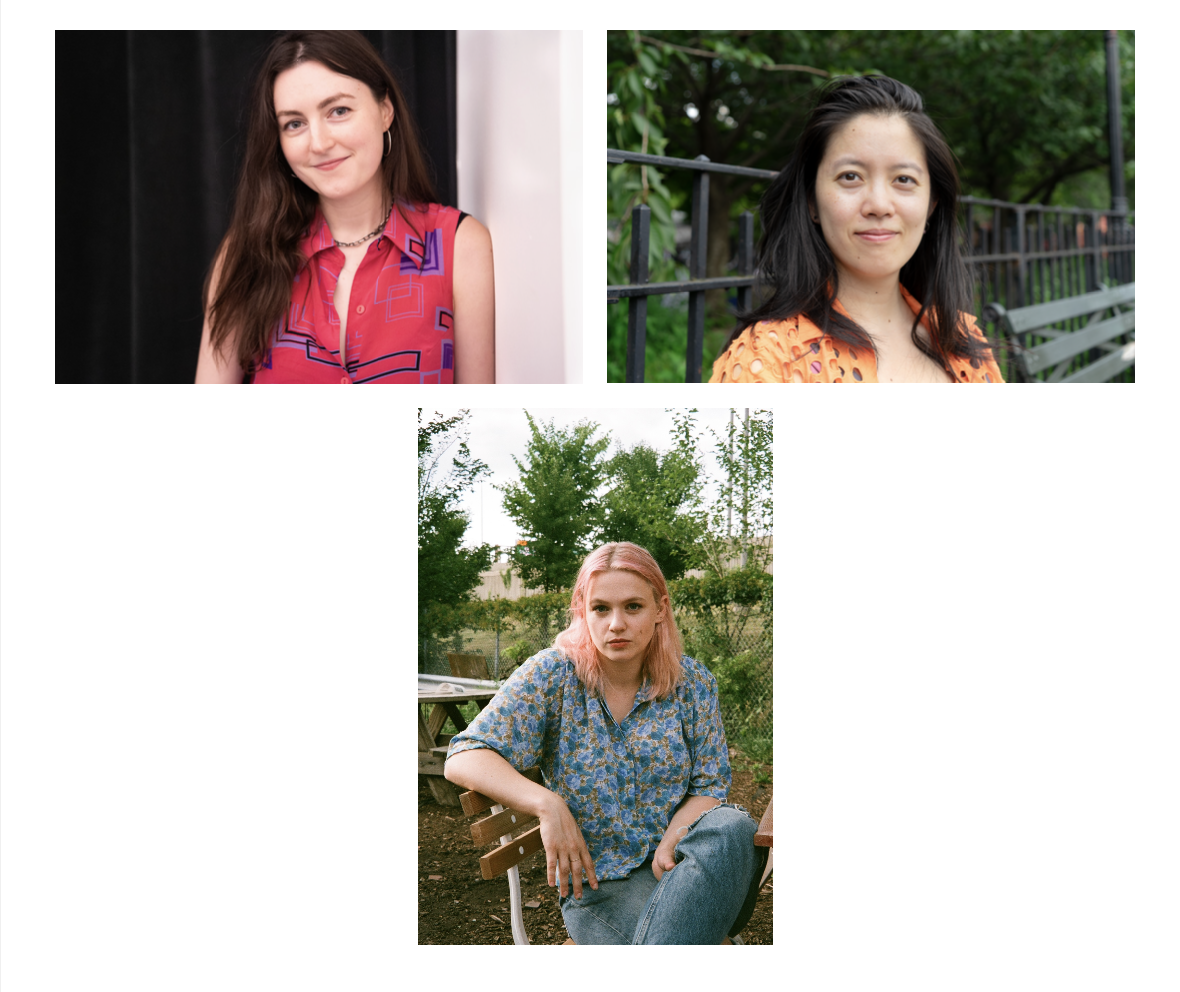
PHOTOS: Artistic Director Christina Tang (Left), Narrative Designer Anna Janstrzembski (Right), Creative Director Carsen Joenk (Center down).
DIRT is up until February 15th at The Tank Theater. Tickets can be purchased here.
Leave a Reply