
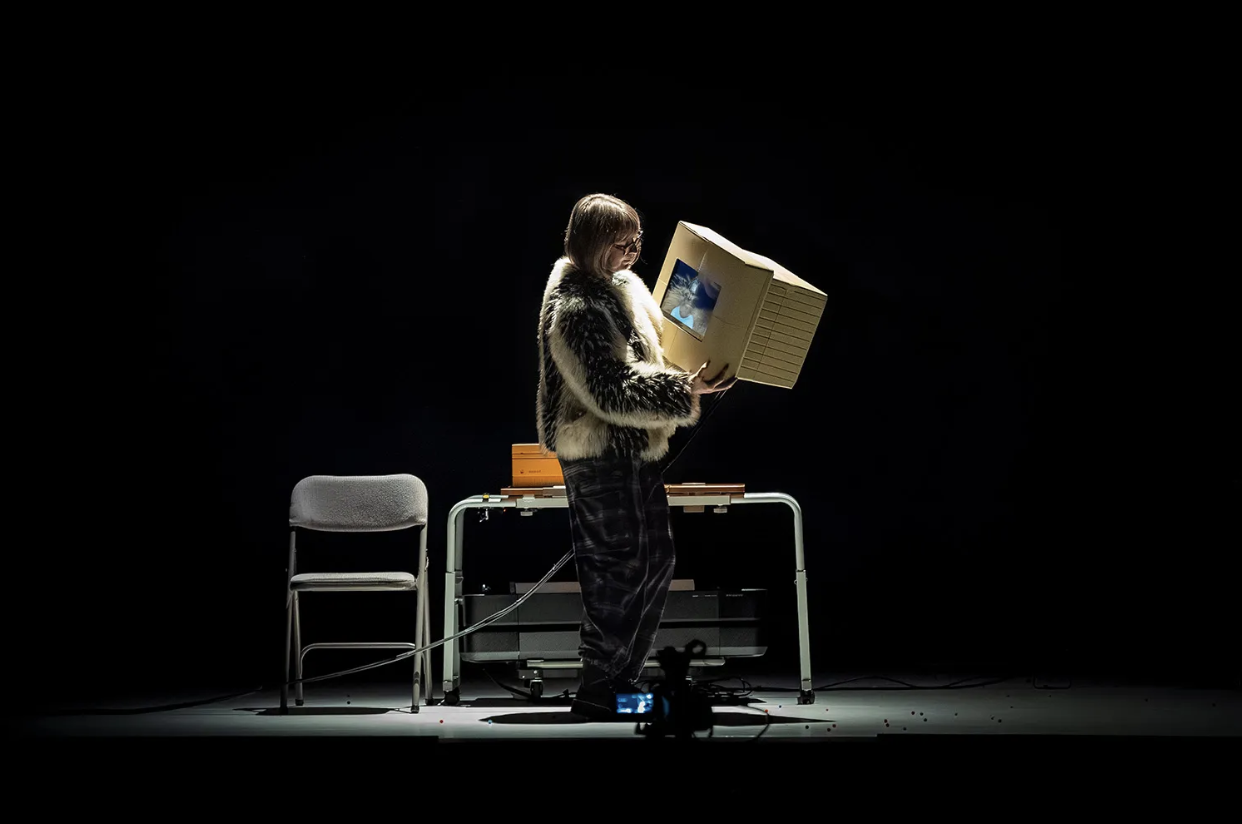

Many of the works this festival season deal theatrically with reconstructions of the past, rendering this process not just in static images, but in complex, vivid portraits of the now. One of these archelogies was one of my personal favorites of the festival season: 2021, a piece of tender personal narrative blended with AI facsimiles and a gonzo live video game (played by an audience member!) of the last weeks alive of Brian Lewis, the father of Cole Lewis, one of the co-creators and performers of the piece. Woven throughout 2021 is an earnest attempt to cross divides, both physical (Brian dies across the USA-Canada border during pandemic shutdowns) and ideological (Cole grapples with Brian’s increasingly far-right views in his old age). Before an evening performance at Mitu580, I sat down with the trio behind the show, Cole Lewis, Patrick Blenkarn, and Sam Ferguson, to talk about radical connectivity, “grief bots,” and how to get the perfect retro video game sound.
Ethan Karas: To start off, if you could say who you are and what your role is on this show.
Cole Lewis: I’m Cole Lewis, and I am one of the co-creators. I helped write the text in the play, and I helped build the AI by doing data curation, talking through how to formulate the system prompts, researching what we can do with the AI, and then performing in it.
Patrick Blenkarn: My name is Patrick Blenkarn, and I am also one of the performers. I play music in the show that is composed by Sam, and I’m also the programmer on the video game component of the show.
Sam Ferguson: I’m Sam Ferguson. I am another co-creator of the show. I’m also the sound designer who composed music that Patrick plays, and I also coded a bit of the AI with Cole’s data.
Patrick: Lots of overlap!
Ethan: What drove you into making 2021?
Cole: The thing that got the engine revving in this show was Patrick going, “I think that we should make a show about the year your dad died.” It’s really interesting how difficult it was to navigate all the paperwork, and with the borders closed, trying to navigate that. For all the doctor’s appointments, it was all through the phone.
Patrick: And we had all collectively just lived through this massive digitalization of culture and life through the pandemic. Thinking back on “peak pandemic” in 2021, there’s something about the radical connectivity that comes from all of the technology that we have, and then being radically connected to people that aren’t so easy, being forced to have relationships with people who aren’t so easy.
Cole: We initially saw it as a kind of live cinema documentary. I was interested in archival material and how to tell the story through material artifacts, so there was this thinking that we could do a live cinema experience through these archival materials. The video game was a small part, and then AI was introduced really serendipitously. It helped make the game make more sense to me, and it changed the direction of the show.
Patrick: We did a lot of rapid prototyping to be able to see if it would work, and then we spent basically the last year and a half filling out the thing and refining our own language model. We want to have our own infrastructure. And so the show now has taken on a structure where the first act is largely about physical matter, the second act is about a sort of digital reenactment, and then the third act is about data. A confrontation with algorithmic and AI-infused data.
Ethan: Across several of the festivals, there’s a thread that keeps coming up of reconstructions of the past. What do you find theatrical about that? How do you make an act of reminiscing theatrical?
Cole: I think reminiscing is not the right word, actually. We’re evoking something different if we “reminisce” it; “reconstruction” is a good word. One of the lines in the play is that a photo does not show us the past; it generates it with us right now, so that we can replay it together. And I think that’s what we’re doing in the show. We are interrogating the past: reconstructing it, replaying it, reenacting it, and then asking what do we do with it? And what is our responsibility around it, now that we’ve made it? I give space for people to create and change who my father was. I share a story with you, and your version of it is going to go somewhere else.
Ethan: The audience ends with a different interpretation, or “live photo,” every time. But for you, Cole, has your reconstruction of your relationship with your father changed or shifted for you at all? Is it a chaotic difference every night, or is there a trend towards something new that you didn’t realize before?
Cole: A lot of people always ask me like, “How’s your grief?” (laughs) I’ve probably found more empathy through the process, more understanding. There are some documents that are on stage, and reading all 203 pages of them so that I can learn that history, and then making the decision to edit that and determine what’s worth sharing and what’s not worth sharing.
It is a question of: what do we do with the data of some of these people? We think about AI as “grief bots,” right? There’s a tendency to always think about preserving celebrities, or someone who’s good or worth preserving. What do we do when the data is questionable, and we don’t like some of the data, or it’s harmful? What’s worth saving, what’s not? My husband’s concern is that this will reshape my understanding of who my dad was. But I don’t think it has.
Patrick: Cole had to write 1,500 dialogues with the AI as models for it to understand how it engages with her. His life is complicated. He was a child in this country. He was abandoned and sent to this other country. What are the long-term impacts on a person who becomes a father over 70 years? What are the impacts of these experiences? And not many people, I think, have done such good text analysis of their parents.
Cole: I’m inspired by my father and my relationship, but it has to be shaped, and so that gives me some kind of distance. I’m watching how people interpret a character each time we do the show.
Ethan: The dramaturgy or the structure of a video game seems key to cultivating empathy in this show. When I think of my own experience growing up and playing video games, a lot of the way that experience of empathy is shaped for me is through sound and music. Sam, are there ways that you are actively thinking about that as you compose for this show?
Sam: I was really interested in coming up with sounds for the show that felt like they referenced video game eras and had that kind of nostalgia to them, but were also new. I spent a lot of time designing the instruments of the show to sound both like they belonged in a video game, but also eerily referencing this kind of futuristic-sounding thing, because I knew the AI was coming, and there’s something a little disturbing about that conversation. I did a lot of techniques that old video games used to use. Back in the day, they didn’t have that many oscillators. So to make chords, they would rapidly switch between different notes in one oscillator. That’s how you get that kind of trilly sound in a lot of the old games. But then I would take that idea and be like, well, instead of rapidly switching oscillators, what if I slide harmonics back and forth? And so I spent a lot of time really honing those elements so it had this kind of new-but-old sound at the same time.
Patrick: There’s no sheet music. You come home at points to certain ideas and motifs, just like Cole’s text as the narrator. There’s a structure; we know what happens in the level at the beginning and the end, but where do we go in the middle? We explore, but we know how to come home to certain things. And so we’re both improvising. I can give signals to the player. I can do certain things musically with the instruments that Sam’s made.
Ethan: When I think about AI as a consumer model, the first thing I feel people do is, “Look at all the dumb things I can get it to say and do.” There’s not a lot of empathy for it in the way you might see now, with people starting to form strange parasocial relationships with these chatbots. It feels like it has gone from us not treating AI like a real thing to now not treating the subjects of AI like a real thing. Like, it’s easy to beat up a chatbot of somebody, but then when it’s taking a photo of a real person filtered through the tool of AI, it dehumanizes them in a way.
Cole: There’s that kind of slippery slope. And this kind of technology, it already exists, and it exists better than what we’ve created in the show because they have huge corporations to help them.
Ethan: It’s almost like the not-quite-full seamlessness is helping bridge that empathy gap that you were talking about before. Like if it was too seamless, it wouldn’t have the same effect.
Patrick: Definitely from a video game design perspective. As an indie developer, there’s a certain ceiling of what you can achieve. But that lower common denominator also creates a collective entry point, right? There’s a better chance that everybody in the audience is actually gonna recognize these aesthetics, and we can do more with our story if everybody understands. It creates a bigger pool of entry points into the ideas because, in so many ways, each act is getting at the same question just through these different forms.
It’s very much a story about a person who found themselves in a situation where they were very alone. What would this person’s life have been like had they had the opportunity to be less alone? So when we gather inside of a theatrical space, when we bring someone on stage, we really say, you are not alone.
Cole: We have a tendency to simplify people that we politically disagree with into one thing. Trying to create space to show all the contradictions, so that then we can ask questions, what do we do with that? It doesn’t fit a simple narrative.

BONUS: an exit interview with the January 11th performance of 2021’s Brian Lewis, Mario Montes
During each performance of 2021, an unrehearsed audience volunteer performs the onstage role of Brian Lewis, Cole’s deceased veteran father, in an extended guided video game roleplay sequence of Brian’s last weeks alive that is by turns captivatingly zany and startlingly moving. For the night I attended, Brian was played by none other than my dear friend, actor Mario Montes, who was expertly guided through by Cole and Patrick onstage. After the show, I couldn’t pass up the chance to do a short exit interview with the man of the evening.
Ethan Karas: To start, what was your knowledge in advance? Were you prepared for this?
Mario Montes: My knowledge was 0%. I’m gonna be honest with you. I didn’t say this to you earlier, when you texted me, “wanna come see 2021,” I was like, sure. And then I turned to Gavin, my roommate, and I was like, “I have no idea what I’m gonna go to tonight.” Absolutely no idea. Honestly, I’m glad…I think it was even better just going in completely blind.
Ethan: I was surprised because the game starts kind of jokey, and I think everyone’s a little nervous to take it fully earnestly, but by the end of it…I was struck by how you went from being so “haha” to something quite serious. How did it feel for you on the inside? Did you notice when you started to take the game more seriously?
Mario: I think the moment that really hit me were those conversation sections, where on the screen it was my face on one half and her face on the other half. I’m sure you had a similar experience in the audience, but for me, sitting at the desktop, she was staring right into my eyes. To have this really deep personal conversation with me, I felt like it’s just such an immense amount of trust to put into someone that you don’t know at all. And I guess in turn, I adjusted my gameplay to take it more seriously. I felt like I wanted to be there with her, for her.
Ethan: How did you feel your relationship with the audience was like having that many people shout at you? Because it does kind of put you in the shoes of Brian…when you are in a position of needing care, everyone becomes very immediately prescriptive of what you need and what’s best for you.
Mario: I mean, I’ve never had dementia, obviously, or Alzheimer’s, but from what I’ve heard of people’s experiences, it felt maybe like a cousin to it, or it felt like maybe the closest one could get to experiencing it without actually having the disease. It was definitely frustrating, but the multiple moments where the audience did come together and all agreed on one thing felt incredibly satisfying.
Ethan: And it was interesting that everybody was very opinionated when it was “turn left” or “turn right,” but then, when it came to those really tough conversations with decisions of which dialogue option to choose, people were pretty silent.
Mario: That was different, definitely its own kind of pressure, because I felt like I could feel the audience’s expectations of whatever I was gonna choose, and also being entrusted with this woman’s personification of her father. So it was this balance of, do I want to make this choice that will stay true to the story that she’s telling…what’s the right balance here? What’s the right choice?
Ethan: There were moments where I was like, “well, I can tell that this might be something that Brian might say.” I might not necessarily say that, but also I’m not Brian. None of us are Brian. And as she says right at the start of the show, we both do and don’t really know Brian. Ultimately, we don’t have an embodied knowledge of him in the way that Cole does.
Mario: She was such a good scene partner, because anything, any choice that I made, anything that happened, she just took it. I was kind of worried about making the right choice, and about halfway through, I sort of was like, “they’re all the right choice.” So I think that her openness just kept me anchored, kept the whole show anchored, kept the audience anchored. She was such a beating heart throughout all of it.
Cole Lewis (she/her) is a mom and mad theatre artist from St. Catharines, Ontario. She specializes in creating live performance from design ideas, exploring new modes of storytelling, and fusing technologies to the stage. Her practice includes directing, playwriting, and the design of moving image works. Twice nominated for Dora-Awards, Cole’s practice uses humour, design, and technology to explore notions of class and violence, expose questions of bias, and unsettle standard conceptions of ‘truth’ to explore alternative futures. She has an MFA in Directing from Yale and her thoughts on performance have been shared at LMDA, Howlround, FOLDA, Yale CCAM, and Canadian Theatre Review.
Patrick Blenkarn (he/him) is an artist working at the intersection of performance, game design, and visual art. His research-based practice revolves around the themes of language, labour, and democracy, with projects ranging in form from video games and card games to stage plays and books, with subjects as diverse as the labour of donkeys to the valuation of art to historical date farming practices in Iraq. He is a polyglot, programmer, animator, musician, and stage director. He is the co-creator of asses.masses, co-founder of STUDIO FUNFUG, and co-founder of videocan, the national video archive of performance documentation. https://www.guiltybyassociation.ca/
Sam Ferguson is an award-winning sound designer/composer from Toronto. After moving to Vancouver to study under acclaimed electroacoustic music composer Berry Truax he returned to Toronto where he became involved with theatre. This experience led him to enroll in the Yale School of Drama where he received an MFA for sound design. Since graduating he has returned to Toronto and has been working in the industry ever since. In addition to his theatrical work Sam has also been involved with audio postproduction on several documentaries/films, teaching microphone technique at Toronto Metropolitan University as well as the development of creative digital signal processing. Previous credits include The Visit (Iseman Theater), Who’s Afraid of Virginia Woolf (Centaur Theatre), 1991 (The Theatre Centre), and more.
Mario Montes is my friend. For one night, he starred in 2021 in the role of Brian Lewis.
Leave a Reply