
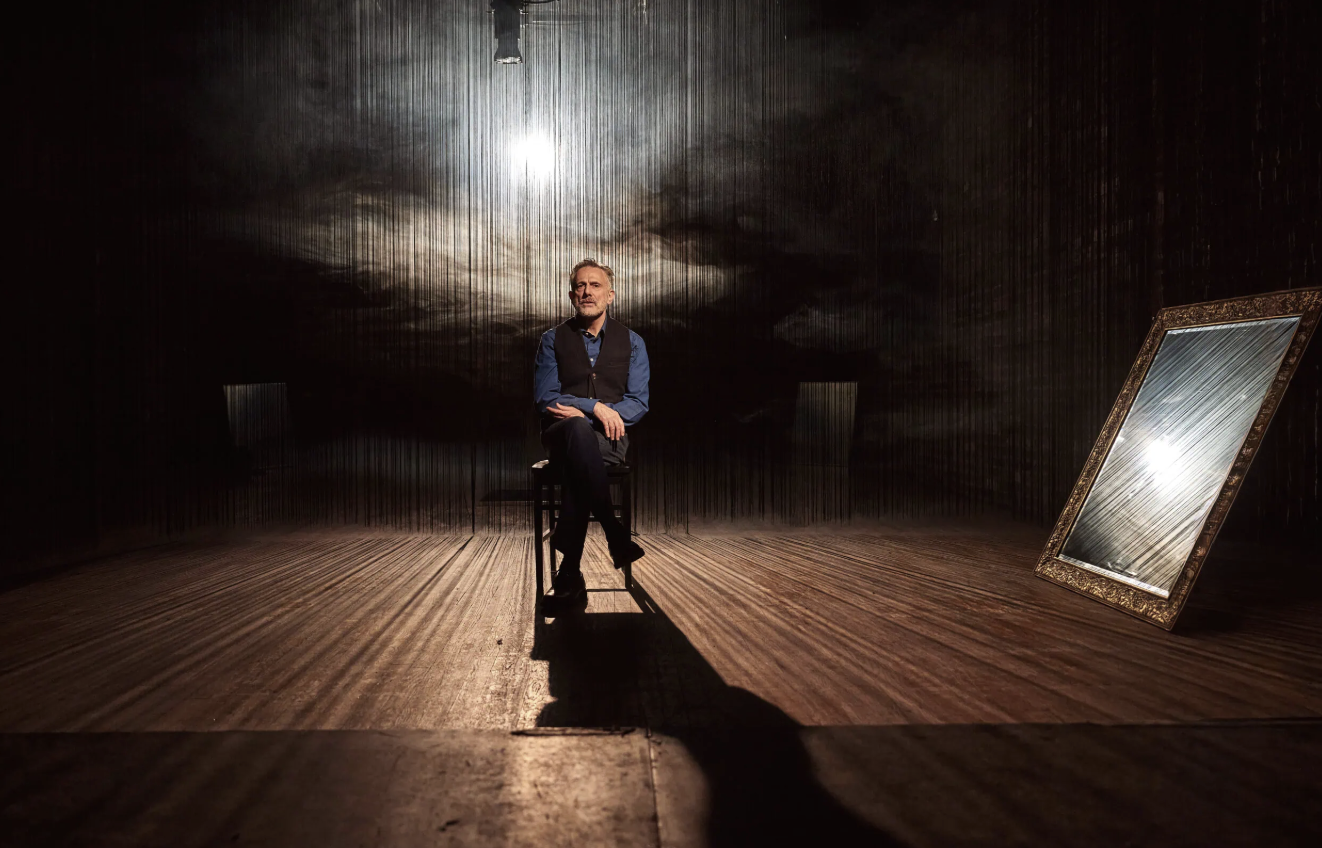
Before the play starts, though after the house lights have gone down, we are given two definitions for one part of the title, “without can be understood both in its prepositional sense, as a lacking, and in its adverbial sense, as the world outside one.” The preamble ends. The actor sits in his chair. The space is plunged into darkness and stays that way for a very long time. I’m slightly worried about what I got myself into.
Then the lights slowly rise, bouncing off a series of mirrors placed around the space. A person is trapped in a cave. Supposedly. Except there is no cave. Not that I can see, really. Okay, metaphorically then. The cave is not a physical place. The cave is a state of being. The cave is in our minds. In our hearts. In our guts. The cave is… me? The cave is you? The cave is all of us and none of us and the light is fading so does any of this matter? My mind keeps wandering but the performer’s piercing gaze brings me back, reminds me to focus. Suddenly I feel alone in the audience. It’s just me and the actor. The actor and me. Don’t worry, I’m with you. I’m paying attention. I’m paying attention. I’m… paying attention.
These were some of the thoughts I remember having at The Brick Theater while watching Without Mirrors, a new one man performance written and directed by Jerry Lieblich starring New York City’s National Treasure, David Greenspan. As I write now, I’m staring at the script – which was offered to the audience at the end of the show as a zine – trying to jolt my brain into piecing together exactly what it was that I watched. My thoughts are coming back to me as jumbled as they were during the experience. The more I attempt to put this experience into concrete terms, the more I’m convinced that wasn’t the point. That it isn’t the point. There is a way to describe this show that will make it seem, at worst, exactly like every cliché of venturing into Brooklyn to see a one man play/spoken word poem/performance piece in a small black box off the L or G train. And there’s a way to describe the show as a transformative meditative exploration of self through the power and vastness of language. Much like the definitions we are offered at the beginning, the play can be understood through what it lacks and what it stands apart from.
From the beginning, before the show even starts, you must make a choice. Without an usher in sight to guide you, you must first figure out how to enter the space. The space is shrouded in a thick string curtain. It’s transparent enough that you can see the rest of the audience sitting in their seats, but opaque enough for you to think, surely there’s an entrance further up. It becomes clear, as you scale this false wall that the only way in is through. Once inside, you pick your seat. Once seated, you must decide to commit to an hour of performance that’s without a destination. Or a character to follow. Or a theme to hold on to. With an entire piece spoken by one actor, sitting on one chair, with little to no movement, you are asked to practice – not active listening – concentrating. Without Mirrors demands engagement, even if the engagement is only to bring your errant mind back to the present. (Here I fear I must confess that David Greenspan was a big part of how I convinced my fiance to spend Valentine’s Day in a dark and tiny theater. The prospect of being enlightened once again by Greenspan’s singular performance style was enough to sway him away from a candlelight dinner adorned with flowers.)
The only action on stage is haze, which shoots out like a cannon during a moment of transition, slowly dissipating throughout the rest of the play. It was hard to not get lost in the vapor’s shape, resembling a cloud and reminding me of a world beyond the cave, the theater, and Williamsburg. I’ll admit, sometimes, I did get lost. But then David brought me back, through his brilliant, simple gestures and the soft tenor of his voice at times rising and echoing.
For part one of the play, David performed with his eyes closed. The moment his eyes opened, for part two, the energy changed seismically, both within Greenspan and the room itself. It was as if a house had fallen on the stage. Or a new character had entered. Or the language had suddenly changed to French. This small shift might not have meant anything in any other context, but that’s the effect of David. He crafts small into big, blinking into emotion, subtlety into presence. In this play, where changes are few and far between, the act of an eye opening was enough to enrapt me for, at least, the next few lines.
I consider myself a good audience member. Attentive and present, I never play with my playbill if I’m bored. I try to give as much as I can to the performance, because it is giving, or at least trying, to give me the same back. However, this one was a challenge, not only to my attention span, but to my very self-imposed label of “ideal viewer.” Is it me – unaccustomed to this type of intense nonlineality or is it just the play, constructed so internally it’s impossible to understand? One thing is for certain – it is and was not David. But then the question becomes, what was it? How reliant on performance, particularly with solo work, can a piece be? Should enactment of source material carry as much weight as the source itself? Can the text hold up next to David? Would the piece have been more successful if text stood on its own, inviting no comparison?
I’m flipping through my zine again. It’s beautifully constructed. When it’s just me and the words, I can see what Lieblich was going for. An exploration of isolation, of existential dread, a feeling that arises when you spend too much time in the Berkshires. The way the script is laid out on the page indicates the words’ poetry. Maybe this is the best way to receive this piece: not in being spoken to by the immeasurable David Greenspan on Valentine’s Day, but in the days later. Alone, on your couch, sitting next to the person whose company lasts beyond Valentine’s day, parsing through figuring out exactly what you experienced for those 55 minutes, stuck in a cave, or in a theater, or in a mind, collapsing on itself. What is there, what is left?
Photo: Valerie Terranova
Leave a Reply