
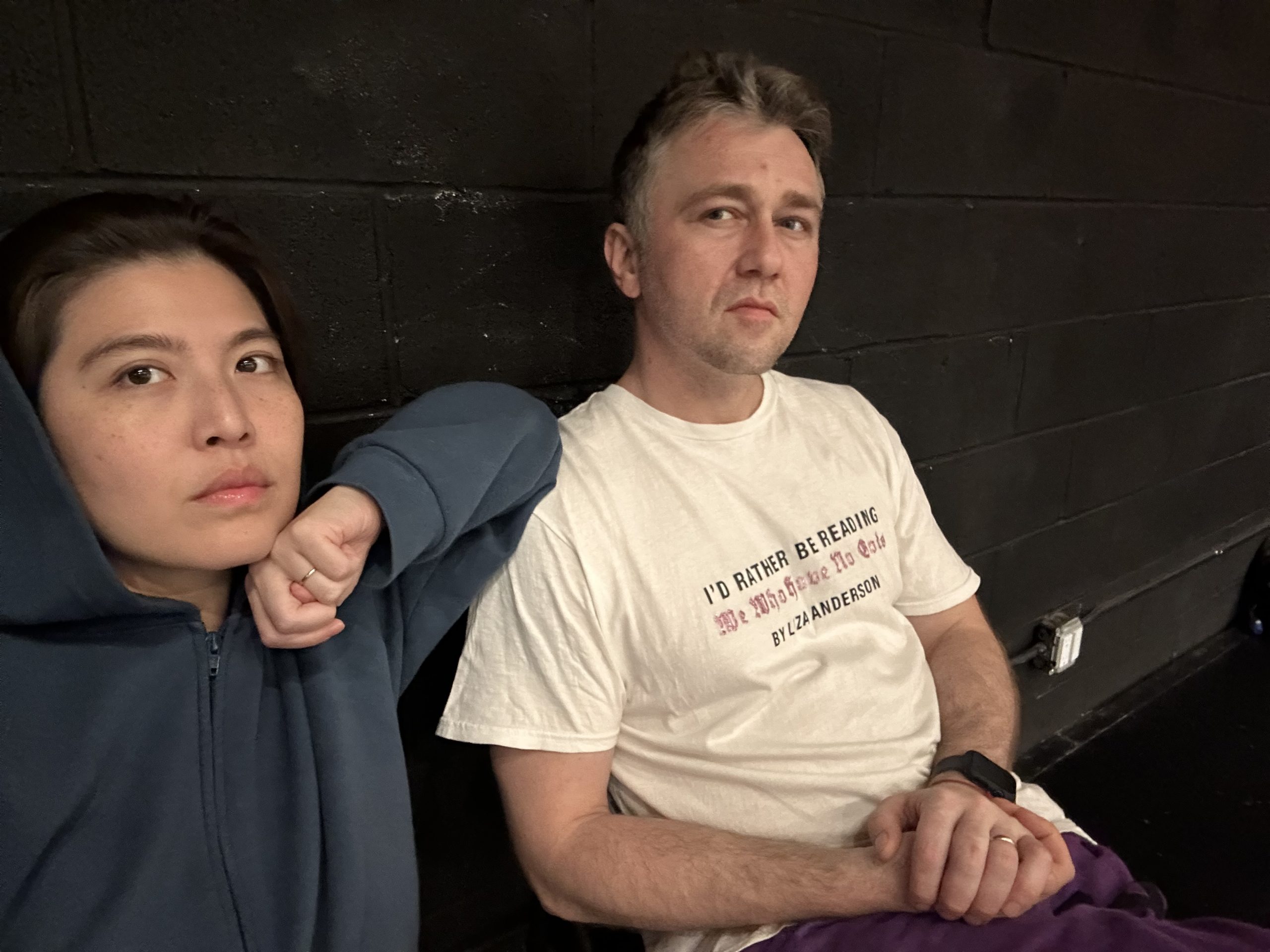
Last month, I sat down with Carolina Đỗ and Vas Eli in preparation for the premiere of their play, ExtraO1dinary Aliens! at JACK, jointly presented by BETTERFLY, Leviathan Lab, and JACK. Written by Đỗ–a child of Vietnamese refugees– and directed by and starring Eli–an immigrant from Romania– ExtraO1dinary Aliens! follows interwoven accounts of diverging immigrant experiences.
The play is a sincere attempt of art as connection, for Đỗ and Eli, as immigrant artists forever on the edges of precarity. Our frank discussion, despite an unreliable internet connection conducted on Zoom, was occasionally interrupted by a very cute baby, other immigrant artists, and phone battery failures. All apt. I spoke to Đỗ and Eli earlier this month.
Luz Lorenzana Twigg: Carolina, I’m going to start by asking a question typically understood by us children of immigrants as rude: Where did this show come from?
CAROLINA Đỗ: It’s auto-fictional, loosely based on Vas’ immigration story, and me in relation to that as someone who’s been with–God how long has it been?
VAS ELI: 13 years
CD: And married for almost 10 years! I met Vas when he was on an F-1 student visa. He’s gone through the whole alphabet of it all. It’s also loosely based on a lot of my friends. For some reason, I keep collecting immigrants who are always in some weird, fucked-up circumstances with their visa status. I have friends who came here as students and then ended up being undocumented. And I think–as someone with the privilege of being an American but with refugee parents–I see it a little bit more clearly than if I were an American-American. So this play, to answer your question, is a love letter to all of the extraordinary immigrants in my life. And I hope that, like, anyone who comes to see this show gets a little window into the struggle that immigrants of all varying statuses have to deal with. The time, the money, the sacrifices that it takes to be here in this country.
LLT: Vas, what has it been like trying to make work here as an immigrant actor-director?
VE: Not easy. There are a lot of hurdles that you have to hop over. And there’s always red tape. Just when you think you’re done, and you think you’re in the clear, there’s always one more form to fill out, one more fee to pay, and one more institution that will not work with you.
I’ll give you the best example I can think of. I was on an O-1 Visa, in between gigs, and I was crazy desperate. I just needed to work and put some food on the table, so I decided to work as an extra. I’d do anything at this point, you know what I mean? And so I was looking at listings, and at the bottom of all the listing in all caps–literally the writing on the wall–was NO VISAS OF ANY KIND. So I’m like, this government granted me the honorary title of an alien with extraordinary abilities, and yet I can’t be a body in the background? I was always just so flabbergasted by the incongruity of the situation. It was outrageous.
And equity has its own limitations, too. It’s just not easy as an immigrant. It’s not easy. You really have to have a chip on your shoulder, you have to be hungrier than locals to do anything properly, you know?
CD: It goes back to how hard it is to be an actor, to be an artist in this country. Even if you have the right paperwork, the right paperwork does not allow you to work in this country.
LLT: Are you hoping this starts a conversation within the arts community?
CD: I sure hope so. I hope it’s not just preaching to the choir, and it isn’t just immigrants coming to the show and feeling seen. Yes, that would be great, but I think about theatre people especially. New York theatre’s all “oh we’re liberal, we’re really progressive” and we have this obsession with immigrants. And, for example, I can’t for the life of me name more than one director that is currently working on an O-1 visa at an institution. Maybe there were more a few years ago. We talk a big game about how we’re building a community, but that community excludes a big, big number of people. Especially considering how many BFA and MFA programs make a good chunk of their money from international students. And now we’re under a fascist administration that is closing us off from conversation with the global community. America as its own culture is not good enough.
LLT: I feel that. I’ve toured on the international Shakespeare festival circuit, and the times I’ve gone to the Balkans, our friends would be so happy to see us, but they couldn’t fathom that our government doesn’t pay us to do art. They’d say things like, “What do you mean you don’t have an actor pension?”
VE: Oh yeah, don’t get me started. In Romania you’d actually be employed by the state, which is kind of crazy. And on the other hand, my peers here who are going to the O-1 have no idea how hard it’s actually going to be to make a living, to have a livelihood.
CD: It’s hard. It costs you 10 years of your life and over $35,000 now. We are in a culture that values youth above all. If you’re someone who is going through the O-1, you’re watching your peers be able to take jobs that you, in your 20s, wish you could take, but you’re just trying to stay in the country. It’s that feeling of “well, did I make a mistake coming here? I’m watching my peers buy a house back home.” You know, back in his country, there’s all these ceilings, but you’re able to make a living. And in this country, you’re not only working really hard to just maybe get a job, but you also have to consider how much you want to fight to play stereotypes? Because America always needs an enemy. If it’s not the Russians, it’s the Chinese, it’s the–
LLT: Albanians! Jesus Christ!
CD: But if you don’t do it, you can’t afford a living.
LLT: Is film and TV any better?
CD: That’s actually a different application. Vas found out the hard way. For an O-1, you have to apply separately for film or theatre. And yet, if you do get the O-1 for film/tv, for network TV you have to have a green card in order to be seen.
LLT: So there’s a breakdown between what the government permits and what the industry will tolerate.
VE: It’s a mind-eating paradox.
LLT: Meanwhile your friends back home are part of legacy ensembles and making work every three months.
VE: Oh yeah, that’s actually in the play. Carolina has had to save me from many a meltdown, where I’m like look, my peers my age back home are building names for themselves, they’re buying homes, they’re celebrities, and they’re thriving.
LLT: They’re playing Hamlet.
VE: Yes, and I’m struggling, doing, you know, co-stars–which I’m thankful for–but it’s a huge difference. I’m always living in the “what if?”
LLT: You two are partners in life and art. When did you start making art together? How did this happen?
VE: Carolina started off like myself (an actor) before being a turncoat and migrating towards playwriting. And I’ve always been the dramaturg or sounding board for her plays.
CD: My first eye!
VE: Slash audience member. And that’s a privilege, and a very big responsibility, and sometimes a curse. But for me, it’s a very specific type of flex. I don’t shy away from boasting that I am performing in my wife’s play. I am very proud of that. Not many people can say that.
LLT: This is a little off-topic, but I think it’s important. Can you tell me a bit about what it’s like making work as a new parent?
CD: It’s hell. It’s hard. I don’t know how anyone does it. For anyone thinking about having kids, [holding up baby] let Baby be the condom, let Baby be the inspiration. I spent an hour I didn’t have this morning figuring out babysitting. I’m trying to normalize bringing babies into the [rehearsal] space because, well, that’s what we’re doing it for. Also, I can’t afford childcare.
It’s hard to figure out the boundaries of me as an artist versus me as a mom versus me as a wife, versus me as holding all of my other hats of part-time jobs.
VE: But we contain multitudes. I’m not an optimistic person, but I’m trying to cultivate optimism. This morning we just got a grant to help offset some of the expenses of babysitting. That is a big, big, blessing that we have to be thankful for.
CD: I think one of the great things that has come from being a parent is being in conversation with artist moms who have done it, are doing it, and have tips or hacks or are like, “I want to make it easier for you than it was for me.” Gone are the days where people go “Oh, I had to struggle hard, so I’m gonna make it hard for you.” Now there’s a whole generation of theatre makers who did not leave the industry when they had kids. And there are people who are like, we’re going to make it work, we’re gonna show you we can make art in New York City, you can have a kid in New York City, and live until you’re 80. We’ll find those people. And in the meantime, I get to have kisses. [kisses baby]
LLT: Is there anything else you want us to know about the play?
VE: I do want to make an addendum that the play is not solely focused on this, my type of visa. It addresses immigration in general. Personally, it’s made me reflect on how many different types of immigration there are. America statistically has the highest immigration rate in the world, right? From being undocumented all the way to the EB-1. There are different levels of privilege. I worked in restaurants with undocumented coworkers. I had a massive privilege of working the floor, but I went home to an empty apartment and they went home to their families. The immigrant experience is not a monolith.
CD: There is so much heartbreak that comes with an immigrant’s journey. As a child of immigrants myself I’m always . . . I think this play is trying to answer the questions that I have. What makes someone leave everything they’ve ever known, where generations of their family members have died, been born, and live, to seek out the unknown? And then what keeps them here in America? If the odds and all the obstacles are fighting against their existence here?
VE: It’s crazy. Some people work their entire lives to get the green card. Some people have been working here with businesses who are still under a business visa. And some folks just apply and win the lottery! They have no idea what to do, but they came anyway! It’s just this . . . oasis. It’s still . . . the American dream is still being fabricated. I don’t know if it’s at the same quality, but it’s definitely at the same rate.
ExtraO1dinary Aliens! runs March 7-14 At JACK Arts. For more information, visit https://www.jackny.org/extrao1dinaryaliens
Leave a Reply