
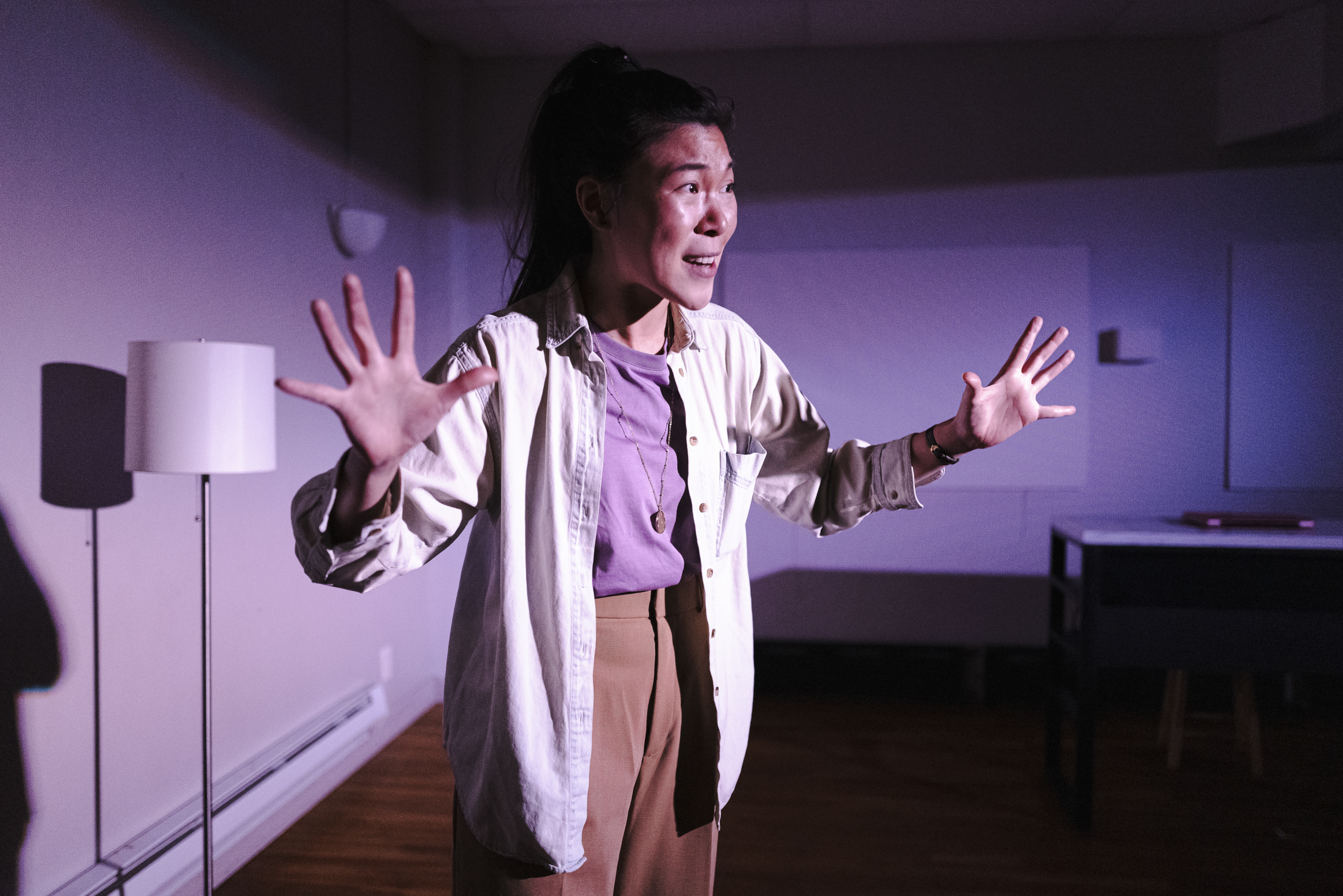
Do you remember when Facebook was a website you visited on a computer? Do you remember the petition “Betty White to Host SNL (Please?!)”? In 2011, Rachel Lin, a newly-minted NYU grad selling skinny jeans at the SoHo J.Crew, got a Facebook message from a man named John. This man, who turned out to be her long-absent father, would continue to contact her for the next five years. In Dear John, Lin’s solo show about the experience, the audience travels across space and time, through her mother’s decision to leave China, Lin’s childhood in the UK and Brooklyn, and the disappointing early days of her acting career. Throughout the performance, letters from John, recorded interviews with Lin’s mother, and period-specific pop culture references anchor the audience in many timelines.
In John’s missives (which start as Facebook messages and later, once Rachel opens a PO Box, become cards), his attempts at closeness with his daughter reveal the gulf between them. Mostly, he doles out tone-deaf advice. Often it is vague—“teach a man to fish,” etc—but the advice can be strangely specific too, like, “Look out for a desktop computer that people are throwing out,” “Buy a hand-mixer to make some nice cakes,” and “Create a card game for the children using the colors of the rainbow for levels.” He also warns, “women having babies over the age of 35 may have greater risk of their children having serious problems.” There is something universal to this disconnect, this attempt at parenting abstracted from personal connection.
Rachel never responds to these messages from John. What is there to say to a man who begs for intimacy two decades too late?
I spoke with Rachel Lin and Tara Elliott, who directs the show, in late January. We discussed crafting narrative from memory, the role of the audience as a partner in solo performance, and the juxtaposition of Lin’s real mother with the fragments of John that emerge through a screen.
This interview has been edited for length and clarity.
Annie Rasiel: The first thing I noticed about this play is that it’s written in second person. Tell me about that choice.
Rachel Lin: When I started writing this play in 2019, it came out in the second person. I couldn’t write it in the first person. I had hang ups about writing a solo show. I really didn’t want it to feel like navel gazing. Later, as I was developing the show, the second person voice became about the separation from self I experienced as a child of immigrants struggling with identity.
AR: When I refer to the narrator, the name in the script is just “You.” Would you prefer that I speak about her in the third person, using “You” as the character’s name, or in the second person, referring to you, Rachel, the playwright? Is this something that you have had to work through?
Tara Elliott: We’ve talked about this, but never in terms of a third party writing about the piece. This raises a question of who is You? How does that word, “You,” operate when it’s outside the frame of the show?
RL: I think we can say the protagonist or the narrator or the character.
AR: You don’t see this character as just you, the playwright. The character exists outside of you.
RL: The character is an invitation. In my dream world, it’s a combination of the playwright and the audience, a melding of the two. I said to Tara in one of our early rehearsals, the play doesn’t happen without the audience. It’s not entirely a solo show; it’s a partnership.
TE: One of the things that I’m so moved by in the piece is that we spend all this time with You, addressing the audience as You. And then in the last movement of the play, there’s an acknowledgement of how difficult it is to say I that feels so earned. Structurally, it works magic.
AR: What is the role of the audience in this piece?
TE: The audience is essential. One of the things I think about in theater making, especially with solo performance, is that constraint is opportunity. One of the greatest constraints in a solo show is that it can feel like everything is in the control of the writer-performer. The element that isn’t in our control is the audience. They offer surprise, they offer aliveness, they offer presence, and they have the capacity to shake us out of predictability or habit. There’s also this way in which John, as a character, interrupts and imposes on Rachel’s life. The audience fills that role, posing as an interruption, breaking what’s predictable.
RL: I’m really interested in intimacy in theater. In this piece I’m asking, What would it be like if we shared an experience, if we had a shared history? This is my attempt to build it. I often feel like an outsider, and I want the audience to hold that experience. I’m inviting them in, asking, for example, Can you imagine what it’s like to be undocumented? Often when people talk about immigrants, the gaze is from the outside. I want the audience to join me in looking from the inside out.
AR: You involve the audience in the creation of the piece as it goes. The audience reads John’s letters out loud. You construct those moments together. Can you talk a little bit about the development journey of the play?
RL: The events of the play happened to me from 2011 through 2016. As it was happening, I thought, Maybe there’s a show here. I pitched it to a residency in 2019, and I wrote a draft. I did a workshop at IRT and another at the Brick Aux in 2023. Then 2025 was a hard year for several reasons, including that a very dear friend of mine, Diana Zaza, passed unexpectedly. I really wished I had shared the show with them. Around that time, I was offered space at Here Arts Center, where there was an altar made to them. It was an opportunity I couldn’t pass up. It feels like a continuation of their legacy. I don’t want to be grandiose, but I wouldn’t have been able to write this show without their work. This is my tribute to them.
AR: I’m thinking about all of the different people that this play is for or about. Throughout the play, there’s talk about the benefits of moving forward, of not stopping to look back. There’s just forward motion, just getting to what the protagonist calls “real life.” Of course, though, creating this play is an exercise in looking back. What was that process like for you?
RL: Resistance. The first draft of this play was really just the context and John’s letters, then a memory and some audio. I wasn’t doing any processing. I was making a collage, putting the artifacts next to each other. As the show developed, people started asking questions—which I hated—but I realized there was benefit to answering those questions in the show. The process was painful, and it’s ongoing. Tara is always asking me questions. Ultimately, the more I look back and the more I process, the more personal and relevant the experience of the show becomes.
TE: We had a production meeting recently at which Rachel shared a bunch of childhood photos and photos of her mom for the first time. It was a world-opening experience for me as the director in terms of visual language. It felt like a real gift so late in the process. I think that speaks to the complexity of looking back.
AR: Tara, can you talk about how you became involved in the project?
TE: Rachel reached out to me this fall. I’d worked on a lot of writer-performer solo pieces, but I’d never encountered anything quite like this. I was really excited by the structure and the strangeness and the approach to really personal material with broad comedy. I was really excited about the opportunity for physical play and clown, and Rachel was open to trying anything within the framework of the piece, which is really brave because it’s so personal. We decided to work together on the New York Theater Workshop workshop, which was a trial by fire. We had something like twenty-nine hours and a pretty complete design team, and we really designed it in that very short amount of time. We learned so much about how the piece operates and how we function as collaborators. Then Rachel came up to Maine, where I live much of the time, and we had a development workshop up here. That was really special because I feel like I got to know the heart of the piece a little bit more and Rachel as a person inside of it.
AR: I’m really struck by what you said earlier, Rachel, about how early drafts of this piece were like collages or scrapbooks, just audio from here and a letter from there, with very little contextual narrative. I feel like so much of the humor in the piece is in that spine of young adulthood in the early 2010s. Would you say that the play had less humor in earlier drafts, or has that been a through line as well?
RL: I think it’s always been a through line because I think John’s text is so funny. It’s text that my father actually wrote to me. Imagine getting these letters from a guy you’ve never met. I edited it down, but there are pages upon pages of just, like, Buy this screwdriver, and, Here’s a DVD about how to fix toilets. As a person, I was just asking myself, What do I do with this? Comedy has always been a goal of this show. When the strangest and most painful things happen, I can only laugh.
AR: I noticed that he makes observations in his letters about you, saying things like, “You seem to be working hard,” but you make it clear that you were not responding to his letters. Was this a narrative he was constructing, or was he following you online?
RL: I was an actress, and I had a website. I was also a real estate agent for a while, so there was a lot of publicly available information about me. My Instagram was public. In 2011 you could Google search people in a way that you really couldn’t before. I imagine that’s what he was looking at.
AR: What is the role of the Internet and social media in the play?
RL: As time goes on, we become more and more acclimated to the Internet. We forget—I personally forget—the experience of early Facebook, life before Uber, life before Instagram. That’s when the beginning events of this play are happening. I think my job as the playwright is to remind people that there was a time before.
TE: That was actually a big question in the workshop because of the role of projection in the piece. We were thinking about projecting all of the messages so that the audience could engage with the real document in some way, and the projections became this introduction to the world of the Internet. What we arrived at was that we are in Rachel’s brain, which is being inundated by the Internet in this very novel way, because the Internet was being made more accessible all along the timeline of the play. We follow Rachel from 2011 to 2016. Could you even look at Facebook on your phone in 2011? The rapidly changing Internet is kind of the inciting incident of the play: it’s the reason that John is able to get in touch.
RL: My experience of the internet through the show is that it’s both something that allows us to connect, but also really impersonal. It’s a screen, a barrier. And I’m navigating that impersonal connection with a stranger who is also my family.
AR: What was the process of integrating and balancing the Facebook messages, the letters, the recordings, all the different voices and media? How did you pick which text to use?
RL: I looked to people who work with found text in the downtown theater world, like The Civilians and Elevator Repair Service, and anyone who has taken real life experience and turned it into a show. In terms of choosing the material from the letters, I often looked for what’s funny and weird, or what helps to tell John’s story, moments when he mentions something about himself. We have to track his change through his letters. I included when he says he was fired, and when he mentions that he worked for McAfee. I thought that was so strange. Actually, if you go down a rabbit hole about McAfee—which I really had to resist doing in the show—it brings you into a whole other world.
AR: Oh my God, I watched a documentary about that once!
RL: I love knowing what a character’s cultural context is. I notice the names he chooses to mention, cultural references, anything that grounds us in time and place in a show that moves around so much. I’m always looking for the footholds.
TE: Something that we discovered in the visual language of these textual references and messages was the use of citation. Using citations for the Internet references helped us locate ourselves inside the narrator’s brain and draw attention to the self-referential logic of that world.
AR: Those references really brought me back in the most visceral way. The petition for Betty White to host SNL was like being catapulted into 2010! This is a two part question. For Rachel, what is it like to perform as your mother? And for Tara, what is it like to direct Rachel as she performs as her mother?
TE: We found that scene at the end of the NYTW workshop! For a long time, we couldn’t quite figure it out. The solution we found allows for a layering of Rachel to perform May [Rachel’s mother] that I think is really beautiful and exciting.
RL: Something that feels emblematic of the show and my relationship with my mother is that when I first did a public showing in 2021, I invited my mother. But, um… I hadn’t told her that interviews I had recorded with her were in the show. I just put them in without telling her. I don’t endorse this! It’s not ethical! When she saw the show, she was like, Oh, that’s me. In the show, I say that we don’t talk. But I think she really appreciated the show, because I don’t think she ever imagined that someone would want to watch a story about her and her life. That was really rewarding. Then the next time she saw the show, she was like, Oh God, my English is so bad.
AR: In the show, you talk about your early days of auditioning in New York, and how often you were asked to perform these stereotypical Chinese immigrant roles. Now you’re performing as your mother, who is a Chinese immigrant and has what you claim casting agents would have considered a “bad-fake Chinese accent.” How does it feel to perform the parts of your mother that could be seen as stereotypes?
RL: I don’t even think of that character as my actual mother. She is a creation. The early roles I played were often immigrant street vendors who didn’t speak English. That happened a lot early in my career. I guess I just give that vibe! And I needed a job. Western media has a practice of commodifying identities. Often when that happens, it means taking a real person and flattening them into a two dimensional experience. For the types of roles I was playing, those people deserve screen and stage time. We should tell their stories. At the same time, though, I want the stories to be moving forward. I want them to be nuanced and real. It’s complicated, and it’s an aspect of my career I need to laugh about.
AR: I have the same question about performing as John. What is it like performing as John? What is it like directing Rachel as she performs as John?
TE: John is fun!
RL: Yeah, John is fun.
TE: He’s a fiction. There’s a juxtaposition between the fact of May and the fiction of John. Not knowing him allows us so much room for invention and for the play to get so much weirder. One of the things that we were doing recently in Maine was really digging into the physical comedy of the letters. We get to invent the rules of John’s world, a world we get glimpses of in his absurd letters. There’s an acknowledgement early on that we don’t know what his voice sounds like, which gives us so much permission.
RL: I didn’t grow up with a dad. I’ve only observed dads from the outside, dads I’ve met in the wild. I’m sure there are dads who are lovely, but they’re also weird. A lot of dads are weird! I get to put all my weird dad observations into this character, which is so fun.
AR: Rachel, I’m struck by you saying that you don’t know what John’s voice sounds like, because in the play you reveal that you went to China to visit him. Even though he is a stranger and a mystery at the beginning, you as the playwright do know more of his textures. I’m interested in the decision to let him be a goofy fantasy, a parody, even though he is someone you’ve actually met.
RL: That part of the story is from my perspective before I met him. I was letting my imagination play. It was like online dating, seeing a profile and creating a fiction about who that person is. That’s part of why I ended up meeting him. When I first got the message, I was in a pretty bad place, and there was a small hope that maybe he would save me. As the play goes on, it’s clear that he’s not capable of doing that.
AR: He can tell you what screwdriver to use, though! That does feel universal to dads. Your situation is specific, but that feeling of a parent swooping in with the most utterly useless advice feels universal. At the end of the play, you imply that you wrote the show for John, that you never responded to his cards or his messages, but that this play is your answer. Does that still feel true to you?
RL: I think so. I didn’t have the language to respond to him at the time. I didn’t know what I could possibly say. The language that I speak best is theater. That’s what I’m fluent in, so that’s the form that I chose to respond to him.
AR: This play has been in development for several years, and now we’re in a moment when the struggles of undocumented people are at the forefront of national consciousness. Does it feel different to perform the show today?
RL: Yes. I don’t think of the context of the play as directly applicable to this moment, though. I’m grateful that I didn’t come of age in the current political reality. This moment is so profoundly challenging for so many people. In creating this play, I can’t help but think about my advantages: I came to the US from an English-speaking country, and English was my first language. Aspects of the way I present in terms of race and gender also lend a certain privilege. Part of my privilege as a theatermaker, and as someone who now has legal status, is that I get to speak up. Somebody who is in a more dangerous situation or has a language barrier wouldn’t have this platform. I really think of this play as a coming of age story about a daughter and a father. The rest is circumstance.
TE: I was reflecting on a conversation we had about whether to cut the scene where you pick up your mom from the precinct [Lin’s mother was charged with a misdemeanor connected to her work as a street vendor in Chinatown]. You said that growing up undocumented then was so different from what is happening now, and you worried that the scene wasn’t aligned with the story you wanted to tell. I think that scene is so important because it tells us about your relationship with your mom and reveals some of the context of your childhood. It’s really valuable to allow that complexity, to live inside of it, without it being the focal point.
RL: I think part of how we got to this place as a country is through people’s inability to put themselves in another person’s shoes. I want this show to be a plea for humanity. These are real people with real dreams. I want people to think, That could be my family. In this country, that was most people’s family at some point.
AR: Putting the play in second person really implicates the audience, too. It intensifies that call for empathy. Throughout the show, the narrator searches for “the real world.” The mother character also mentions searching for “the real world.” What does the real world mean to you now?
TE: We talked about this recently.
RL: Growing up pre-Internet, the “real world” was what I saw on TV. That’s what life was. It’s what I imagined life would be after college. I can’t speak for my mother, but the reason you immigrate is that there’s a picture in your head of a better life. This imagining of the “real world” is, like, the TV show version of your life. Of course the real world that she ends up living in is way less glamorous. She has to come to terms with the real world.
TE: The “real world” is this distant castle in the clouds notion throughout the play. I think that throughline of the “real world,” concludes with the line right after that scene with your mom at the precinct, when you say some rules are meant to keep people safe, and some rules are meant to keep people out. There’s an expectation and then a harsh land in reality.
AR: I was thinking about when people say “in real life,” as opposed to online—like, that’s someone I met in real life, or I saw that IRL. That term can be used to distinguish between social media connections and connections in person. John is trying to construct this relationship through Facebook, not “IRL.” It feels like his fantasy world.
RL: When you’re young, you’re fed all these myths for some reason. I don’t know why, maybe because adults want to control you. Then you grow up and you have to recalibrate. There’s this promise of a different world, a better life.
TE: That’s capitalism, baby! It’s always juuuust out of reach.
Tickets for Dear John (March 9-16) can be purchased here.
Photo by Marcus Middleton.
Leave a Reply