
Aimee Mann has an “if you know, you know” flavor to her music. An alt-rock cult croaker, Mann has an intense eye for lyrics that require many rewinds. In the process of replaying a song to catch the full meaning of a lyric, she writes into the grooves of your brain. It’s this oddness and ambition to create something beautiful, outside of an easy pop earworm, that led her to leave her studio label Geffen before her album Bachelor No. 2. Mann bet that she could maintain a career outside of a system that prioritizes breakaway hits. Since her departure from Geffen, Mann’s has become an independent artist with widespread acclaim, a serious feat.
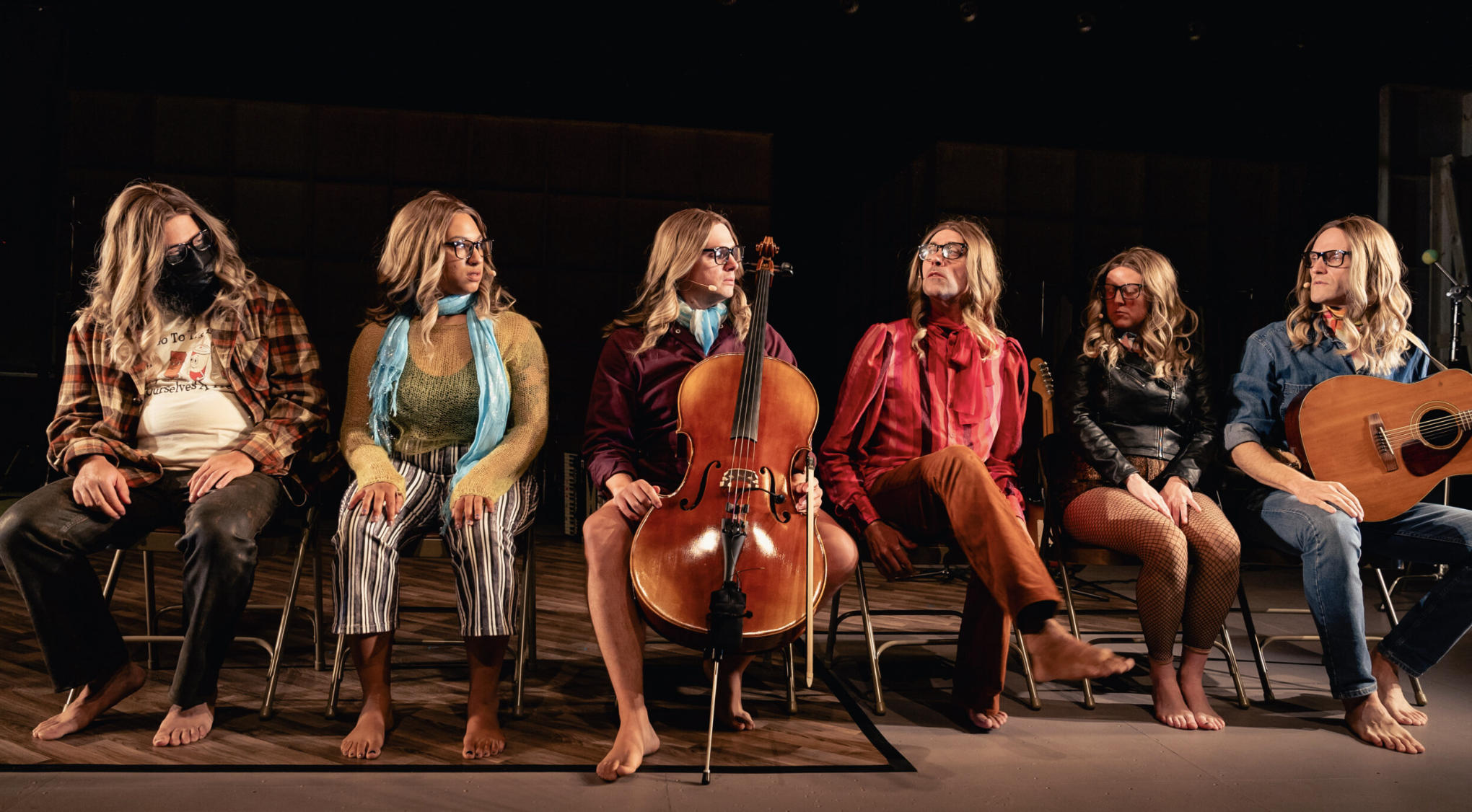
Aimee Mann was the soundtrack to Dito van Reigersberg’s pandemic hospitalization for cancer treatments. Van Reigersberg, a long-term member of Philadelphia’s Pig Iron theatre ensemble, brainstormed a show where Aimee Mann’s music spoke to the grief of a disrupted future. From hospital conversations with Pig Iron director Eva Steinmetz, van Reigersberg created the cabaret show Poor Judge, originally showcased at The Wilma Theater in 2024, where van Reigersberg performed alongside a full ensemble of company performers all dressed as Aimee Mann.
When Poor Judge returned this season, van Reigersberg had to step out of the production due to his health. In response, Poor Judge’s creative team, including returning director Steinmetz and musical arranger Alex Bechtel, shifted Van Reigersburg’s central role around a new lead, actor Pax Ressler. While the team wondered how they would evolve Poor Judge without the creator who created it and originated the lead role, the challenge presented an opportunity that became the show’s central question: finding beauty in new beginnings.
In advance of Poor Judge’s filmed performance becoming available online, I spoke with Steinmetz, Bechtel, and Ressler about returning to the Wilma and “the church of Aimee Mann.”
The interview has been edited for both length and clarity.
Chloe Cullen: Pax, can you tell me more about how you came into this production?
Pax Ressler: My main connection to the show is that the folks on stage are all dear friends of mine, and I was coming in as a big ole fan. I was really impressed with the music. I find that it’s rare in Philly to have something that’s interested in the different forms of theater, film, screen, and music. It was special and caught my attention. And it’s beautifully constructed.
I came aboard about two weeks before rehearsals. I got a notification, like, Hey, would you consider learning some stuff in case Dito needs a cover? That was how I became a part of the process.
Eva Steinmetz: Dito van Reigersberg is the conceiver of the piece, and it is his creative brainchild. As a cancer survivor, Dito had come off of an intense, rigorous, amazing run of a show in New York, and he was pretty spent. We had some conversations about finding someone who was willing to learn the songs and get familiar with the script, so if Dito was feeling tired, we had someone who could go on. And then Dito wouldn’t feel responsible for pushing himself for the sake of not canceling a show. Pax’s initial role was this cover.
And then Dito had a health situation that put him in the hospital, and we were like, Pax, how soon can you be here? I know we said come to one or two rehearsals maybe, but could you come to all of them? And I know we said maybe one show, but what if you did as many as you can? So Pax swooped in at the last minute and learned the whole dang thing!
And because they’re close with so many of the ensemble members, it was an amazingly fast integration. There’s a lot of history and collaboration that set a strong foundation.
CC: Eva, you were in the early stages of creating Poor Judge with Dito when he was going through treatment in the hospital. I would love to know about that collaboration and when Aimee Mann came into it.
ES: Aimee Mann was not part of the making of this piece at all. She came and saw it when we did it in 2024, but, like Pax, came as an audience member and was like, “What did these weirdos do with my music?” We got to chat with her afterwards, so she is not a creator on Poor Judge, but her music was the seed of the idea.
Dito said, “I want to make an old school Pig Iron dance theater piece using Aimee Mann music.” That was the offer. Alex [Bechtel] has been a long time Aimee Mann fan. I was familiar with some of her music, mostly through movie soundtracks, and I’ve come to love her music intimately and dearly through making the show.
It started as Aimee Mann/California/dance theater. We started mining stuff from her lyrics to figure out what the material of the show would be. The next pools of material became breakups, bad jobs, and Hollywood. The noir spy thread added to a sense of disillusionment and lying. We like campy genres, so it was an excuse to lean into that.
PR: You said there were some images too. You or Dito had the image of “We wanna sing on the floor.”
ES: Yeah, Dito was like, “I want to sing lying down.” It wasn’t until later that we thought, “Oh, everybody has to lie down because this is great.”
I was in film school at the time when we were working on it. We were geeking out about how fake film can be because you only see so much of it. And Dito said, “I wanna see a woman washing dishes, but she’s not washing dishes. And there’s somebody handing her the dishes off-screen.” That was a clear image that he had. He likes the idea of car windows going up and down when there’s no car.
CC: For a show that deals so much in heartbreak as a form of grief, the grief of not experiencing the thing you want, there’s also a visible community in the ensemble. I was curious about how the ensemble came into it, either through casting or brainstorming.
ES: This is one of the other images from the beginning was that everyone’s dressed like Aimee Mann. Why? We don’t know yet. But “what if we sing all Aimee Mann songs and everyone is Aimee Mann?” was the prompt. Our incredible costume designer filled out that world of everyone is Aimee Mann.
The casting is the process that Pig Iron follows for most of its pieces. You get the group of people together first, and then they’re the ones that make the show. So there’s a lot of passing stuff around, like the spy noir scenes. I had forgotten that Justin Yoder, who plays the cello, played the wife in a couple of those scenes for a long time. It wasn’t until late in the process that we realized that it would be helpful for the same person to be consistent [in the spy scenes] in order to follow the story. So there was a lot of trying stuff on and passing roles around.
One of the other things that was consistent from the beginning, because we had to get the rights for the music, was we had to choose early on what the songs would be. So long before we knew what the story was or what the journey of the show was, we knew what the songs would be. In order to get a wide range of music, we wanted to make sure different people with different voices get different types of songs.
Alex Bechtel: I remember in early workshops we started with a certain amount of songs that were from our catalog. We did a little show and tell with the performers for the first day where each person sang an Aimee Mann song that they had mocked up on their own. That was a nice way to get to know which songs sat with each performer uniquely. It was interesting to see which performer gravitated to which song.
PR: I think a lot about how the Connor story and the LA story isn’t necessarily anyone’s story, but the ice cream monologue is Alex’s true story. Different parts got placed on different bodies and different people, but some people brought their real, real bad jobs to the table.
AB: For a long time, the Dairy Queen story was cut, and then it made its way back into the show. I remember feeling very triumphant that my disastrous story of my teenage years at Dairy Queen in Reading, Pennsylvania made it back to the show.
CC: Alex, because you’re not crafting specific lyrics to push a plot, you have to mold the clay that you have musically. Still, if you were listening to these songs on an album, the arrangements carry their own plot. I feel like there’s a rise and fall in the way that it’s sequenced across the show, and I was curious about how you were thinking of the placement of the songs for you all.
AB: Eva can speak to this too, especially in terms of the global placement of what song goes where, because that, of course, went through several drafts. Some of it felt pretty organic. The first song we play, “How Am I Different,” is the first song on Aimee Mann’s album Bachelor No. 2. For me, as someone who has loved her music since I was 14 years old, Bachelor No. 2 is such an access point for me in her catalog. My vivid memory of driving my terrible Dodge Neon around suburban Pennsylvania and listening to that record on the CD player—for me, that answers, Well, how does a show with this music start? It starts with those first guitar chords of “How Am I Different,” because that’s how the experience of meeting Aimee Mann’s music started for me.
The rest of the show does fall in line with the process of collaborative ensemble devising. As Frankenstein’s monster slowly gets made, its needs become clear. Even if they’re constantly changing, they’re often clear. You continue to bounce and roll with those changes. And you find a narrative arc both in the physical action and in the musical makeup of the show that feels unique to the piece itself.
In terms of the musical arrangements, I’ve been thinking a lot about how this show relates to another musical that Eva and I made before this called Penelope. In both pieces, I’m discovering instrumental music is dramatic action. In Penelope, there’s lots of instances where the band is playing a song, but the actor is not “doing” anything. And we’re inviting the audience to accept the performance of music by musicians as dramatic action.
I feel a similar thing is knit to the way that I approach the arrangements of these rock songs, because, as you say, they’re not theatrical songs. But I was thinking about recorded music and how the mix of a recorded rock or pop song foregrounds and backgrounds certain instrumental elements. You hear the little synth horns in Justin Bieber’s “Sorry” right at the front when they want you to hear them, and then they’re gone. So often when musicians think about playing a rock song, a guitar player will be like, Cool, these are the chords. I’m going to keep going from the beginning of the song all the way to the end. What I started to do with a lot of these arrangements is, “Or what if you play these two bars and then you lay out for eight bars?” In those eight bars, the cello is playing, and then the piano tucks in. Then we keep deleting and insinuating ourselves in a way that not only mimics recorded rock and pop music, but also leaves the audience on a journey that is dynamic and theatrical. You invite the audience to accept the rock music as a dramatic structure.
Not that I knew that that was like what was happening in real time while I was putting the arrangements together, but that is a way in which they’ve started to behave.I can’t describe it in words, but it is deeply felt in this space by the audience, and that feels exciting. It feels very Pig Iron. Very experimental theater.
ES: We had a post-show talk back one night, and I was struck by three or four different people referencing the song where everyone’s lying on the floor crying. None of the actors are crying. Nobody. I don’t think the actors have ever cried while singing that song, but the combination of lying on the floor and Alex’s subtle but substantial shift from Aimee Mann’s version makes it feel like the cast is crying. It was a lovely, poetic resonance where the people watching it were filling in their own emotional experience.
PR: Totally. It’s interesting to hear you talk about the technical elements of theatricalizing the songs, Alex, because the only way that I could conceive of it was listening to some more of Aimee Mann’s music and then processing it through the lens of your arrangements. I was like, oh, we’re like in the religion of Aimee Mann. These are the sacred versions of the songs where we’ve come together to praise Aimee Mann.
AB: That’s the promise of the premise of this project, which is that all rock music and pop music is so deeply personal. As is all heartbreak, as is all artistic ambition.
No two people have ever said, “I want to go to LA and make it,” and meant the same thing. In the same way that no two people have ever said, “My heart is broken, I love that person so much, and now they’re gone,” and meant the same thing. In the same way that no two people have ever said, “I love that song,” and meant the same thing. That’s why I love the fact that Justin Yoder with a cello and his beautiful voice singing Aimee Mann is never gonna sound or feel the same as Emily Bate with her incredible voice and a guitarist singing Aimee Mann. The project is an amazing prism to feed that idea of this very personal, very unique thing. And the audience plugs into it in a similarly personal space.
Photo featured is from the 2024 production of POOR JUDGE.
Leave a Reply