
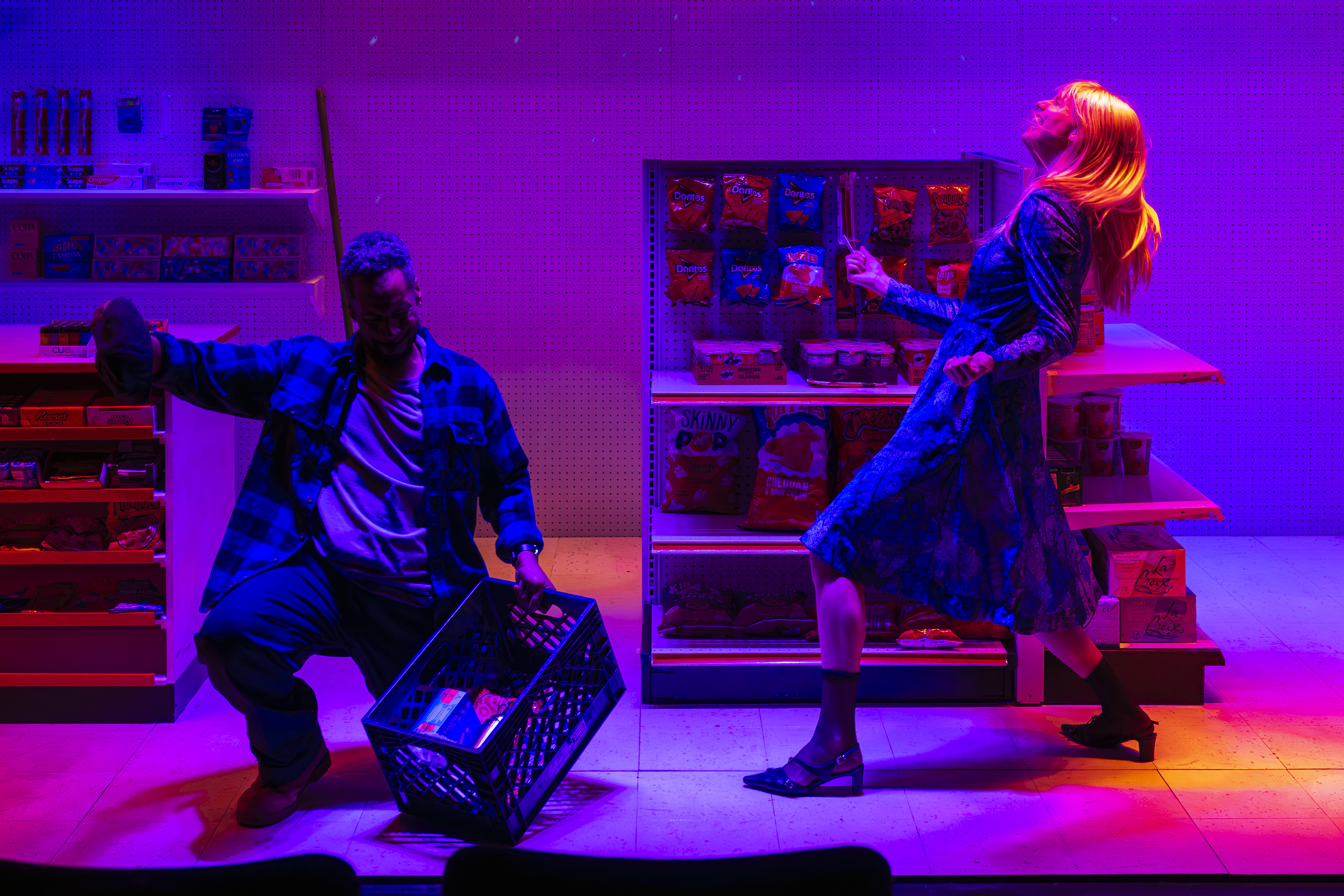
Out in the vast New Mexico desert, strange things are happening at a Circle K gas station.
People are disappearing. Events are repeating themselves. Time itself seems to be shifting out of linear order.
Perhaps it’s something to do with the nearby Los Alamos laboratory, birthplace of the atomic bomb? Is this gas station a portal to the space time continuum? Or maybe the attendant, in struggling to make sense of his little world, has simply lost grip on reality?
The SOCIETY Theater Company returns to New York with Entangled: 12 Scenes in a Circle K off the I-40 in New Mexico, the company’s third New York production following its formation in 2019. A collective of theater makers inspired by the Joint Stock method, SOCIETY first devises each new work through a collaborative, research-driven process before handing over to a writer (or writers) to craft the final script.
For Entangled, the company handed over to two company members and acclaimed playwrights: Mona Mansour (The Vagrant Trilogy) and Emily Zemba (Superstitions). The two sat down with Joey Sims for CULTUREBOT to discuss the process.

JOEY SIMS: Tell us—what is SOCIETY Theater Company? How was the company’s collective research process born?
MONA MANSOUR: Back in 2011, when I was an “emerging playwright”—whatever that means—I was asked by [director] Mark Wing-Davey to write a play for NYU grad actors. Their process was inspired by the Joint Stock method of collective research. The actors were all part of the development. I did improv with them, and a lot of scene ideas were born out of those improvs. Actors don’t tend to get asked to do that. You’re engaging a fuller part of them. And I fell in love with that embodied way of writing and developing a piece.
On that show, I was paired with Scott Illingworth [director of Entangled]. Then in 2020 myself, Scott and Tim Nicolai formed SOCIETY, because we kept finding that actors loved being asked to bring in research material and contribute in that way.
JS: You have 12 actors in Entangled, all of them SOCIETY company members. In today’s off-Broadway landscape, it is rare to see a cast that big, even at larger institutions—it’s a distinction that really makes SOCIETY stand out. Why is that important to you?
MM: When I wrote that play at NYU, part of the challenge was writing roles for 10 people. It just does something different to your artist brain!
But it also felt important as a “shaking of my fist” at the American Theater havens. I like to pretend that we’re in Germany, or France, where we are funded. It just fucking makes me mad that American theater is so cheap in this way.
EMILY ZEMBA: My play Superstitions, which I self-produced in 2021 as part of The Pool Plays, was an 8 character play. And the reason I chose to form that collective with two other playwrights was because I knew: “No-one is going to produce this.”
We don’t require [large casts] as a company. If the playwright goes away and writes a two-hander, we might be like: “Let’s do it!” But in trying to craft a piece about quantum physics, Mona was very much in the camp of wanting to get as many company members in it as possible.
It is logistically difficult. And we are a small company, and we are doing our own fundraising, and we are not paying people enough by our own values and standards. But it’s about the work.
JS: I agree that the expansive, impossible ideas you’re tackling in Entangled do demand that large ensemble. How did you decide, as a company, to attack these themes of quantum theory, free will, and the mechanics of time and the universe?
EZ: It was at a moment where it felt like quantum entanglement had entered the cultural conversation. A company member brought in an article about it, and nobody knew what it was. So because of our curiosity about the quantum world, what that concept means, how it impacts what we are as human beings—because everyone was so obsessed with it, it became our next show.
JS: What is your process as a company?
MM: For this one, we had four significant workshops, with other mini-workshops along the way. It’s very hands-on for the actors. We split them into groups, and each group has 20 minutes to research free will, or dark matter, and come back with a scene.
JS: What kind of research do you conduct together?
MM: We had a Zoom with a physicist who works at Firmilab. That was probably one of the most significant meetings, because you have a room full of artists who make their bread and butter on listening to their instincts. And here we have this physicist saying: “This is not instinctual—and if you think you are grasping it, you probably aren’t.”
EZ: Which is the nature of quantum physics versus classical physics. Quantum is so imperceptibly small, so beyond our understanding of the universe, that the moment you think you understand it…. As artists, we were coming at him with metaphor. We were going: “So, is it like this?” And he was like, “No—and what makes you think your intuition of how the world works is correct?”
JS: That exact frustration found its way into the play. There’s no single answer offered for what’s happening in this Circle K. Every explanation we’re offered of what’s going on, we then have the rug pulled out from under us.
EZ: After those workshops, Mona and I went away and wrote separately, and when we came back together, it was clear we both had more questions than answers. The nature of this topic is that there’s no catharsis in giving an answer, because that would not be true to the science. So we honored the individual characters and these little moments we’d crafted, and then figured out how to puzzle piece it all together.
JS: Is there indeed a Circle K near the former site of Los Alamos, in New Mexico? What is it like out there?
MONA: Yeah, they’re all over. I’m from California and I went to school in Texas. Something happens when you’re driving across that vast expanse. You’re in this weird stasis. What is the relationship within this vehicle, with the person you’re with, just you two and the universe you create inside this car? But then around you is this gigantic country we live in? And then you come to this little way station…something about that is so interesting to me metaphorically, that I can’t quite put my finger on. About forward motion, or stasis, and just the beholding that big emptiness. If you drive through Texas, or New Mexico, there’s a lot of…what we perceive to be, nothing. Which is also how we feel when we look at the universe.
JS: The Circle K becomes this little refuge amidst that vast nothingness, sort of. But strange things are happening within the store. The Gas Station Attendant is trying to figure out why people are disappearing, why events seem to keep repeating…
EZ: He is trying to make sense of his world, and his time, and his place, as strange things start to happen at this Circle K. And he’s trying to find comfort. Which ties in with these questions of science vs. spirituality, and how they’re actually kind of the same—the desperation for meaning is the concentric circle.
Our Gas Station Attendant is somebody who notices the oddities of the world, the inexplicable thing that it is to be a human moving through time, and wants answers. He’s looking for evidence of something, scientific evidence, maybe something that explains: why do things feel weird? Why does it feel like I’ve experienced this before? How did I end up here, in this moment of time? And: is this it?
JS: And while you have some science fiction elements at play, folks shouldn’t necessarily expect a tidy explanation for everything that’s happening in the Circle K.
EMILY: That was the big question. Time does work differently in this Circle K. So is there something weird due to the store’s proximity to Los Alamos, and the atomic bomb test? And if there is, do we explain it fully?
But it felt like none of the specific sci-fi explanations that Mona and I could come up with would have been nearly as satisfying as living in the questions. So we left it at the question, but with the hope of: there is something, some answer, and we’re close. Which is also where the field of quantum physics is at. It’s not concluded. We’re on our way towards answers.

Leave a Reply