
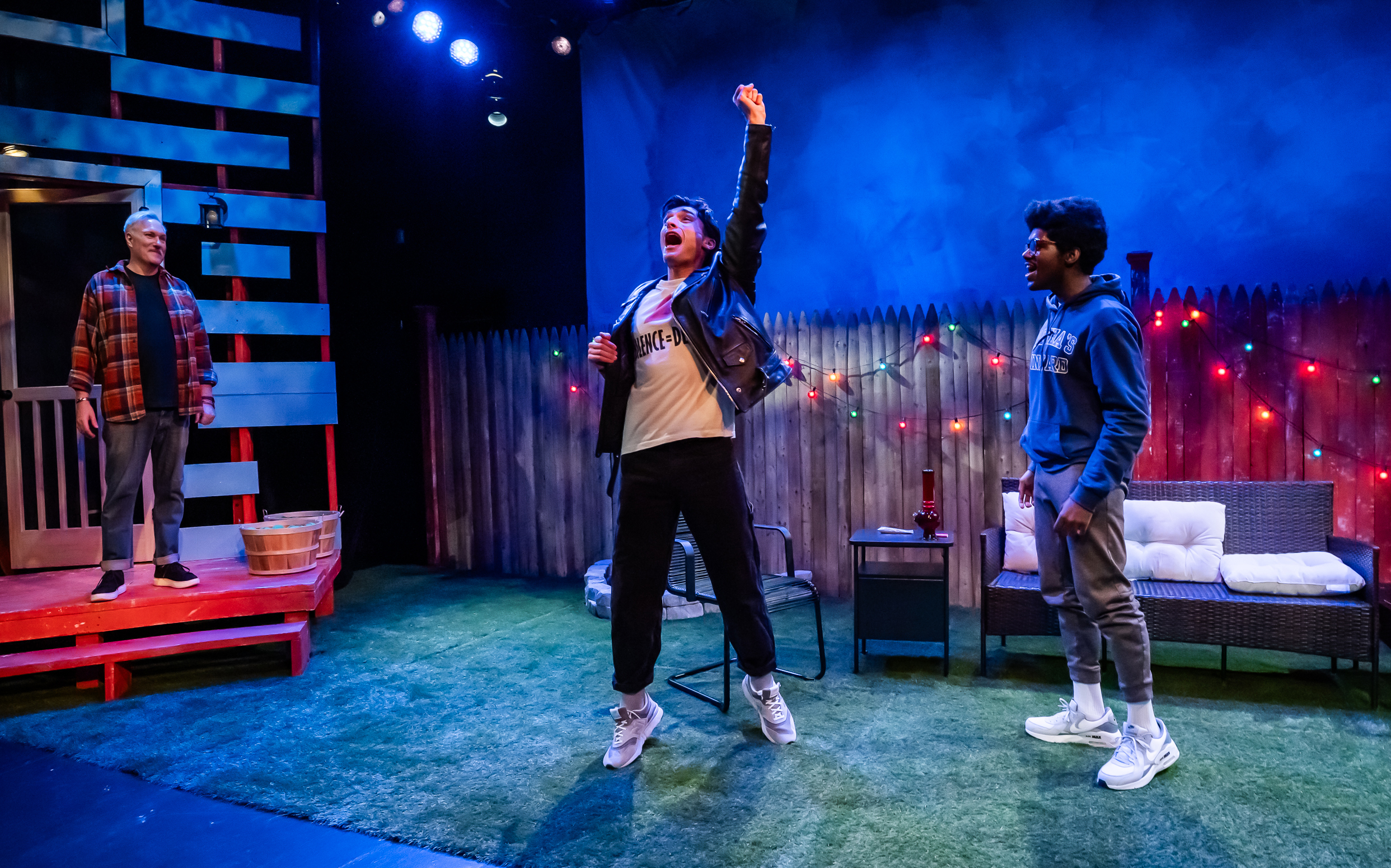
Brendan (CJ DiOrio) and Eugene (Jalen Ford) are young, gay, and engaged. At the top of Barry Boehm’s new play Our House, presented by The Other Side of Silence (TOSOS) at the A.R.T/NY Gural Theatre, the couple has just arrived from New York City to the cornfields of Iowa. They need to get over the culture shock of their new surroundings quickly, as their wedding ceremony tomorrow is not just a public declaration of love, but also a political act.
Our House is set in 2014, less than a year before Obergefell v. Hodges, the landmark case that affirmed same-sex couples’ right to marry in all 50 states (same sex marriage became legal in the Hawkeye State in 2009). While often cited as a watershed moment, the certainty and legal endurance of this decision feels precarious in 2026. Justice Thomas made an explicit call for the Supreme Court to review past decisions (including Obergefell) back in 2022; there has been a steady stream of attacks against LGBTQ+ people (especially trans folks) through various forms of legislation, and amplified by the current administration in the White House; and just in the past year, the National Parks Service has made efforts to erase queer history by removing any mention of transgender people from the website about the 1969 Stonewall uprising. The battles of the past sadly never really ended, and the play reminds us that the personal remains very much political.
TOSOS is New York City´s longest-producing LGBTQ+ theatre. Founded in 1974 by Doric Wilson, Billy Blackwell, and Peter del Valle, witnessing their continued dedication to creating theater by and about queer people feels particularly vital right now, when the American government is zealously attempting to erase the dignity, safety, and history of LGBTQ+ people. The company is currently led by Mark Finley, also the director of this production.
In this play, the young lovers stay in the renovated house of Brendan´s gay uncle Andy (Christopher Borg) originally belonging to his great-grandmother. This was a prosperous neighborhood, a century ago, but now, the block seems beleaguered, having endured multiple attacks over time. The house serves as an apt metaphor for the life Andy and his partner Stanley (Tim Burke) have attempted to create.
Multiple queer histories and perspectives converge in Boehm’s play. Brendan and Eugene come out after 9/11, while their elders reckon still with their past, particularly the lingering effect of AIDS. Andy’s temperament toggles between despair, outrage, and desperation during much of the play; he marched with ACT UP (the AIDS Coalition To Unleash Power), and, when not protesting, buried his gay peers. Was it all worth it, he wonders? Are things any better? Memories of Raphael–another activist, friend, and maybe lover gone by suicide–continues to haunt him. Stanley is unable to offer any solace. Andy´s efforts to exorcise his demons offer little peace. He gives his nephew Brendan his old “Silence = Death” t-shirt, but later he becomes outraged towards a cop (played by Jon Spano) putting him in danger.
All of the characters in Our House are white except for Eugene, who is a Black man–an important point that will prove pivotal as the play approaches its dramatic climax. The LGBTQ+ community is not a monolith, and the experience of the play is informed as much by age, race, and personal circumstances as sexual identity. Boehm’s play invites us to speculate on when to speak up, and how to let go. During most of the first act, we witness two generations of queer men laugh and reminisce over cocktails in Stanley and Andy’s backyard. Ford’s work stand-outs in his portrayal here, as he shows us Eugene’s thoughts and feelings while listening to others around him: he appears visibly uncomfortable as his fiance blithely conflates racial discrimination with homophobia. Later, when Eguene asks his future relatives if they ever wanted children, Stanley reveals how he and Andy had always dreamed of “adopting a little Black girl.” Why does the kid have to be Black?, Eugene asks. Though often well-intentioned, even gay allies suffer from blind spots. We can share a common cause and we each have different proximities to power and privilege.
Finley directs his actors with a light touch, giving them room to play off of one another in a loose framework. While many of the themes of Our House are rather heavy, Finley and Boehm aim for an atmosphere emphasizing humor and snark before turning to tension and violence for the play’s dramatic conclusion. This structure helps the audience to relax and then open up for the play’s second half, an emotional punch. It is a strategy that succeeds, but its abruptness lands unevenly amongst the cast. Except for Ford, who effortlessly plays for both laughs and drama, the cast seemed mostly wooden during the more comedic first act. Only when Our House shifts into full-on drama for the last thirty minutes did the ensemble seem to fully cohere, resulting in some truly engaging and heartbreaking performances in act two.
Moments of this production felt jagged at times, but ultimately the experience of watching Our House is one of joy and pride. There is something particularly potent about seeing positive representation of multiple generations of queer folks onstage right now. This play, and everyone at TOSOS involved in making this world premiere, urges us to remember our history, and do the work to protect ourselves–and one another.
Photo by Mikiodo.
Leave a Reply