
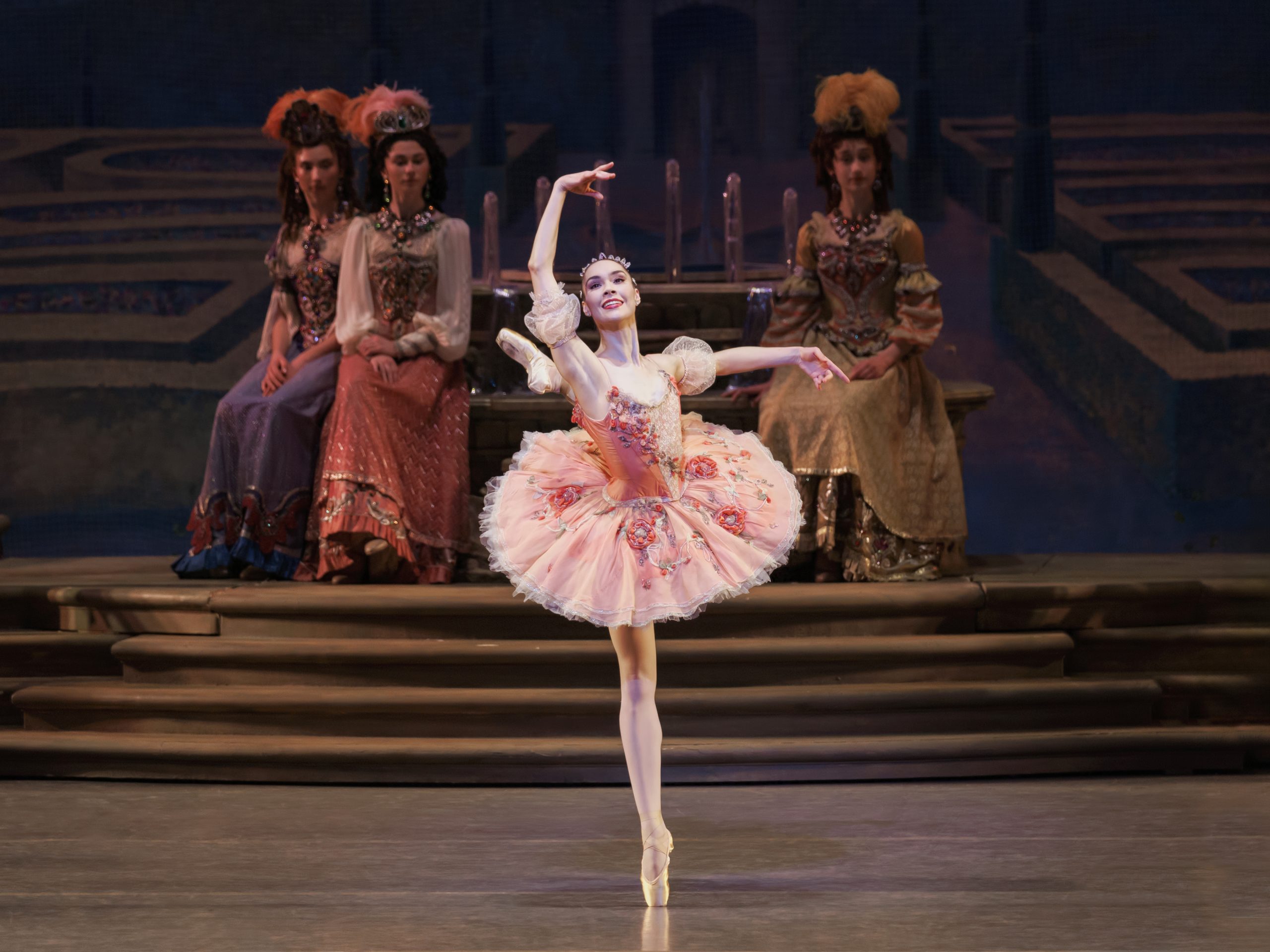
George Balanchine once told a corps de ballet dancer that if she wanted to dance Giselle, she could “go across the plaza” to the more classically-focused American Ballet Theatre. But, despite his drive to push ballet towards new developments, and perhaps a personal disdain for the drama of Giselle, one of the most classical full-lengths was a different story. Though Balanchine created over four hundred ballets during his 79 years, his lifelong dream of a splendidly extravagant Sleeping Beauty went unfulfilled. In the courtly splendor of Diamonds and in Theme and Variations, he grazed its surface and with his own interpretation of The Garland Waltz, which he choreographed for the 1981 Tchaikovsky Festival, he gave us a glimpse. He returned repeatedly to tinker with the tantalizing concept, choreographing Sleeping Beauty variations, pas de deuxs, a pas de trois, and the vision scene for various companies throughout his career, including the Ballet Russe, American Ballet Theatre, and Eglevsky Ballet. Yet a year or two before his death, he was still adamant, telling journalist Solomon Volkov: “I would like to do a complete Sleeping Beauty sometime.”
Balanchine was dreaming with eyes full of past wonders, of the days when the Imperial Theater’s production of The Sleeping Beauty swelled with real foliage and fountains, horses, moving stage levels, and in the midst of it all, a very young Georgi Balanchivadze, “in indescribable ecstasy enjoying it all– the music, the theater…thanks to Sleeping Beauty I fell in love with ballet.” It was this experience as a child that sparked his visionary career and was, more than half a decade later, still a constant calling to artistic grandeur despite his minimalistic, pure dance intentions.
Such grandiose dreams kept Sleeping Beauty ever just out of his reach, for realistically speaking, Balanchine was building the first major center of ballet to “flourish without monarchical support” (Morrison). There was never a big enough stage, never the budget to give his vision justice, and perhaps, never the right time to try to compete with his own golden childhood memories. In 1975, Lincoln Kirstein told the critic Richard Buckle that, “Balanchine is very well and full of plans for big ballets, if and when we can find money. He is now speaking of a Sleeping Beauty.”
But despite their combined efforts, this great classic remained untouched in its totality until eight years after Balanchine’s death, when Peter Martins gave The New York City Ballet its own Beauty. The production, announced on Kirstein’s 80th birthday in 1987, was “a gift to Lincoln,” Martins told Playbill before the ballet’s 1991 premiere. “But is it presumptuous to say it’s also a gift to the company? It’s the company paying homage to its past, its foundation, its language…where it all came from.”
Staging one of the most classical full-length ballets for a company founded on contrary pursuits is a test of range. But it is also a triumphant feat that New York City Ballet has, like nearly every ballet company in the world, the epitome of classical ballet in its repertoire. Watching City Ballet’s rendition, it is at times evident that the dancers find themselves pushed outside of their comfort zone, immersed in the language of mime and theatricality appears like a foreign concept to some. But to see the ballet Balanchine spent his life dreaming of filling his beloved jewel box of the David H. Koch Theater, is in itself a deeply moving sight.
Peter Martins’ The Sleeping Beauty, choreographed loosely after Marius Petipa’s 1890 production, is a streamlined, two-act affair. It’s hard to say whether Balanchine would have approved of such a chiseled version of the ballet when his memories of the Imperial Theater were marked by abundant, overindulgent splendors and detailed technical advances. Does Martins’ Beauty live up to Balanchine’s vision? Probably not, but how could it?
In an effort to distill the momentous ballet, several cuts in score and scene were made. In Martins’ own estimation, about thirty minutes of Tchaikovsky’s one hundred and fifty-minute score were scratched. Huge swaths of Carabosse’s anger vanish, including the scene where the fairies beg Carabosse to rethink her ill intentions (the chopped score is particularly obvious here, sounding as if a record has jumped). The entirety of delightful folk dancing that traditionally adorns the top of Act Two has vanished, although the hunting party still appears ready to play Blind Man’s Bluff, the game originally notated to begin the frolic dancing. The top of the second scene, where knitters were traditionally chastised for their possession of spindles, is nowhere to be seen or heard. Martins claimed that “no one is going to feel this is a condensed version of the score”, but at times it is nearly painful to audibly jump over entire regions of Tchaikovsky’s score as if he did not meticulously plan its themes, historical references, and brilliant significancies to serve the story.
Martins has, in his own words, retained the “essence of the choreography”, yet pruned steps abound. Throughout the ballet, simplification often blurs the original detail as though sweeping a brush across drying watercolors. For instance, the little beats that accent Aurora’s piques as she travels upstage in her wedding variation dissolve, the pantomime of the Lilac Fairy in the vision scene cuts off before it can fall into the rich swell of Tchaikovsky’s score. Even the stylistic use of stiff separated fingers that shake in the fourth fairy’s variation have been softened and no longer sing with glee.
The presentation of Martins’ fairies serves as an example of how easily a ballet can be cut off from its historical identity. Though most of their choreography traces its origin to Petipa, in Martin’s rendition, the fairies’ names have changed and lost their meaning. Fairy Candide (from the word “candid”), the fairy of purity, honesty, and sincerity, is renamed Fairy of Tenderness. Fairy Fleur de Farine, her original name derived from the face powder that was once made from wheat, brings Aurora the gift of beauty. Here she is the Fairy of Vivacity. Fairy Miettes qui Tombent– known as the Brumbcrumb Fairy, references the Russian tradition of scattering breadcrumbs in a baby’s cradle as a symbol of prosperity, fertility, and good fortune– becomes the Fairy of Generosity. Fairy Canari, or Fairy qui Chante, who brings Aurora the gift of eloquence, is simply the Fairy of Eloquence, without any reference to this original “singing canari” name, though in the music it still rings true. Finally, Fairy Violente, literally meaning ‘violence’ or ‘force’, brings the future monarch the gift of power and the ability to command. At City Ballet, she is the Fairy of Courage, and her choreography disregards some of the unique finger choreography originally intended to show positive and negative poles of the newly discovered power of electricity.
The Sleeping Beauty is a ballet rich in history and in intention that, when curtailed for time or style’s sake, lessens the power of its lineage. Who is to say Balanchine wouldn’t have taken a similar approach to presenting The Sleeping Beauty? In the early ‘80s, Balanchine told Solomon Volkov, “Petipa’s Sleeping Beauty was sheer genius. But of course, if I do Sleeping Beauty, it won’t be a simple repetition of what Petipa did. I will have a different approach… additions, cuts, things like that. Ballet isn’t a museum where a painting can hang for a hundred or two hundred years.”
And yet, the inclusion of Balanchine’s Garland Waltz in Martins’ Sleeping Beauty hints at just how decadent a production of Sleeping Beauty in his name could have been. The stage is full of life: revolving, kaleidoscopic patterns that curl themselves inside out, creating a visual spectacle with the contrast of spiraling opposition, and the delightful friction of circles moving in polarity. Observed from the fourth ring, yellow skirts sail like Californian poppies as circles braid and unfurl, and students (as a young Georgi Balanchivadze once was) interlace with young corps members into a fold of harmonious constellations.
By the time the dancers come to a halt, Tchaikovsky builds anticipation for the arrival of Aurora. In any debut, that anticipation is a mighty force, and rightfully so. Mira Nadon’s debut was refined from its first glimpse. In stillness and the clarity of her extended line, Nadon has an unearthly presence, continuously heaven-drawn. Her port de bra alone is a poetic song. The haunting expression of her danse-vertige, the lyrical soulfulness imbuing each breath in the vision scene, and the delicate curlings of her port de bra in her wedding variation reveal her Aurora to be of defined purity.
As much potent anticipation as a debut provides, seeing someone return to a familiar role is an entirely different kind of beauty. Tiler Peck first danced Aurora in 2010, and the experience and trust that time has built is evident in every ease-filled moment of crystalline control. From her very first steps down the stairs as a sixteen-year-old, she burst with eagerness, pouncing upon the softest pas de chats and exuding a breath of soul in each flourish. Peck has the ability to stretch a moment so clearly that a step’s beauty is visible in its most clarified form. Beyond her well-honed and velocitous precision, the brilliance of the stillness she conjures, whether in the Rose Adagio or in the beauty of a sustained and enlivened sous-sus, is a virtuosity in itself. And of course, there’s her timing. She exists so fully within the score that each finger seems to dictate its rising swell, and finds accents that paint Tchaikovsky’s score more vividly than he could alone. In the tightest chaines turns coiling upon themselves, and in the lush port de bra that blossoms like a flower at dawn, Peck dances with a wit that is hers, and hers alone.
Roman Mejia, Peck’s cavalier, is lightning in a bottle. Always moving with an abundance of will, he canvases the stage in broad strokes and makes it look like nothing more than a bright thrill of exactitude. He is a powerhouse of height and control, yet centered calm floods from such virtuosity: all ease and luminous pleasure amidst the bewildering aptitude.
Together, Peck and Mejia dance with fire under their feet. Their magnetic partnership is, as always, a pure delight that brims with the most luxurious freedom and spirit. Watching them, you momentarily forget that The Sleeping Beauty is one of the most demanding ballets in the repertoire. They seem to be having the time of their lives through all its trying wonders.
With a cast of over one hundred company members and students, The Sleeping Beauty is a vehicle for revealing a multitude of artistic potential across ranks. Ava Sautter, as the Fairy of Tenderness, brought an abundance of soul into the role as her arms moved like petals grazed by wind. The fire in Taylor Stanley’s eyes as an electrically wicked Carabosse, and the evil laugh that practically rang through the theater in its potency, were a brilliantly brooding darkness. In the precious stones pas de quatre, Kloe Walker’s striking form and vividness in her quick flourishes seemed to find the clearly etched precision of a branch silhouetted against a winter sky–a suspended clarity in each delicate limb. As Princess Florine and Bluebird, Mia Williams and KJ Takahashi were a casually virtuosic pair. Her contagious joy and soulful épaulement, his gravity-defying ease, and tight axis of flight filled this little pas de deux with revelry. The addition of a dance for three jesters in the wedding scene (replacing what was originally a dance for Hop-o-My-Thumb, his brothers, and an ogre) is one of the treasures of Martins’ Sleeping Beauty. Spartak Hoxha, Simeon Daniel Neeld, and Daniel Ulbricht’s boundless drive seemed to break open the ballet for a moment, suddenly jocose with the pure vim of folk-influenced loftiness.
Seeing such a momentous production take flight upon the Koch Theater stage, I could only think of a young Balanchine nestled within the magic of the Imperial Theater, in ecstatic bliss at the marvel of it all. As he once said: “Sleeping Beauty is a pure diamond”, and indeed, even with Martins’ omissions and vanished delights…it is, it is.
Photo by Erin Baiano.
Sources:
Bentley, Toni. Serenade: A Balanchine Story. Vintage Books, 2024.
Solomon Volkov, et al. Balanchine’s Tchaikovsky: Interviews with George Balanchine. Simon and Schuster, 1985.
Leave a Reply